Showing posts with label altruism. Show all posts

Sunday, November 3, 2019

Acknowledging Our Limits - #Rescue #Responsibility #Guilt

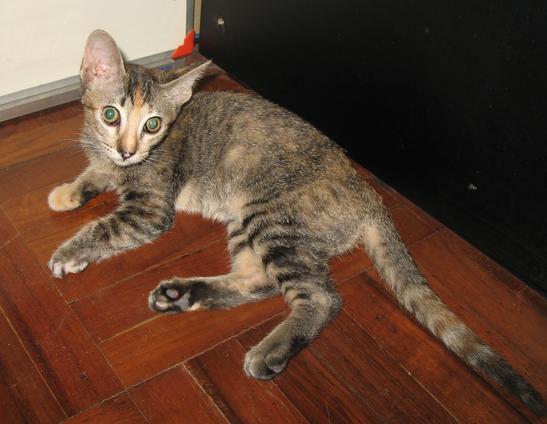
Katie portrait


By Lisabet Sarai

The earnest little kitten above is Katie*. Like all of the felines with whom I’ve shared my adult life, Katie is a rescue cat. We adopted her at the age of three months from our vet. According to the story we were told told, someone brought her in to the animal hospital when she was only a few weeks old. Apparently she’d had been in an accident and had broken her front leg. The wound had become so seriously infected that they had to amputate part of her paw to save her life. Indeed, if you look closely at the photo above, you’ll see that she’s missing the toes on her left front foot. X-rays of her shoulder show a permanent partial dislocation.

Katie’s now a strapping two and a half year old, curious and lively. She has a limp when she walks, but this disappears when she’s chasing our other rescue cat, Simon*. He’s a mostly-black beauty with golden eyes and a kinked tail, who loves to curl up in bed with me, purr in my ear and lick my chin. When Katie was an only cat, she used to nip our toes and gnaw on our fingers. Now she chews on Simon’s ears and chomps on his neck. He doesn’t seem to mind at all. Meanwhile, we’re grateful that she’s found an alternative target for her oral aggression!

Simon lived in a cage for the first ten months of his life. Given that social deprivation, it’s astonishing that he developed such an affectionate, easy-going personality.

Our neighborhood abounds with stray cats. Kind-hearted locals feed them, so of course they stick around, mate and reproduce. There’s one female, in particular, who has given birth to at least six litters (that we know about). We’ve tried to catch her in order to have her neutered, but she’s more or less feral and won’t let us come close.

So there are always kittens around, and we’re constantly tempted to adopt a couple more. But realistically, we couldn’t handle this. We live in an apartment, just the two of us. If there were a fire, we’d have to grab the felines, stuff them in cages, then carry them down six flights of stairs. Given our age and physical condition, two cages is our limit. In addition, we do quite a bit of traveling. Our part-time housekeeper cares for the kitties while we’re away, but I think she sees even two cats as a weighty responsibility.

Our friend on the fourth floor, on the other hand, has taken in at least five of these neighborhood kittens, as well as rescuing cats from the highway and from the roof of a nearby shop. We’ve lost count of how many felines he and his family have, because they keep some at his office, some at the restaurant they run, and some in their apartment.

Another friend, a woman I work with, has zero ability to resist strays. At present she’s caring for eight formerly homeless cats. The social interactions among these creatures is extremely complex, so she has to keep them in different rooms in her house, feed them at different times, and so on. Her life more or less revolves around the cats’ needs.

When I look at these two friends, I feel pretty guilty. Are my husband and I really doing all we can to save these furry beings from hard and dangerous lives on the street? Don’t we have the money – and the love – to spend on a few more?

What is enough, though? No matter how many homeless cats we adopted, there would always be an unending supply. It seems more reasonable to acknowledge our limits, and to do what we can to stem the tide. So we support the animal shelter and its spay/neuter programs. We share information about animals who need homes. Of course we neuter our own pets.

Worrying about stray animals gets me thinking about homeless people. We have an extra bedroom. Most of the time, except when we have out-of-town guests, it’s empty. Should we offer it to someone who needs a roof over his or her head? Isn’t it selfish of us to squander this resource? Is it our responsibility to rescue our fellow human beings?

It’s easy to feel overwhelmed by all the pain, tragedy and sorrow in the world. There are no easy answers. I do what I can. I edit altruistic erotica anthologies for Coming Together. I run my monthly Charity Sunday events. I rescue a few kitties and resolve to give them the great life that they deserve.

* Names have been changed to protect the cats’, and my, anonymity.

Monday, June 4, 2018

SpiderMan -- #Heroism #AboveAndBeyond #Altruism

Child in superman suit

By Lisabet Sarai

Last week the world witnessed a startling feat of heroism, when Malian immigrant Mamoudou Gassama climbed four stories up the side of an apartment building to rescue a toddler dangling from a balcony.

According to the twenty-two year old young man, he reacted instinctively, scaling the building without stopping to think about the implications. Indeed, if he’d paused to consider the possible consequences, he might not have taken action. Not only did he risk injury and death, but also, because he was residing illegally in Paris, his highly visible activities were guaranteed to alert the authorities to his existence. His story ended happily—the French government (rather hypocritically, considering their general policy toward migrants) gave him immediate citizenship—but it could have had a far different conclusion.

Stories like Gassama’s always make me feel a little bit better about humanity. I wish the media did more to celebrate the everyday heroes who put aside their own best interests to help others. There are more of these people than we realize; they just express their heroism in somewhat less spectacular ways than the guy whom the tabloids have christened “Spiderman”. I’m awed, for instance, by the people who work with Doctors Without Borders, providing medical and humanitarian services in conflict zones where they are as much targets as the individuals they serve. Or for an even quieter type of heroism, consider the millions of people who devote themselves to the health and well-being of the severely disabled—not just professionals (though their day-in, day-out service is also heroic), but ordinary folks whose children, siblings or parents can’t survive without them.

I have a three-year old cousin who was born with SMA (Spinal Muscular Atrophy), a genetic neuromuscular disorder that leads to gradual paralysis and (usually) early death. His parents are my personal heroes. They’ve reorganized their lives to give little D not just the medical support he needs, but also to make his childhood as normal as they can. Last year, the whole family (D has a seven year old brother) took a trip to Disneyland, despite the fact that D is confined to a wheelchair and has to wear an oxygen mask because his lung muscles are too weak to let him breathe.

“That’s family,” you might say. “Everyone takes care of their own blood.” Aside from the fact that there are many dedicated caregivers who work with unrelated individuals, does that make the actions, the dedication, the sacrifice, worth any less? Not to me, at least.

Although sometimes it seems that society has become totally selfish and self-centered (think about the billions of dollars spent on devices to capture and “share” trivial self-portraits), altruism is a fundamental human characteristic, one that is not sufficiently acknowledged. It flows, I believe, from the unconscious knowledge that we are all connected. I don’t think it’s an accident that last week’s Spiderman comes from a traditional culture where family and community are given higher value than in individualistic Western societies. I don’t have any data, but I’d bet that instances of heroism like this are more common in more sparsely populated rural or agricultural areas, where people tend to know their neighbors, than in crowded, anonymous cities.

Superheroes are all the rage these days. Traditional comic book characters are being resurrected and reshaped for the twenty first century. From what I can see, though, these characters are more occupied with egotism and inter-personal conflicts than with truly helping the powerless. In today’s typical superhero film, the so-called heroes have no qualms about destroying vast swathes of public infrastructure in their pursuit of the so-called villains. Civilians become collateral damage in a clash of super-powered titans.

Entertaining? Maybe, but I wouldn’t label that as heroism.

Real heroes aren’t necessarily as flashy. But they’re all around us, if we look. Including when we look in the mirror.