Showing posts with label guilt. Show all posts

Sunday, November 3, 2019

Acknowledging Our Limits - #Rescue #Responsibility #Guilt

Katie portrait


By Lisabet Sarai

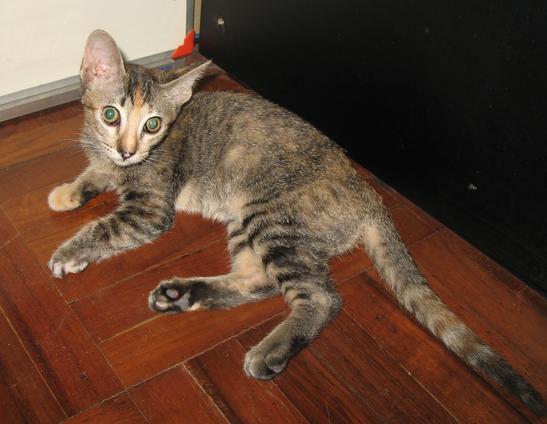
The earnest little kitten above is Katie*. Like all of the felines with whom I’ve shared my adult life, Katie is a rescue cat. We adopted her at the age of three months from our vet. According to the story we were told told, someone brought her in to the animal hospital when she was only a few weeks old. Apparently she’d had been in an accident and had broken her front leg. The wound had become so seriously infected that they had to amputate part of her paw to save her life. Indeed, if you look closely at the photo above, you’ll see that she’s missing the toes on her left front foot. X-rays of her shoulder show a permanent partial dislocation.

Katie’s now a strapping two and a half year old, curious and lively. She has a limp when she walks, but this disappears when she’s chasing our other rescue cat, Simon*. He’s a mostly-black beauty with golden eyes and a kinked tail, who loves to curl up in bed with me, purr in my ear and lick my chin. When Katie was an only cat, she used to nip our toes and gnaw on our fingers. Now she chews on Simon’s ears and chomps on his neck. He doesn’t seem to mind at all. Meanwhile, we’re grateful that she’s found an alternative target for her oral aggression!

Simon lived in a cage for the first ten months of his life. Given that social deprivation, it’s astonishing that he developed such an affectionate, easy-going personality.

Our neighborhood abounds with stray cats. Kind-hearted locals feed them, so of course they stick around, mate and reproduce. There’s one female, in particular, who has given birth to at least six litters (that we know about). We’ve tried to catch her in order to have her neutered, but she’s more or less feral and won’t let us come close.

So there are always kittens around, and we’re constantly tempted to adopt a couple more. But realistically, we couldn’t handle this. We live in an apartment, just the two of us. If there were a fire, we’d have to grab the felines, stuff them in cages, then carry them down six flights of stairs. Given our age and physical condition, two cages is our limit. In addition, we do quite a bit of traveling. Our part-time housekeeper cares for the kitties while we’re away, but I think she sees even two cats as a weighty responsibility.

Our friend on the fourth floor, on the other hand, has taken in at least five of these neighborhood kittens, as well as rescuing cats from the highway and from the roof of a nearby shop. We’ve lost count of how many felines he and his family have, because they keep some at his office, some at the restaurant they run, and some in their apartment.

Another friend, a woman I work with, has zero ability to resist strays. At present she’s caring for eight formerly homeless cats. The social interactions among these creatures is extremely complex, so she has to keep them in different rooms in her house, feed them at different times, and so on. Her life more or less revolves around the cats’ needs.

When I look at these two friends, I feel pretty guilty. Are my husband and I really doing all we can to save these furry beings from hard and dangerous lives on the street? Don’t we have the money – and the love – to spend on a few more?

What is enough, though? No matter how many homeless cats we adopted, there would always be an unending supply. It seems more reasonable to acknowledge our limits, and to do what we can to stem the tide. So we support the animal shelter and its spay/neuter programs. We share information about animals who need homes. Of course we neuter our own pets.

Worrying about stray animals gets me thinking about homeless people. We have an extra bedroom. Most of the time, except when we have out-of-town guests, it’s empty. Should we offer it to someone who needs a roof over his or her head? Isn’t it selfish of us to squander this resource? Is it our responsibility to rescue our fellow human beings?

It’s easy to feel overwhelmed by all the pain, tragedy and sorrow in the world. There are no easy answers. I do what I can. I edit altruistic erotica anthologies for Coming Together. I run my monthly Charity Sunday events. I rescue a few kitties and resolve to give them the great life that they deserve.

* Names have been changed to protect the cats’, and my, anonymity.

Thursday, March 10, 2016

Standing Up for What I Like

by Annabeth Leong

When I look up “guilty pleasure” on Google, I get this result: “something, such as a movie, television program, or piece of music, that one enjoys despite feeling that it is not generally held in high regard.”

Despite my tendency toward guilt, I reject the concept of the guilty pleasure. I believe in owning what I like. When I stand up for that, I’m standing up for myself.

It interests me that this definition is so focused on cultural products (movies, TV, and music). My first association with “guilty pleasure,” probably thanks to advertising, is chocolate. I’ll talk about food first and then get to culture.

So, I have been studying Danish for the past six months or so (I am planning a trip to Copenhagen). In the course of that, I’ve encountered a lot of word lists, and these often turn out to be unintentional packages of cultural assumptions. I was studying a list of words labeled “Food,” and suddenly found myself learning a lot of Danish words that I personally would have filed under “Religion:” “temptation,” “sinful,” “guilt.” I was in a very practical mindset—I wanted to learn food words so that I can order things in restaurants when I get to Copenhagen—and so the intrusion of these moralizing words really rubbed me the wrong way. A chicken sandwich isn’t temptation, it’s a piece of food. Neither is a piece of chocolate sinful.

I think it is a sickness in our culture that we’re putting these religious words onto the act of eating. Health and morality are becoming conflated, and health is taking on a twisted form in the process. For example, there seems to be a widespread belief that you can tell whether someone is healthy by looking (for example, by judging whether or not the person is fat). That, however, is scientifically incorrect. I’ve read many studies about how thin people sometimes have trouble being taken seriously by doctors who assume that they are fine because they’re thin. On the other side of things, there are plenty of fat people who are healthy in all kinds of measurements (cardiovascular health, etc), eat well, and exercise.

A little over a year ago, I got very sick with vertigo and lost 30 pounds in about a month. While visiting my doctor to talk about my illness, I mentioned the weight loss because I was concerned about it. A drop that sudden seemed like it might be dangerous in some way. His only response was to say that he wished he could get vertigo, too! That, for me, was a powerful illustration of how twisted our culture has gotten about food and weight.

There are some great books on this subject. One that I’d recommend is Linda Bacon’s Health at Every Size. Bacon talks about the importance of listening to your body when eating.

There is nothing inherently wrong with eating ice cream. It’s probably not a good idea to eat when you’re not hungry because that hurts, but if you wait until you’re hungry I don’t see what’s wrong with eating whatever you want (unless you have a disease such as diabetes). I like a wide variety of foods—from french fries to kale to hot wings to lentils to chocolate to chia seeds and beyond. I wouldn’t call any of them a guilty pleasure.

I spent so much time on food because it’s of great concern to me that there’s so much misinformation and moralizing out there about it. It bothers me that people feel so free to shame each other over food, body size, health, and everything related, and I feel that comes up even in supposedly benign phrases like “guilty pleasure.” I have been stunned by food packages that say things like, “Great taste without the guilt!” I am disturbed that the ideas of great taste and guilt have been so closely married.

I also wanted to talk about culture, though. It’s worth thinking about why I might call certain things guilty pleasures, and why I reject that.

At one point in my life, I might have called reading romance novels a guilty pleasure. I snuck them in the bookstore where I worked, but never had the courage to come out and purchase one. And that’s very much because of the definition I quoted up top—my idea that romance novels weren’t held in high regard.

But why weren’t they? I bought stacks of pulpy science fiction and fantasy novels and felt absolutely no guilt about doing so. It wasn’t a writing quality issue because I wasn’t ashamed of reading poorly written speculative fiction.

Honestly, I think sexism is the answer here. Romance novels are for the most part written by women, and as such they have the reputation of being trashy, unrealistic, and stupid. Some of them certainly are—but so are some of those science fiction books I was reading, too.

When I started to get wise to that, I realized how important it was for me to stand up and claim what I liked as a smart person and as a woman. I made myself go to a brick and mortar store and buy a stack of romance novels (until then, I’d only been willing to buy them online or through e-readers). The first time I did it, I felt foolish and ashamed. I followed up by reading the books in public, on an airplane, at a tech conference. I noticed how that made me feel. I made a point of doing these things until I stopped feeling weird about them.

If I’m going to read it, I’m going to own that I read it. If someone tries to make me feel guilty about it, I have a lot of questions for them.

Then there’s music. I identified as a goth or as a cool kid for a lot of my life, and as such I never listened to pop music. When I was getting divorced, though, I went through a period of exploration, questioning why I did or didn’t do various things, why I identified in various ways, and so on. In the process, I discovered that I loved Kesha. Immediately, I noticed people trying to shame me for listening to her music, which they perceived as shallow or lowbrow. Again, I asked myself why. You’re not going to tell me that every Bush or Foo Fighters lyric is deep and meaningful, and yet I never felt shamed for listening to those bands… Interesting.

So again, I decided to stand up and own that I liked this. I used to tell people that Kesha made my spirit music. I went to see her at Lupo’s in Providence, at the very first concert where she headlined. I saw her again on her Warrior tour—twice, actually—and bought VIP tickets the second time. I came out covered in blue and gold glitter and felt amazing because that’s how it feels to embrace your real interests without fear. I wear her shirts proudly. That’s not a guilty pleasure at all.

(As a side note, Kesha is of even greater importance right now because of the horrible situation she’s involved in with the producer “Dr. Luke.” She is fighting against sexual harassment, abuse, predatory contracts, you name it. I absolutely believe that dismissing her and her music as lowbrow or silly contributes to an environment where the concerning details of her case aren’t taken seriously. Kesha’s art has meant so much to many people, including myself, and she’s being very brave in a situation where there’s a serious power imbalance. It feels more important than ever to refuse to accept any shame in relation to her work.)

Monday, March 7, 2016

Guiltless Pleasure, Pleasureless Guilt

Sacchi Green

It’s a sad thing to realize how boring one’s life has become. I’m no stranger to guilt, but pleasure has seldom been in that mix. I suppose failing to do something because it’s just too hard seems, at the time, to be less unpleasant than actually doing it, but that doesn’t make it pleasant.

There is something, though, that I do often enjoy, even though it makes me feel guilty (which tends to lessen the pleasure.) It’s an addiction, in fact. A case could be made for most addictions being guilty pleasures.

My failing is procrastination by way of the internet. If there are any possible directions to ramble online where there might be something new of interest, I’m driven to exhaust all such possibilities before I get down to writing, or serious reading. A looming deadline can get me to shape up and do real work, but it has to be looming pretty ominously, and the figurative pile of books I should have read and would have enjoyed looms high enough to block out the sun.

Fortunately I do manage to get myself out under the actual sun fairly often, and I’ve been wise enough—or miserly enough—not to invest in the sort of device that would let me noodle around online even while I’m hiking along a woodland trail. If I had such a thing, I’d probably have broken my neck by now tripping over tree roots or stone outcroppings (or moose or bears.) Getting outside and walking even saves my writerly bacon from time to time by letting solutions to plot problems float up out of my subconscious and call attention to themselves, something that doesn’t happen while I’m following seductive links on Facebook. No, not that kind of link! More like odd historical bits and scientific discoveries and information about people and places that interest me. Sometimes, it’s true, I do come across information that I can make use of, or that sets off a productive train of thought; such serendipity is more than I deserve when I’m just web-surfing as a means of procrastination rather than dedicated research.

The guilt is a sort of background music in my consciousness most of the time when I’m procrastinating like this, especially if I’m not getting any actual pleasure out of the process. All too often I just forge ahead taking any route to keep from doing what I should.

Like I said, boring. Guilt that comes with sex at least is likely to be paired with pleasure. It’s true that I don’t associate sex with guilt much, but even that indicates how boring I am. Still, there’s one kind of sex, masturbation, that most of us would rather no one knew we were enjoying, or at least (with some exceptions) would rather do in private. That’s not guilt, exactly, but it’s the closest I can come, and even then I’m not going to come any closer that resorting to an excerpt from a story where pleasure mingles with rage, and guilt. Yes, this is cop-out. I feel guilty about it. But the main pleasure involved is that I’m finding a way to fill out my post this week, on time, with hardly any procrastination.

This is from a heterosexual historical romance story I wrote for Delilah Devlin’s Hot Highlanders and Wild Warriors. I only did it because I’ll take almost any chance to write historicals, and the Mongol Invasion of Europe interests me. Plus, falcons! (Uh oh, have I quoted this bit before? If so, yeah, I feel guilt, and without the lube of pleasure.)
__________

From "A Falcon in Flight"

By Connie Wilkins (my alter ego)

When word of defeat came from Georgia’s capital, Father Kristopor searched out Ardzvik on the mountainside where she hunted with her falcon Zepyur. She knew, seeing him from far above, what his mission must be, and cursed fate for robbing her of the longed-for solace she reserved for such fine, cloudless days when the blue sky went on above forever and her hawk soared high and free with no likely prey in sight. At least the priest had not discovered her in the midst of what he would surely consider sin.

“Now is the time,” he called, and then, when he was closer, “Send at once to the Mongol General. Say that the Province of Aragatsotn in Armenia has long been a vassal of Georgia, so it is only right that its people offer fealty to the new rulers. I will bear the document myself. The Mongols are quick enough to sack churches, but I have heard that they retain some degree of respect for holy men of any faith.”

“Surrender without a battle.” The words, bitter on Ardzvik’s tongue, burned even more in her heart.

“Without blood. Surely they would rather have the wine of our vineyards and grain of our fields than the lifeblood of those who tend them. Dead men cannot be taxed.”
So it was done. Ardzvik Zakaria, lady of Aragatsotn, signed above the seal presented to her father’s father in Tbilisi by the legendary queen Tamar of Georgia.

As soon as the priest rode his mule northward, Ardzvik retrieved her falcon from the mews and rode again high onto the mountain. Zepyur was still as swift and graceful, the sky as blue, but now the lady of Aragatsotn could not shed her duty, her constraints, and be pure flesh and spirit.

Lying back on tufted mountain grass, she envisioned, as she had so often, the airborne mating dance of the wild falcon pair that had produced her own sleek hunter, but she could not rid her mind of earthbound turmoil.

Her hands knew all the ways to pleasure herself, the places to twist or stroke or beat with rough force while a part of her soared aloft with the hawks, the earth dropping away, away, until they plummeted together as one through space. Falling, falling, diving faster than anything could fall, cold air ripping past, battering, the ecstasy forced deeper and deeper, keener, unbearable...and her own ecstasy bursting forth at last like the cataclysm that had torn open the mountain’s peak.

But this time, no matter how hard she rubbed or deeply she probed, she achieved only a sharp burst of sensation, as much pain as pleasure. The scream forced from her throat was of rage, not triumph, and tears flowed hotter on her cheeks than the rivulets of sweet release between her thighs. Surrender without battle. Dishonor. But duty nonetheless.
__________

Hmm. Maybe I did get some pleasure after all from revisiting this story. And there’s no need to feel sorry for Ardsvik: this is what (or who) the Mongol General turns out to look like:


Monday, February 29, 2016

Stash

By Lisabet Sarai

She should throw them away. After all, she’s married now, and a mother twice over. It’s crazy —unhealthy, even—to hold on to those tattered remnants of her past. If Ben ever found them, she knows he’d be deeply hurt.

Not that there are secrets between them, not really. She’s told Ben about her all-too-brief exploration of her submissive nature, at least in general terms. He doesn’t want to know more. The notion that she ever enjoyed being beaten or bound or “forced” into lewd actions makes him terribly uncomfortable. To be faced with evidence of her joyful depravity would not only disgust him, but also make him feel inadequate. Even after a dozen years together, her husband worries that he’s too vanilla to satisfy her. The nugget of truth in that worry is her private shame.

So she hides the letters between the pages of the New Testament her born-again mother gave her as a gift so many years before. Atheist that he is, Ben won’t touch that volume. She tells herself she’s protecting him from pain. The irony of this strategy isn’t lost on her. She remembers her mother’s shrill voice, naming her as “spawn of the Devil” because of her sexual adventures—the ones Mom somehow found out about, that didn’t include any kink.

Those well-worn epistles wait for her, stashed among St. Paul’s letters to the Corinthians and the Romans. She might not take them out for weeks, but she’s always aware of their existence, a sweet temptation calling to her from the bookshelf. Just a quick look. What harm could it do?

She works from home, transcribing medical records for an insurance company. It’s deadly dull, but pays pretty well. She can make her own schedule, and be there when the boys return from school. Mornings, though, after the kids are on the bus and Ben has left for the office—those are the hardest times. She strikes bargains with her conscience. Three more cases, then she’ll take ten minutes. Reread one letter, or at most two.

An hour later she finds herself on the floor, surrounded by dog-eared envelopes and sheets of paper dense with his firm script, her eyes and her sex both moist.

At this point, she doesn’t really read the letters so much as caress them. She knows every word by heart. Still, some of them leap from the page, echoing in that rich, dark voice he employed with such skill.

Flog.

Fuck.

Open.

Mine.

He’d used these letters to seduce her, months before they’d even touched. Somehow he knew—he always knew—what she craved. After he’d dropped out of grad school and moved across the country, she’d been the first to write, a chatty, chummy letter with only the barest hint of flirtation. How had they progressed to discussing spanking, hot wax and nipple clamps? Had she been seeking that all along?

After their first incandescent encounters, the correspondence had continued, bridging the miles between them, more thrilling and raw than ever.

It never occurred to me that you’d refuse anything I asked.

The letters rekindle that wondrous, terrifying yearning. Once again she’s the innocent, eager creature he’d somehow recognized, pliant and brave, hungry to taste his power. He’d shaped her sexual self like some sculptor of the flesh. Malleable, he’d called her. Back then, his mocking superiority annoyed her slightly. Now it makes her proud. She misses that woman, wonders if any trace of her still exists.

After all these years, she doesn’t really remember the physical pleasure, but she can summon the breathless excitement of surrender simply by opening an envelope, without reading a single line. She’s never been more alive than when she lay beneath him or knelt before him, ready to accept whatever he felt inclined to bestow. That was reality, sparking into existence once again as she scans the pages. It’s her current existence, full of mundane domestic joys and ordinary comforts, that feels like a dream.

He’s married as well at this point, to a kinky girl a dozen years younger whom he met at a munch. They exchange vanilla birthday and Christmas cards, two old friends with a secret history. She’s glad he’s not her husband. He’s critical and difficult, a perfectionist. She’s not sure she could give him what he needs now. But she did, back then. She never doubts that.

With a sigh, she slips the brittle pages back into their envelopes. A few are torn already. How many years will it be before they finally crumble to dust? Will she still be re-reading his words, re-living their past connection, when she’s a grandmother? It’s possible. She’s not ready to relinquish the letters yet, though her lack of total honesty gnaws at her. They are all that remains of the gloriously liberated, utterly devoted slave she once was.

Thursday, December 3, 2015

Making Myself Look Bad

by Annabeth Leong

I think I do lying wrong. I'm supposed to do it to make myself look better, I think, massage my history into something smoother and more attractive, like an age-defying wrinkle cream for my past.

Instead, I'm much more likely to make myself look worse. "I used to cut myself," I'll say. Which makes it sound like I did that all the time, like I carried a kit for it around with me like Maggie Gyllenhaal's character in The Secretary. In reality, I did it three times. I understand that's more than most people have tried a thing like that, but it's not the roundup I gave it, from experimental to habitual.

Another one I used to say all the time is, "When I was drinking." The mental image that gives me is of someone who carries a flask around, or maybe someone who makes herself cocktails with breakfast. At the least, it's someone who drinks every night, who gets drunk all the time, who has a serious history of alcohol abuse and its attendant troubles.

What I meant when I used to say that was "the period of time during which I sometimes drank," as opposed to the many years of complete religious abstinence that followed.

I'll keep going on the drinking thing because I used to lie a lot about that. I used to say things like, "When I was drinking, I would do really bad things." Here, "drinking" meant "consuming alcohol in any amount." (A drink or a sip might count). And "really bad things" meant "have sex with people," or "have sex with women," or "have sex in a non-mainstream way."

Obviously, I know sometimes people get drunk and have sex that they regret and might not otherwise have had, but I'm talking about going to a party, having a drink, and starting to make out with the ex-girlfriend I still wanted but was trying to stay away from for reasons neither of us really understood. I'm talking about going home with her because that's what I knew I wanted to do before I even went to that party, having one drink first as an excuse, making love to her, and then feeling bad about what a terrible thing that was to do only because it wasn't acceptable, not because we hadn't wanted to or something bad had happened.

A few years ago, I started to catch myself in this habit. "When I was drinking, I did really messed up things sexually," I said to someone. Then I stopped and remembered beyond the phrase I'd gotten used to saying. What was messed up about that thing I used to do? What do I really regret?

What I regret is that I wouldn't hold her hand in public. I wouldn't kiss her unless we were alone or had an excuse. I wouldn't go home with her without this ritual of being at a party, pretending it was a mistake. I regret that I didn't tell her in the morning how it felt to be with her, how beautiful it was to wake up in her bed, how I always thought about standing together in her shower.

The story is so different from the one I used to tell.

Maybe that's part of what's disturbing about deceit. I can only tell the truth if I know it. I never set out to lie. I used to let my guilt speak for me, make it sound like things I did out of love happened by accident, from corruption. I used to tell myself that so I didn't have to think about what it meant to have loved.

I also still have trouble seeing the truth about myself. I notice all too frequently how my perceptions are out of sync with my actions. Someone told me once that when she met me she thought I must be a terrible person because of the way I talked about myself. She said she kept waiting to find out the dark and ominous secret, the horrible things I had done to certain people, like maybe my ex-husband. And then after knowing me for several years, she said she realized I was just a normal person. Nothing especially horrible there. (In fact, I may be lying again. I think she said something nicer than that, thought I can't remember what).

It's funny. It's my deepest wish to be a good person, but I can't stop making myself sound like I'm bad. One thing I've gotten from my erotic writing, at least, is that I'm clearer now on what I actually think is bad. I'm sexual and kinky, but that's not the same as bad. It's helped a lot to know that, to look back at my life and see that many of my "crimes" were simply curiosity, things that I have no moral objection to at all. Things I'd like to do again.

Saturday, December 7, 2013

A Visit from the Furies

by Jean Roberta

Guilt was personified for people in ancient cultures. The ancient Greeks feared the Furies, a trio of supernatural beings that were old even in the “Golden Age” of Athenian culture (approximately 500-400 BCE). They haunted anyone who broke their moral laws.

In the 1970s, I was married to a Nigerian from the old city-state of Kalabari (reminiscent of Greek city-states, IMO), traditionally presided over by a goddess named Akaso, who drove evil-doers to madness. I sometimes dreamed that she was tormenting him.

At this moment, I feel guilty because, in the craziness of end-of-semester grading (and chasing plagiarists), holiday parties, and exchanging emails with the young man who offered to set up a website for me (yes!), I forgot that December 6 was my day to post. Ack. I like to think I uphold my commitments.

Like Amanda (probably on a milder level), I also feel guilty for having a health problem that has forced my spouse to go out of her way to help me. This is my broken wrist, which is now healing nicely after surgery on November 5, though I’m still wearing a sexy-looking removable lace-up cast, like a corset for my hand and forearm. This all happened because I slipped on snow-covered ice in early November. I probably wasn’t careful enough, and I hadn’t learned how to fall on less-vulnerable parts of my body. I was obviously lacking in useful survival skills, even though slip-and-fall accidents in winter are very predictable in mid-Canada, where I've lived for most of my life.

The truly scary thing about personified Guilt in ancient cultures is the implacable nature of them, or her. (And is guilt considered female because she is imagined as an angry mother, or several? I wonder.) According to the myths, you couldn’t talk your way around her/them, or apologize, offer a few “Hail Heras,” and be absolved. The Furies would hound you to the grave because something about your transgression, no matter how minor, upset the grand scheme of the universe, and they were its original guardians.

Sometimes the worst guilt is the most irrational. I feel guilty because I didn't send Christmas presents to my grandchildren since their mother told me to stay out of her life (and theirs) in summer 2010. (This means that they heard nothing from me for 3 Christmases. Each year, I sent my daughter and her husband an email asking if they would let their children receive presents from me. I got no answers.) This year, I mailed a box of toys in time to get there before December 25, even though I have no way of knowing if the box will be intercepted, re-labelled, or given to charity. I might never find out.

According to the Greeks, the crime of killing one's mother (e.g. what Orestes does to Clytemnestra, according to a famous cycle of tragedies) is unforgiveable. Simply banishing her from one's life is clearly a lesser crime, but it would probably attract attention from the Furies, those upholders of traditional respect within blood families. Would I want my family of blood kin to fall like the House of Atreus? Hell, no. I would have nothing to gain from that, even if I were spared.

Conflict in general tends to make me feel guilty, even if I can't imagine what I could have done to prevent it.

I feel guilty about former friends (and friendly acquaintances who might have become something more) that I've lost track of over the years. While not posting here on Friday, I invited a very long-term friend at the university to lunch with me in the Faculty Club next week (she's not a faculty member, and could only go as my guest). Her religious views sometimes grate on me, but her good qualities compensate for that.

I do what I can to fend off the Furies.

Thursday, November 28, 2013

What, Me Guilty?

by Giselle Renarde


This week, an excerpt from my pretty much completely autobiographical book, Audrey and Lawrence:


“I’m sorry,” Lawrence said, so heartfelt it made me want to scream.
“Don’t,” I stopped him.  “Because the second you say you’re sorry, I’m supposed to say it’s okay.  It’s not okay.”
“I know…”     
You had all this time to tell me!”
            “Oh,” he replied.  “Well, I knew not to tell you by e-mail.”
            “Right.” I percolated, calm before the storm.  “Because if you’d written an e-mail I would have told you to go fuck yourself.  When you give me bad news in person, my love and my hatred get conflated and that fusion turns into sex.  At least you get what came for.”
“I came to see you,” he argued. “This is more than just sex, to me.”
The worst part of was that I believed him.  But I shook my head and muttered, “Whatever,” so not to lose face.  The last thing I wanted in an argument was to seem uncertain.  “Some day you'll break your legs or get pneumonia or something horrible will happen to you and I will laugh my ass off because you deserve it.  And in case you think it's taking me too long to get over all your compounded lies and deceptions, let me tell you: I will never get over them.  And here I have to carry this burden of being the only person in the world who knows what a fucking liar you are.” 
He rolled his eyes.  “I’m not sure how this is a lie, but I’m certain you’ll let me know.”
You are a liar is a general statement,” I enunciated, incensed by his reaction.  In my state of intense upset I was losing grasp of my English.  My words were drowning in my accent, to the point where I wasn’t sure if Lawrence could even understand me anymore.  “You tell lies.  That’s something I know about you that nobody else knows.  Not even you know it, because you delude yourself into believing lies of omission are not really lies when they truly, truly are.  So here I hold this knowledge about your nature and constantly I have to make the decision, do I keep this secret?  Do I tell?  And every day I make the same choice:  I detain this knowledge.  I imprison it, though it’s a burden to me, though it’s the wrong thing to do.”
“It isn’t wrong if it’s for the right...”
“It is wrong!” I cried.  All that is necessary for the triumph of evil is that good men do nothing. You taught me that!  And here your evil triumphs because I sit idly by.  Just keep breaking those promises, Lawrence.  Keep lying.  See where it gets you.”
His whole body straightened, stiffened.  “Is that a threat?” he asked, raising an eyebrow like he was the innocent.  “You’re going to tell Ruth?"
“I shouldn’t have to,” I said. “You’re the husband, and you did wrong.  It’s your job to set it right.  But of course you’ll never come clean.”
“That’s right.  I won’t.  And you want to know why?”
I couldn’t remember ever feeling such hatred for the man I’d wanted so badly.  “Because you’re a fucking coward is why!  You can’t face the consequences of your actions.  You’re just a little boy who wants everything for himself, but doesn’t want to pay the price.”
He didn’t move from the bed.  He rested with such languor I wanted to punch him in his stupid mouth.  It was like he didn’t give a fuck about what I was saying.   
“My only lies are omissions,” he said self-righteously.  “And those are to spare Ruth a pain she does not need to feel.”
“Who are you to decide what she needs to feel?” I cried.  That was such a patriarchal attitude.  “Just tell the truth for once.”
“Oh, I see.  So, you want me to hurt my family.”  He offered a simple shrug, like it was just that easy.
“I want them to know the truth, Lawrence.  When you respect a person, you tell her the truth.  Do you have so little respect for your own wife?” 
I could tell I’d struck a nerve, but only because he flinched.  His words still flowed out calm, cool, collected.  “Respect doesn’t enter into this conversation.  You know why I won’t tell her?  Because she has enough pain already.  I don’t want to cause her any more.”
“Bull-fucking-shit!” I spat.  I wouldn’t buy that excuse for a nickel.
“And because I love her.”  His expression was the dictionary definition of smug. 
            My throat was already so constricted that my gasp sounded like something struggling to stay alive.  I saw my brain in pixels, vibrating in a frenzy of particle motion until the energy of my whole body started to spin out of control.  A tornado whirled around my head, escaping with my words.  “No you don’t!  You love me!” The tears came pouring out, falling hot on the hands wringing in my lap.  My chest heaved.  “You love me!”  I cried. “You love me!”
Sobs like mocking laughter escaped my lips as they opened wide and contorted, the mask of tragedy.  
With my head hanging low, I bawled. “Why do you hurt me like this?” 
Wrapping distraught arms around my waist, I made a desperate attempt to comfort myself. I must have been mad, taking his shit year in, year out.  Who else would have?  
“Would she have stayed with you if she knew what a horrible, horrible man you are?  Calisse de crisse, I hate you so much!  I hate what you’ve turned me into: this maudit whining little child.  I hate who I am with you.” 
Lawrence knew better than to comfort me.  I would only have lashed out at him.  He got up from the bed and pulled his jeans up.  “I think I should leave now.”
“No! Lawrence, I love you,” I cried, confounded by my quick change in temperament.  
 I love you, I hate you, I love you, I hate you
“Don’t go yet.”   
Stay and share in my misery.  Stay and watch me cry.  Just stay.   
What was wrong with me?  Why did I abuse him and then panic when he chose to leave?
“Why would I stay?” he asked, retrieving his T-shirt from the floor.  “So you can hurl more insults my way? More threats maybe?”  
He was already at the front door when I wrapped my arms around him, like those children who hurl their entire bodies at their parents’ legs when they try to walk into the next room.   
Burying my face in his chest, I whimpered, “You don’t really love her.  You love me.” 
I grasped his core, trying to squeeze a response from him.  He held me, but said nothing, and for a long moment that was enough.  I started wondering why the hell he was with me at all when my behaviour was so wretchedly unpredictable.  Was it my fault, all this arguing?  Or was it his?  My energy was so zapped from the fight I couldn’t recall what it had been about.
“You love me more…?” I begged.  My hopes were high.   
When he didn’t say anything, the upset flooded my veins once again. 
“Fine!” I replied, sullen as a teenager.  Pushing him away, I cried, “Leave!  Go!  What do I care?”   
But I must have cared to some extent, because I picked up a thigh-high boot and hurled it at his head.  The heel made contact with his skull, issuing a knocking noise, and the boot fell back down to the floor.
“Audrey!” Lawrence cried, his jaw hanging open as he reached up to touch the gash across his bald head. 
“What are you going to tell her now?  My mistress threw a boot at my head?  Try to explain that with one of your lies of omission...”

Monday, November 25, 2013

Born to be Guilty


By Lisabet Sarai


Oy! Do I know about guilt? Is the Pope Catholic? (Yes, I know he has his own guilt issues, but I'll leave that for other Grippers to discuss.)

I grew up a nice Jewish girl, with a Jewish mother. And a Jewish grandmother. I was born to be guilty.

It's not as if I really had anything to feel guilty about. Other than a tendency for the clothing in my bureau drawers to be a bit messy, I was almost sickeningly well-behaved. I earned all As from elementary school all the way through college and into grad school. I helped with the housework. I always asked for permission before going out and never came home late. I didn't smoke. I didn't drink or use drugs (well, not until I was well into adulthood). I didn't beat up my siblings. I didn't get pregnant.

And yet, when I think back to my early life, it seems as though guilt, and its quivering sister, anxiety, were my primary motivations much of the time. When I didn't get absolutely top marks, I had the sinking sense I'd let my family down. When I did make 100%, I worried about how I'd manage to do as well next time. I loved school – reading books, writing papers, learning new facts, principles and skills. At the same time the need to excel made the experience oppressive. Obsessing over grades and deadlines, I'd forget to enjoy the process.

My mom had her ups and downs emotionally. When she was upset or depressed, I'd have the totally irrational conviction that it was somehow my fault. I'd clean the kitchen and iron the clothes, trying to “make it up to her”. When my brother did something naughty and was punished (he wasn't nearly as goody-goody as I was), I felt responsible, as ridiculous as that might sound. Maybe I could have stopped him. Maybe I shouldn't have told my parents about his transgressions. It's possible I felt guilty because deep down, I was tempted to emulate his insouciance and independence, so different from my own behavior.

I should clarify that despite the stereotypes, my parents didn't usually use guilt to manipulate me. They were proud of my achievements, but never pushed me the way some families do. As far as I can tell, most of this guilt was self-generated. Perhaps it's hereditary. Or possibly learned. I suspect my mom felt guilty and inadequate for much of her life as well.

When the pressure built to an unbearable degree, I became anorexic – the ultimate in guilt-induced perfectionism. If I allowed myself to eat, I'd suffer torments of self-reproach at my “lack of discipline”. I'd look at my scrawny body in the mirror and see obesity, the objectification of my gluttonous appetites. As I watched the pounds drop away, though, there was a sense of triumph, a momentary release from the terrifying sense of my own badness.

As I got skinnier, my interactions with my mom deteriorated. She thought the world was blaming her for my condition (and to some extent this was true – women who become anorexic often have close but difficult relationships with their mothers). She hounded me, trying to force me to take in the nourishment my body needed. I became increasingly dishonest, pretending to eat while hiding or disposing of the food, or I acted out, throwing tantrums – something inconceivable for the good little girl I'd been up to that point. She was obviously at her wits end, and of course I hated myself for hurting her, but the emotional penalties for giving in and letting my monstrous desires run free were even worse. Meanwhile, her very logical concerns about my health were tainted by her guilty fears that she was responsible for my decline.

I can bring back all those emotions – so vivid and so painful. Somehow, though, I managed to escape from the deadly cycles of fear and self-disgust. Honestly, I don't know how I survived. Therapy helped, I guess. When my therapist gave me unconditional approval, I was somehow able to believe him, when I'd never been able to do the same with my parents. I moved out of my mom's house and went to live with my dad, who while more emotionally closed than my mom, was less volatile and more accepting of me.

These days, guilt plays a far less central role in my life. I've come to the conclusion that it's a totally non-productive emotion. If you've done something less than admirable, wallowing in guilt won't change the past. It just interferes with your moving forward. And if you're feeling guilty because of something you should be doing – well, guilt is just another word for procrastination, isn't it?

Still, I'm sure that I haven't completely outgrown my guilty tendencies. That's one reason I never had kids. I didn't want to inflict my mishegas on them.

Sunday, October 16, 2011

Angel on my Shoulder


By Lisabet Sarai

“What a lazy slacker you are, Lisabet! You haven't written a word on Quarantine for nearly a month!”

“No wonder your books don't sell. You barely put any effort into promotion.”

“You just walked right by that beggar. You've got so much more than he does – couldn't you spare a dollar?”

“You said you were going to cut back on drinking, but that didn't stop you from ordering two whiskies last night, did it?”

“You dreamed about him again. Aren't you ashamed? Here you're lying next to your devoted husband, and fantasizing about someone else.”

Remember those cartoons, where the character has a devil on one shoulder, urging him to act on his desires, and an angel on the other, exhorting him to be strong, moral and virtuous? Well, I've got one of those – an angel, I mean – and I have to say she's a bitch. I don't know what happened to her demonic counterpart. Maybe he figured I didn't need any help giving in into temptation. Perhaps the angel actually managed to drive him away. Hallelujah! Good triumphs over evil. Why don't I feel like celebrating?

From what I can tell, she doesn't plan on going anywhere soon. She seems to get her jollies making me feel as guilty as possible. Now I know I don't live up to her ideals – or even my own – but honestly, I do try. And what she doesn't seem to realize is that the guilt she stirs up actually hinders me from accomplishing more, following through on my resolutions, acting more thoughtfully and compassionately.

The more I obsess about my writing (or lack thereof), the more difficult it is for me to sit down and let the story flow. The task of getting my name out there begins to seem so insurmountable that I'm tempted to just give up. I look at all the misery in the world, the hunger, disasters, injustice, and feel as though my own modest resources can't possibly begin to make a dent.Why bother to even try?

It used to be much worse, though. When I was younger, guilt could literally paralyze me. I'd wake up in a panic, palpitations and all, about everything that I had to do and hadn't done. I'd sit there with a mind as blank as my screen (or paper, in the earlier days), unable to write a word. Now I have a strategy that helps quite a bit.

I forgive myself.

Seems like such a simple idea, doesn't it? I listen patiently to the litany of my shortcomings that my angel offers. I acknowledge that perhaps I could have done better. I remind myself (and her) that I am only human. I take responsibility for my failings, but I also note the many successes that my angel somehow never bothers to mention.

Self-forgiveness takes effort. It should be enough to just let go, to release the notion that I've fallen short and accept myself as I am. For some reason, though, I tend to cling to the guilt. Maybe it's a way of punishing myself. I should feel terrible, if I haven't measured up to the world's standards, or my own, right? If I'm serious about self-forgiveness, I have to deliberately put my sins out of my mind and remind myself of the truth. I am basically a good person. My intentions are for the most part pure. I'm doing the best that I can.

What helps most is to realize that all I really have is now. Of course, I want to learn from my mistakes, but they're already in the past. Dwelling on them will not change anything. I don't know what the future will bring, either. All I can do decide how I will think and act now, at this moment. That's where I focus my attention. I can choose industry over sloth, generosity over miserliness, compassion over selfish disinterest. Peace over pain.

It's easy to know when I've been successful in forgiving myself. Relief and comfort pour into my soul. I'm energized and hopeful, ready to apply myself to my goals once more. I'm not the religious sort, but indeed, I feel blessed. And, for a while, at least, my angel falls silent.

Perhaps she doesn't come from heaven at all.