Showing posts with label magic. Show all posts

Sunday, July 21, 2019

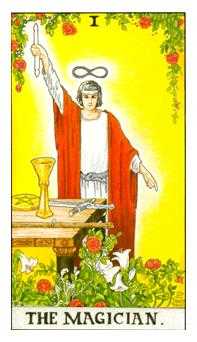
The Magician and Me #Tarot #Writing by @GiselleRenarde

Universal Waite deck © U.S. Games Systems, Inc.
I'm coming home to things I loved as a teenager. Tarot is one of those things.

When I can't sleep, I listen to tarot podcasts. One night, I listened to a podcast about calculating your birth card. I knew about significators--cards you use to signify yourself or other people--but I'd always used the card associated with my astrological sign as mine.

My birth card (Major Arcana card you get to by adding down your birth date, month and year until you have a number that's less than ten) turned out to be... The Magician.

I wasn't feeling particularly magical when I made this discovery. This past year has been full of grief, depression, anxiety, and plenty of other deep feelings. I've been in midlife crisis mode, big-time. I've made sweeping changes and questionable choices.

Where work is concerned, I wondered: "What is the point?" My books are still selling, but only the old ones. When I write something new, I can't seem to convince more than 3 people to buy a copy.  It's disheartening, it really is.

Life felt like something that was happening to me, not something I was actively engaged in. When I was numb, I didn't care whether I lived or died. When my feelings came back, I had too many all at once. Too many emotions, too strong. What's preferable? Feeling too much or feeling dead inside?

When I realized The Magician was my birth card, it opened up something inside me. Couldn't have come at a better time, because I was really starting to feel like I had no control over my life. Huge choices and life events all seemed to be in other people's hands, and I felt like I was just waiting for others to make a move so my life could finally begin.

The Magician doesn't wait around. The Magician makes things happen. He is me. I can manifest my will here on earth! I can do it!

One of the tarot podcasters I listen to and love is constantly saying that nothing's fixed in stone--if you don't like the direction your life is going, you can change it. For some reason, that had never occurred to me. I felt like I just had to wait around until something happened, and hope it was something good.

The Magician card convinced me that I have a part to play in my own life. I don't have to feel like everyone else is running the show (though, realistically, I still do, most of the time). I have the option of making choices and acting on those choices. I can choose which direction I want my life to go.

Even that much is progress. A few months ago, I felt like I had no life left in me.

https://www.patreon.com/audioerotica

Tuesday, July 9, 2019

In the Realm of Gods and Monsters and Billionaires


Most of us might not consider this – especially if we’re in the camp that is sick to death of billionaire stories, but billionaires have been with us in their more archetypal forms since the time of telling stories in the cave around the fire. 
The truth is that power and control, in all their guises have a facet of raw, primal lust, and few things are more darkly and secretly fascinating than the idea of being forced to give up control and finding that we like it. Being possessed, being under someone else’s thrall, being taken to the realms of ecstasy, whether it’s on Mount Olympus, in Dracula’s dungeon lair or in a penthouse apartment, is a part of that dark fantasy that makes up, not only the mythological seductions, but every vampire story, every monster story, and yes … every billionaire romance. 

Why is that? What makes that dark fantasy such a powerful one. Well, I have a theory, and I’ve been toying with it ever since I penned my first PNR story. I think that no matter how appalled we are by the thought, no matter how stubborn and independent we are, we want to know what it’s like to be with and to be taken by a force so much greater than us that we have no control. What’s it like to be bitten and seduced by a vampire? What’s it like to make love to a monster? What’s it like to be seduced by a god? What’s it like to be the object of lust for a billionaire? And ultimately what price are we willing to pay for entrance into Club Billionaire, Club Olympus, Club Undead? 

It’s more than lust. It’s more than love. In fact it’s all a little mercenary really. We want, we long for, a chance to take into ourselves all that we’re not. We want to know their secrets. We want those divine, powerful, filthy rich, forbidden lovers to reveal to us their inner workings just as much as they want to possess us. The ultimate question then becomes can we pay the price and survive to tell the tale? Can we achieve our HEA and find some sense of balance in a world to which we are the interloper?  Oooh! It’s always so much fun to find out. And what I am discovering as I delve deeper and deeper into Magda/Medusa’s world and that of her Consortium, is that the answer is … complicated. Sometimes the Happy Ever After looks more like “what the f*ck is this then?” Sometimes the true adventure only begins just when the HEA is lost in a constantly changing landscape in which we’re strangers. Sometimes there are far greater things at stake. 

Being whisked away into the arms of a demon or a vampire, or even a gorgon also means while there may not be a need to wear a condom, there is quite literally no such thing as safe sex. You never know what will happen if you sleep with the monsters, and once that decision is made, in a world where rules don’t apply, we can’t help but be affected. The question then becomes, will we survive the change? 

Wednesday, July 3, 2019

Among the Elves and the Orcs -- #Tolkien #adolescence #magic


Elves and magic

Image by Prawny from Pixabay
By Lisabet Sarai

I spent a significant part of my adolescence in Middle Earth.

When did I first read the Lord of the Rings trilogy? I suspect that I first encountered Tolkien when I was twelve or thirteen, a socially awkward, intellectually precocious kid whose primary pleasure was to lose myself in fiction. The Hobbit charmed but didn’t excite me. The epic trilogy, in contrast, drew me deep into its magical realms. I read the three volumes multiple times during my teens. The geography of Middle Earth were almost as familiar to me as my home town. I had dreams set in Tolkien’s world. I painted its landscapes, recited its verse and sang its songs.

My high school senior honors thesis was entitled “Middle Earth as Macrocosm: Operation of a Chain of Being in The Lord of the Rings”. This paper begins:

“The Great River Anduin is born far up in the north, amid the tumbled ruggedness of Ered Mithrin, the Grey Mountains; it courses southward between Mirkwood and the Misty Mountains, cascades over the golden falls of Rauros, flows with regal dignity past the city of Gondor and finally pours itself through a hundred mouths into the Bay of Belfalas. To the east lie the desolate plains of Rhovanion and Rhûn, and the black land of Mordor, fenced by the perilous crags of the Ash Mountains and Mountains of Shadow, Ered Lithui and Ephel Dúath. Westward, across the mountain backbone, rolling reaches of Eriador stretch in leagues of grey-green to the Gulf of Lune and the Grey Havens. Beyond, there is only the Sea, vast and deep, separating from familiar lands these hills and moors of Middle Earth.” (*Lisabet Sarai, 1970)

I don’t recall any of this geography now, but at the time, I could have drawn you a map and guided you along the paths taken by the Fellowship of the Ring in its quest to destroy the perilous One Ring of power by unmaking it in the volcanic fires where it had been forged.

You might very well have found my obsession boring.

Why did Middle Earth have such a hold on me? When I skim through the pages now, the prose seems a bit stiff and pendantic, and the tale has lost some of its thrill. Of course, this is partly because Tolkien’s masterwork established high fantasy as a popular genre. Now elves and orcs, wizards and dwarves have become familiar and commonplace. First books are like first lovers; they make a strong impression.

One reason I enjoyed Middle Earth, I think, was the subtlety and imperfection of its magic. In Tolkien’s universe, various races and creatures have special powers, but no one, not even the Dark Lord himself, is invincible. Strands of magic weave through the story, sometimes turning the tide at a critical moment, sometimes not. Magic is not reliable; thus when it does emerge, this enhances the wonder. Furthermore, magic follows the laws and limits of the universe. In Tolkien’s Middle Earth, magic is part of nature, not outside it.

A world in which magic can surmount any problem is simply uninteresting. One problem I’ve had with many subsequent “high fantasy” tales I’ve read is that the characters are too powerful. (I have a similar criticism of some science fiction as well.)

The characters in The Lord of the Rings are engaged in both a physical and a moral struggle. The latter is far more intriguing. While Tolkien’s characterization is far less nuanced and complex than in George R. R. Martin’s Westeros (my most recently discovered magical realm!), even the great heroic figures have their weaknesses. The Fellowship sets out unified in its purpose, but gradually disintegrates as its members choose personal or racial priorities over their common goal. Even Frodo, the good-natured and unassuming hobbit charged with bearing the Ring, at the final moment yields to the temptation to keep rather than discard it. Only a satisfying twist of fate very much like karma saves the quest despite Frodo’s moral failure.

I feel as though I’ve outgrown The Lord of the Rings, but my time in that magical realm had a huge influence on me. On the other hand, my own paranormal tales tend to be set in worlds only slightly different from our own. Indeed, I’ve tended to take the notion of minimalist magic much further than Tolkien. Still, I try to evoke the same sense of wonder, though I doubt I’ll ever succeed with such brilliance.

“All the world, the land and the waters, the skies above, the sun and the stars, the Elizabethans called the ‘macrocosm’. The term has a profound significance lacking in the word ‘universe’; it automatically implies the existence of order, of a pattern and a plan. A universe may be absurd, meaningless, an existential ‘neant’, but a macrocosm can never be.

“Middle Earth is a macrocosm, organized as the Elizabethan one was, according to a great chain of being. From the Iron Hills in the north to the hot deserts of Haradwaith – from the inland Sea of Rhûn to the westermost tip of the Forlindon peninsual – throughout Middle Earth, all creatures on all levels obey and reverence laws. It is only the evil ones who strive to upset the marvelous and intricate balance of divine order.” (*Lisabet Sarai, 1970)


* Not, of course, the name under which this paper was submitted.
 

Monday, December 3, 2018

A heady mix of eroticism and terror - #Arcanium #review #magic

Spider cover

By Lisabet Sarai

There aren’t too many authors whose books I’ll buy on release day, but Aurelia T. Evans is one of them. When I saw the November 6th announcement in the Totally Bound newsletter, I hesitated only long enough to start up my special e-commerce computer in order to purchase a copy of her latest novel Spider.

Spider, the sixth book in the fascinating and disturbing Arcanium series, brings readers back to the alluring, terrifying circus created and nurtured by ancient jinni Bell Madoc. For Bell, Arcanium is simultaneously a plaything, a work of art and a cosmic mission. The appeal of his edgy big top performances and horrible but fascinating Oddity Row depends on his “people”: captive demons, human misfits, and unfortunate innocents whose unintentional wishes have bound them to the circus. Although Bell is capricious and can be cruel, he’s also exquisitely sensitive to the secrets that haunt visitors to Arcanium. The transformations he works upon those whom he entangles via their wishes make those secrets visible.

Elizabeth, the protagonist of Spider, lives her life in fear: fear of heights, fear of darkness, fear of insects, fear of disease. A member of a conservative, Amish-like religious cult (in fact, the illegitimate daughter of its prophet), in public she covers her hair and every inch of skin apart from her hands and her face. Like many unmarried daughters of the Petrosian Saints, she works as a nanny; Christian parents view the modest, sober, serious Petrosian women as ideal care-takers for their children.

A mistake leads Elizabeth to takes her charges on an afternoon outing to Arcanium—a mistake that will change her life forever. Trying to keep track of a teenager, a ten year old, a toddler and an infant, she idly wishes she had extra hands. Bell pounces upon her figurative statement. He has her abducted, brings her to Arcanium, and magically bestows another pair of arms and another pair of legs, turning her into his human spider. Then he installs her in his dreadful “fun house”, actually a prison he has created to punish evil-doers who have threatened Arcanium. Visitors assume the bloody horrors of the fun house are fake, but Elizabeth soon learns that every terror is real.

However, Bell has not brought Elizabeth into the circus for punishment, but to help her accept her fundamental nature. He knows that her many phobias mask a deeper fear—that she’ll be exposed as the elaborately tattooed porn performer her seductive, abusive former boyfriend had made of her. Indeed, as she adapts despite herself to eight-legged life in Arcanium, she gradually comes to understand that her true self is something even darker, wilder and more forbidden.

Totally Bound is a romance publisher, yet Ms. Evans’ books break every romance rule. That’s probably one reason why I love them. Here’s the publisher’s Reader Advisory for Spider:

This book contains plot-driven dubcon, monster sex, arachnophobia, public sex, extreme violence and horror-related gore, accounts of noncon and sex trafficking, double penetration, sex addiction, alcoholism and religious guilt.

Definitely not a book for the faint of heart! At the same time, none of this content is gratuitous, inserted just for shock value. Like many of the characters in the earlier Arcanium books, Elizabeth is broken inside. Strange as it might seem, her ordeals contribute to a sort of healing.

I find Arcanium’s mix of terror and eroticism refreshing and deeply enjoyable. Even after six books, Bell can still inspire my wonder. He wields incredible power, but he’s constrained by free will. His moral ambiguities fascinate me. He loves his people, yet also tortures them. He leads them to deeper self-understanding even as he selfishly uses them to increase the popularity of his circus. In this book, one character, with powers of his own, comments that Bell came into being before good and evil, that he is born of primordial chaos.

This book is the first in which Bell’s omnipotence is seriously challenged, by a mysterious outsider. I’m assuming that Ms. Evans is working on another volume that will explore this plot twist. I only hope it comes out soon!


My reviews of some of the earlier Arcanium books:


Monday, August 28, 2017

Forever Aquarius (#idealism #compassion #magic)


By Lisabet Sarai

Harmony and understanding,
Sympathy and trust abounding,
No more falsehoods or derisions,
Golden living dreams of visions,
Mystic crystal revelation,
And the mind’s true liberation...

“Age of Aquarius” by James Rado and Jerome Ragni
From Hair: The American Tribal Love-Rock Musical (1967)

I was born on January 31st, smack in the middle of the period for the sun-sign Aquarius. Although I’ve never put much stock in astrology—I find it difficult to believe that remote stars and planets could influence our personalities or our fates—I have to admit that my character fits the classic description of the Water Bearer amazingly well. Aquarians are supposed to be independent dreamers, intellectuals, humanitarians and idealists. Sometimes they are contrary and rebellious against authority when it conflicts with their visions. Compared to some other signs, Aquarians may seem emotionally remote; they live in their heads more than their bodies.

Recognize me? I do.

I was also born in the mid-nineteen fifties, so I came of age in the sixties and seventies. Songs from the musical “Hair” were my anthems as a teen. I was convinced that a new dawn truly was on its way, that “the times they are a-changing”, in the words of another icon of those years. Compassion and love would overcome hatred. Justice would vanquish oppression. Peace would reign. Creativity would flourish. A new openness and mutual respect would liberate us from the societal prohibitions and taboos about sexuality, leading to greater happiness and satisfaction for all.

What a dreamer, right? Look around you. Disasters, violence, famine. Ignorant, selfish materialism. Global warning. Nuclear proliferation. Rape and other atrocities. Millions of human beings worldwide forced from their homes, struggling to survive in strange lands where they are demonized and distrusted.

Surely I must be disillusioned.

Not really.

If you do the math, you’ll figure out that I’m now in my sixties. And after more than six decades on earth, I still believe in the power of love and compassion. I’ve seen the magic of kindness work wonders on a personal level. I’ve observed first hand the beauty of community, the power of people working together for good. And I’m totally convinced of the truth of karma, which also happens to be a foundational principle of magic: what we sow, we reap.

I have seen how violence breeds violence, how the oppressed can easily become oppressors. I question whether there’s such a thing as a “just war”. When I read about a terrorist or a white supremacist, about gay people beaten or murdered by homophobic gangs, about Buddhists slaughtering Muslims in Myanmar, Israelis attacking Palestinians and vice versa, Sunnis and Shias trading bombs, I try to remember that each of these individuals is a human being—more like me than different.

We all want and need certain things: food, shelter, family, security, status, a level of comfort. Love. Much of the horror we see around us stems from fear on the part of the part of the perpetrators: fear of scarcity, of losing resources or power or status, and fear of the Other. Politicians and governments deliberately stoke these fears for their own benefit. Take away the fear and maybe the opponents will see that they are not so different.

I’m not traditionally religious, but I believe in John 4:18:

There is no fear in love, but perfect love casts out fear.

I believe in the basic goodness of humanity and the overall upward trend of society. Furthermore, statistics support my beliefs.

World hunger statistics show that the number of hungry has dropped twenty percent since the nineties: http://www.fao.org/news/story/en/item/288229/icode/

Worldwide, violence has declined dramatically or time:


Meanwhile other positive indicators, like literacy, educational level and political freedom, have improved:


The educational, economic, social and health status of women relative to men continues to get better, though major inequalities still exist:


Impressive progress has been made toward fulfilling the United Nations’ ambitious Millenium Development Goals (MDG), though there is still much to do:


So why does it seem that we’re living in the most violent, heartless, miserable, insecure period in history? The media have a great deal to do with this. Stories about conflict, crime, disasters and atrocities attract more attention and sell more advertising than those about harmonious communities or successful mediation. The instant availability of news from anywhere, plus the fact that such news is more likely to be negative than positive, lead us to the perception that the world has never been in worse shape and is going to straight to hell.

Do we face serious challenges? Of course we do. From what I can see, though, taking a negative perspective exacerbates these problems, instead pushing us to solve them. Anger is not a reliable long-term motivator. It may catalyze dramatic, sudden action, but is unlikely to contribute to analytic thinking. Despair saps the will completely. Negativism fuels amoral selfishness; if the world’s about to end, why shouldn’t I do what I feel like and damn the social consequences?

Many readers may be shaking their heads. “She’s a deluded optimist,” they’re saying. “A soft-headed pacifist. We’ve got to fight 45, fight the Nazis, fight the North Koreans, fight the Islamic terrorists, fight the male chauvinists, fight for equality, fight for a decent wage, fight for our piece of the pie...”

I believe that if you view your life as a fight, it will become one.

I’ll work for the things I believe, but I’m not going to cast that activity as a war, because I don’t want to think of my fellow humans as enemies (difficult as it may be to avoid this).

Seriously, I believe that our minds control our experiences. I am convinced that so-called reality is malleable, shifting as we change how we think about it.

And I’m working to make the Age of Aquarius more than just a song.

Friday, January 27, 2017

Women and Magic, Part 1

by Jean Roberta

Hellebore and Rue: Tales of Queer Women and Magic, edited by Catherine Lundoff and JoSelle Vanderhooft (Lethe 2011) is an anthology of a dozen stories. A review copy was sent to me years ago, but I didn’t find time to read it until lately. The two herbs named in the title are either healing or poisonous, depending on how they are used: in poultices, remedies, or spells.


Two of the stories in this collection were reprinted in the 2012 edition of Heiresses of Russ (co-edited by Sacchi Green and publisher Steve Berman), an annual best-of collection of published lesbian spec-fic. Several years later, I was invited to co-edit Heiresses of Russ 2015. Several weeks ago, I received a gift copy (for review?) of Heiresses of Russ 2016.

So I’ve learned that in the 21st century, there is no shortage of fantasy and sci-fi stories in which the protagonists are women-loving women. The genres of the stories range from “high fantasy” or sword-and-sorcery to steampunk, slipstream, projections into the future of current technology (science-fiction), parody, and horror.

The lesbian relationships in these stories range from casual hookups among adventurous young women to long-term nesting to working/romantic partnerships between women with complementary skills. However, none of the sex in these stories is explicitly described.

To add to my pile of stories by/about women, I recently received the first five chapters of an upcoming novel, The Lost Art of Letter-Writing by Menna van Praag, to be released on February 16, 2017. This writer is a young woman in Cambridge, England, who writes fantasy romances set in her city. So far, they are: Men, Money and Chocolate (novella), Happier Than She’s Ever Been (sequel), The House at the End of Hope Street, The Dress Shop of Dreams, and The Witches of Cambridge. Over a year ago, I picked up a reduced-to-clear copy of The House at the End of Hope Street in a bin in my local Safeway store, and I was charmed. I signed up for the Menna van Praag (MVP) newsletter on-line. This is how I know that she and her husband now have two children, and that she struggles to find writing time.

To start with Hellebore and Rue, since this is the oldest book in the pile, I was impressed for several reasons: the stories are really varied, they are by authors I’m fairly familiar with, as well as ones I’d like to know better, and they include some Canadian content.

One of the authors, Rrain Prior, comes from the prairies (Manitoba, just east of where I live), and the protagonist of her story is a bounty hunter named “Key” who was hired to trap a rogue Salamander (elemental spirit) that starts wildfires. This story seems to foreshadow several actual fires that occurred later, particularly the one that largely destroyed Fort McMurray, Alberta, to the west of me, in spring 2016, and forced the evacuation of thousands of people, including a writer I know. (To this date, it is the costliest natural disaster in Canadian history.) Where is Key when she’s needed?

Another story in this collection, “Counterbalance” by Ruth Sorrell, is set in Toronto, although it was written by a writer from Birmingham, England. This story, like several others, deals with kitchen magic (e.g. an ability to make a cake from raw ingredients on a hot summer day without turning on the oven) which requires an exchange of energy in the world. A supernatural villainess tries to seize too much power, only to find that the kitchen witch has allies.

Space doesn’t allow me to describe all the stories in this book, but the theme of undercover witches runs through several of them. “Witches Have Cats” by Juliet Kemp is probably the funniest; in this story, a woman with latent psychic power but no knowledge of how to use it effectively has a cute but clueless puppy rather than a cat as familiar. The process of learning how to wield one’s power is shown as parallel to the process of “coming out” as queer.

In “D is for Delicious” by Steve Berman, a school nurse facing retirement is introduced to the witchy tradition of feasting on children in order to prolong her life. Of course, she resists at first, but she has resisted so much of her appetite for pleasure that at last, she decides to give in to it, having been seduced by a tempting sister-witch.

The female police officer who returns to a small English town from the city in Rachel Green’s “A State of Panic” is probably the most complicated kitchen witch of the bunch. This story is a self-contained murder mystery, but it is better-understood as one of this author’s “Laverstone” tales (including a novel, An Ungodly Child), set in a town with an unusual number of supernatural beings due to a portal which was never properly closed. In this story, local landmarks include Moot Point and Hobbs’ Wood (as in “hobgoblin”).

The stories that are not set in the world as we know it feature women with professions that don’t exist here. In “The Windskimmer” by Connie Wilkins, the greenmistress who can control plant life has a history with the wind pilot who sails airships. Although their specialties seem to have nothing in common, it turns out that they were once sent on a joint mission that threatened the earth for the sake of victory in war. Their agreement to right an old wrong also reignites their love for each other. This story is one of the more satisfying of the other-worldly stories because the reader is not left wondering WTF?

If I have any complaint about anything in this collection, it is that some of the writers rely too much on the formula: Show, don’t tell. Characters suddenly appear with a clap of thunder, and exude attitudes of various kinds, without much explanation of where they came from or what they want. Fantasy writers of the past (who are still read, I might add) didn’t seem to dread world-building in the form of long introductions or info-dumps which could inform readers about the culture and history of the setting. In some cases, info was dumped into a Book of Lore which was left someplace where the protagonist (and reader) could find it. Some of the stories in Hellebore and Rue left me wishing I could find a book of spells, a long footnote, an appendix, or a concordance.

------------

Monday, November 24, 2014

Magic in the Blood

By Lisabet Sarai

He may well be the love of my life, but I haven’t seen him in years. Now I sit beside a hospital bed where he lies pale, still and swathed in bandages. His chest rises and falls with his breath, but his eyes are closed. He doesn’t see me.

Something terrible has happened to him; I don’t know what. I hold his chill hand, willing comfort across this fragile physical link. A terrible grief overwhelms me. Sobs catch in my throat. I mustn’t cry. He needs me to be strong.

****

I wake from the dream disoriented, but the sadness lingers. This is long ago, long before email. I call him when I can grab a moment, long distance, a rare indulgence back then. He can barely speak. His father committed suicide last night, he tells me. Under my sympathetic pain there’s a flicker of wonder.

****

She’s a free spirit, my wild, artistic friend from California with whom I drove a thousand miles across the frozen west one icy winter, in order to spend New Years with our respective lovers. We’ve been out of touch for quite a while, though, since I returned to the East Coast. I know she has married a physicist, a deceptively normal guy whose order balances her chaos. She makes her living as a freelance journalist. She plays French horn in a rock band. She has a pet pig and a female store manikin she dresses in retro clothes and poses on her front lawn.

In the dream, over coffee, she tells me she’s pregnant. I can hardly believe that she would tie herself down with that sort of responsibility. Of course I keep quiet, but inwardly I marvel at how unlikely a mother she’d make.

****

Two days later, I receive her email. She and Dan are expecting a baby in six months’ time. She’s delighted but full of doubt. I am, too.

****

I’ve always had vivid dreams, the sort that haunt you after you wake. My dreams are like movies, with startling, brilliant images, exotic and mysterious locations and compelling characters, often but not always amalgams of people I know. Desire stalks me in many of my dreams; more than a few of my stories have been born from my night time visions.

I’ve had lucid dreams, where I know I’m dreaming, dreams I can control. In some of them, I have powers. I can fly. I have telekinetic abilities. If I concentrate my will on an object, it will fly across the room to my hand.

Yesterday while I was working out, I tried this on one of my weights, which had rolled away from my mat, out of reach. I wasn’t successful in drawing it back to me. However, the problem may have been insufficient mental focus or inadequate confidence rather than lack of ability.

When I was in grade school, I had a magic ring, adorned with a lovely faceted garnet, my birthstone. The ring granted wishes. With enough belief, I could cause a blizzard that would result in school being canceled. No homework! I lost that ring somehow when I entered junior high. By that time, though, my powers had shifted in new directions.

At the student summer carnival, I dressed as a gypsy and told fortunes. I’d studied the basics of palmistry, so I could identify the various lines. The process was anything but analytical, though. When I gazed at someone’s upheld palm, my predictions started to flow. I have no idea where the notions came from, but my clients seemed impressed.

And did the events I foretold come to pass? Of course I don’t know. As with the recalcitrant hand weight, I could be deceiving myself about the power I felt. Then again, maybe not.

My father told fortunes. He could read palms, tea leaves, crumpled paper. Once, at a party, I’m told that he read someone’s future in the bumps on a pineapple. We all laughed at this story, but his tight-lipped smile whenever someone brought it up made me wonder. He had a first cousin who made her living as a psychic.

Could it be that I have magic in my blood?

Could that be true of us all?

I do believe in magic, in the ability of mind to shape the material world. Too many of my desires have come to fruition for me to doubt that truth. The things we label as paranormal, in my view, are simple demonstrations of the fact that reality is a malleable construction of our collective consciousness. Our perceptions shape the world. We change our world by changing the way we see it.

All that sounds easy, but of course it’s not. Mystics and yogis have perfected techniques for controlling the mind and hence the world, but most of us only pierce the veil of illusion occasionally, as in my prescient dreams. I think it’s a mode of consciousness, not something to be achieved via intention or effort. My dreams reveal truths only about people with whom I have strong emotional connections. Love, not reason, is the origin of magic.

I’ve explored this view a bit in some of my stories. Right now I’m working on a story about a trio of witches. Two of them are aware of their power; they’re in the process of initiating the third. I don’t usually publish excerpts from works in progress, but this is so relevant I’ll make an exception.

****

“Come, sit. Across from me, that’s right. We’re going to play a game.”

“A game? What kind of game?” Memories of high school spin-the-bottle flashed through Emmeline’s mind. I wouldn’t mind kissing Beryl, she mused. Or Marguerite either. She’d never been attracted to women before – at least not consciously – but now the notion seemed almost natural.


“Cards,” Marguerite answered. She lowered herself to join them on the floor, tucking her legs underneath her, then placed an over-sized deck in the center of the triangle formed by their bodies. An intricate design decorated the back of the cards, full of stars and planets, fanciful animals and twining vines. The illustration, plus the size of the cards, led Emmeline to expect a tarot deck, but when Marguerite turned over the top card, it was an ordinary three of hearts.

“Take a good look at this card, Emmy. Fix it in your mind. Close your eyes and visualize it.”

Card tricks? Spin the bottle sounded like more fun. Brushing the thought away, Emmeline did as Marguerite instructed.

“Can you picture it?”

“Yes. Of course.”

“Now open your eyes. I’ve hidden the card somewhere in the deck. I want you to find it.”

“Don’t be silly!”

“I think you can do it, Emmeline.” Beryl fixed her with that penetrating green-gray stare of hers. “Concentrate. Send your mind out seeking that three of hearts. Listen until you hear it call.”

“Please! I don’t have any kind of psychic abilities or anything.” The two women stared at her, focusing on her face. Their scrutiny sent hot blood climbing into her cheeks. “Aside from a couple of strange dreams that seemed to predict the future... Honestly, I can’t.”

“I believe you can,” said Marguerite, her voice rich and sweet as whipped cream. “You can if you try.”

“Do it for me, Emmeline.” Beryl leaned forward. Her blouse gaped at the neckline, revealing the symmetric curves of her bare breasts. Emmeline’s own nipples snapped into aching knots.

“But...”

“Emmy.”

She heard authority in Beryl’s voice, power that had been cloaked until now. It simply wasn’t possible to refuse.

“Okay, okay...” Emmeline shut her eyes once again and summoned the image of the card.

Some force tugged at her hand. At first she tried to ignore it, but as the pull grew stronger, she gave in. With the three of hearts blazing behind her closed lids, she reached for the deck, gripping it with her thumb and forefinger about a third of the way down. She cut the cards, laying the part of the deck she’d removed on the floor. When she opened her eyes, a ten of clubs lay at the top of the deck.

“You see? I told you...”

Marguerite’s voice was almost inaudible “Look at the bottom card of the stack you removed, Emmeline.”

She flipped the pile over to reveal the three of hearts.

Fear, excitement and lust washed through her in alternating waves. She pushed the exultation away. “It’s just random luck,” she said, wanting but not daring to believe. That force, that attraction – she’d imagined it. She was suggestible – Richard had always said so – and these two women had formidable wills.

“Try again,” Beryl urged.

The two of spades, the Jack of diamonds, the ace of hearts – she found them all, one after the other. The pull of the card she sought grew stronger each time.

“What does it mean?” she asked at last. She sounded small and scared to her own ears.

“Let’s try something else first.” Marguerite drew a card from the deck, gazed at it for a moment, then placed it face down in front of her. “Tell me which card I just picked.”

The answer came to her almost before the tawny beauty had asked her question, with no effort at all. “Four of diamonds.”

“Now me.” Beryl selected not one but three cards, setting them out in a row. “You know what to do, Emmeline.”

The messages weren’t so clear this time. She felt as though several different people were shouting in her head. Images of cards flashed by, too fast and indistinct for her to decipher. “I don’t know,” she whimpered. “I can’t...”

Beryl seized her by the wrist across the gap. Power jolted through her. The pictures snapped into focus. “Nine of spades, six of clubs, Queen of hearts. Oh my God...”

Marguerite gathered Emmeline into her arms as the girl burst into ragged tears.


****
Of course I identify with Emmeline. It would be scary to discover irrefutable evidence of one’s own magic powers.

But thrilling, too.