Showing posts with label Canadian literature. Show all posts

Monday, October 21, 2019

Running Away from the Sad #books #depression #amreading


A post by Giselle Renarde

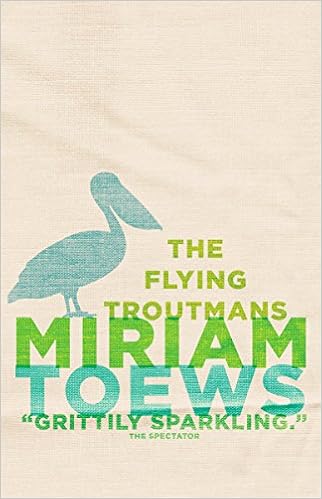
My life's been overwhelmingly eventful lately, so I haven't been carving out as much reading time as I'd like. The book I'm slowly working my way through is Miriam Toews's The Flying Troutmans.

It's a road trip book.

I don't drive, I don't spend much time in cars, and so I find road trips particularly exciting.

I wish I could write like Miriam Toews. I say that every time I read one of her books, but I absolutely love the sardonic tone she uses to approach themes of depression and suicide. I find her books very funny. Depression, suicide... hilarious stuff.

You really have to read her books to understand what I mean.

And you could read any of her books to get it. I haven't read everything she's written, but I get the sense the same types of characters show up in all of them: family members of people who are suicidal or people who have committed suicide.

I remember one time listening to someone rant about how nobody should ever write books about relatives of people with disabilities or mental illness--that writers should only centre the character with the disability.

True, those stories can go wrong in a lot of ways.

But, from my perspective, Miriam Toews's books are a prime example of thoughtful, empathetic, and realistic portrayals of the inner lives of family members. I realize that my depression impacts the people around me, so I'm interested in reading these stories of caring and sometimes exasperated relatives.

I'm very close to the end of The Flying Troutmans, so I don't know what's going to happen. I'm curious to find out whether it's possible to run away from the sad--for these characters, that is. In fiction.

In real life, I know that's not possible.

https://www.patreon.com/audioerotica

Sunday, December 9, 2018

Up to My Ears

by Jean Roberta

Please excuse my silence here for the past two days.

I’ve been hard at work marking late essays before my first exam on Monday morning (December 10). I haven’t had time to read anything else.

Here is a randomly-chosen passage by one of my international students (i.e. English is not their first language) on a short story by Margaret Atwood, “My Last Duchess.” (The story refers to “My Last Duchess” by Robert Browning, a monologue put in the mouth of the Duke of Ferrara, rumoured to have had his teenage bride murdered in the 1500s.)

The point of view in “My Last Duchess” is very important. The reader sees the point of view through the author’s eyes. The reader gets to see inside her head and understand how she feels. The reader, however, does not get to see inside Bill’s head so the reader does not understand why he is trying to defend the Duchess. The author, however, has a reason why she doesn’t defend the Duchess and why the Duke should be defended. The reader also sees why the author sees her teacher as important to her and how her teacher is her role model.

Students were supposed to explain how the viewpoint from which a particular story is told (first-person, third-person limited, third-person omniscient, third-person objective, etc.) affects all the other elements: plot, tone, characterization. I’ve used this as an essay topic for a few semesters because it tends to prevent plagiarism. For some reason, the standard on-line student-help sites (Schmoop, Sparknotes, enotes, Grade Saver) don’t feature sections on viewpoint which could easily be copied-and-pasted into an essay. So first-year university students who rush to their favourite site as soon as they get the topic for their next essay are left to flounder on their own.

There is a lot of plot summary in the essays I’ve read so far.

In addition to the essay on a particular short story, students had to write about a novel.

Every semester, I must assign a book-length work (novel, collection of short stories, volume of poetry, play in several acts) that students must read on their own without much guidance, and then write about in an essay. This assignment was set in place by the English Department as a whole, even though I think it’s too much for first-year students in addition to everything they are guided through in class.

Last year, I bought twelve copies of the very recent novel Fifteen Dogs by Andre Alexis, put them on reserve in the university library (they could only be taken out overnight), and assigned an essay on it. I found the animal-fable format of the novel intriguing, and it is set in a particular part of Canada: the city of Toronto, with a map. The following semester, I found passages from on-line book reviews leaking into my students’ essays.

This semester, I decided to change the book. In line with the university policy of “indigenization,” I bought ten copies of a dystopian YA novel, The Marrow-Thieves by Cherie Dimaline, and placed them in the library. Serendipitously, I learned later that the Metis author will be coming here to Regina, Saskatchewan, to give the keynote address in a conference on dystopian fiction in February 2019.

The novel is movingly and poetically written, and it combines a coming-of-age story with the endless journey of a makeshift “family” of survivors, including a wise old “nokomis” (here she would be called a “kokum”), a grandmother with useful knowledge to pass down, and a kind of family leader who turns out to be a man who was married to another man, the love of his life, whom he lost and quietly mourns.

There is much to like about this novel. The central plot premise, however, works much better as a metaphor than as a biological possibility. Indigenous people are being ruthlessly hunted by a Canadian government agency for their precious bone-marrow, which contains their dreams, and all other people are losing their sanity because they can no longer dream. The extraction of the marrow kills the subjects, and it is saved as a kind of fluid in test tubes that are then transported away from the “schools” where the captive human subjects are destroyed.

In a one-class discussion, several students asked how this marrow transfusion is supposed to work, exactly. All I could say is that the novel is not intended to be sci-fi, and the author clearly had other priorities when writing it than to work out the biological details.

The exploitation of indigenous people as a natural resource seems all too believable, and the “mainstream” (government) assumption that the bodies of those defined as sub-human should be available for use by the privileged has resonance in a time when sexual abuse is regularly in the news.

It bothers me, though, that a process that is clearly conceived of as symbolic is central in an otherwise realistic novel about survival in a damaged physical environment, relationships, group dynamics, and the preservation of endangered cultures, including languages. True enough, the makeshift family creates a tradition of storytime because stories (both individual and collective) are an important means of maintaining life and hope, but even the stories-within-the-story are meant to be truer, in some sense, than official denials and rationalizations.

I chose this novel because -- at the time I chose it -- there wasn’t much about it on-line for students to find, but The Marrow-Thieves has won several awards and is getting a lot of buzz. I can see that I’ll have to change the book again in the near future.

Meanwhile, I have to read essay after essay which summarizes the plot instead of defending an argument about the concepts in it.

Then I’ll have to grade a pile of exams a.s.a.p. I’m sure there will be times when I’ll feel as if my marrow is being drained.
-----------------------------

Thursday, July 19, 2018

Into the Woods with a Good Book #amreading

by Giselle Renarde


I have a little ritual I repeat from year to year.

Every year when we arrive at the cottage, the first thing I do is peruse the bookshelves.

The cottage is not our cottage, and so the books are not ours. The owners of the cottage are avid readers (of literary fiction in particular), and their new books quickly carve a path to the cottage bookshelves.

But, among the newer books are a host of older ones, the jazz standards of the cottage bookshelves. They're always there and I never tire of seeing them. Plenty of Canadian fiction: Robertson Davies, Stephen Leacock, Margaret Laurence.

A few years ago I read A Bird in the House. This year it was A Jest of God.

There's a reason I don't bring my own books to the cottage: I'm generally a slow reader, and choosing a book from the owners' shelves challenges me to read the entire thing in the span of a week.

You can't take it with you--the book, that is. This isn't a lending library.

So I spend the week reading.

At home, I start every day with a book. Now that I've kicked coffee, I brew a cup of tea and I sit and read for a while. But at the cottage that while stretches out, fills much of the day. Reading, eating, board games, DVDs at night. That's a family vacation at the cottage, and it's really something special.

https://www.smashwords.com/books/view/879056?ref=GiselleRenardeErotica
If you'd like the inside scoop on this year's cottage vacation, I invite you to read my second book of correspondences, Hi Babe. It's just a little book of letters, the ones I wrote to my girlfriend while I was away.

This year's vacation was more eventful than relaxing--not at all what I'm looking for at the cottage. As much as I complain about the city, our family getaway proved that life follows you wherever you go. It even follows you into the woods.

Thank you, technology.

If you're at all interested, grab a copy this month from Smashwords, where you can get it for free during July's big ebook sale: https://www.smashwords.com/books/view/879056?ref=GiselleRenardeErotica

Enjoy!

Thursday, December 21, 2017

We All Love the Beautiful Stories #CanLit #Storytelling #AmReading

A Post by Giselle Renarde


https://www.amazon.com/We-All-Love-Beautiful-Girls-ebook/dp/B01N2QRXQQ?tag=dondes-20
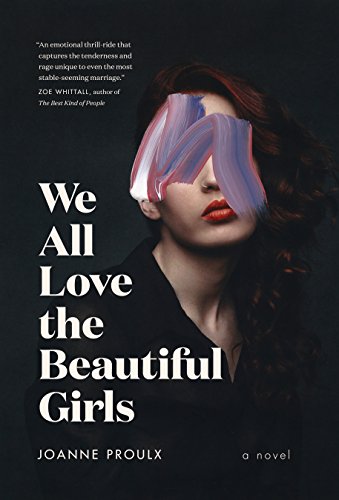
I just finished reading a novel called We All Love the Beautiful Girls. It's Canadian literary fiction by Joanne Proulx. I don't think I've ever read a book the year it came out (I'm very behind the times that way), but I found it in a Little Free Library near my house. The title and the cover appealed to me. I'll admit, I thought there would be lesbians. Spoiler Alert: there weren't.

But instead of talking about the book, I'm going to talk about my family. What else is new?

Okay, I lied.  I'm going to talk about this book a bit.  I'm going to tell you about something that happens in the book. Something fantastically Canadian, come to think of it. Something that touches on the story of my family.

A boy passes out in the snow.  He gets frostbite and loses a hand.

Now, here's why this story hits home for me...

My grandma loved her dad. When her parents divorced, she chose to live with him. When my grandmother married, he came to live with her.  I think he slept in her kitchen. I know my uncle slept in a drawer. But this was the late 40s, so I guess people were just sleeping all over the place.

I never met my great-grandfather, but evidence suggests he was a kind and caring person. He came here from rural Scotland, where he'd been a farmer. During the First World War he worked with horses, and when he came to Canada he continued in that vein, working in stables where milkmen kept their teams.

He wasn't much of a drinker, as far as I know, but one New Year's Eve he went down to the pub.  I guess he drank much more than his body was used to, because on his way back he passed out in a snow bank.  He wasn't far from home.  My grandmother tells me the snow bank was right in front of the house.  She's the one who found him there the next morning.

I'm telling you the story of how my great-grandfather died.

But I'm making choices about how I tell it.  I could stop right there.  Everything I've told you is true.  However, the implication is that, when my grandma found her father in the snow on New Year's Day, he was already dead.  That's not the case.  It's the best version of the story of my great-grandfather's death, but it's incomplete.

Because, when my grandmother found her father in the snow, he was still breathing.  They rushed him to hospital, where he died of pneumonia three weeks later. He never got out of that hospital bed.

When we're creating fiction, we're obviously making choices about how we tell a story. But when we're telling the stories of our lives, we're making choices too.

Good storytellers choose the best possible version of that story.

This is a lesson I learned from my aunt, who, I now realize, is the person who taught me how to be a storyteller.  When I was a child, I found her stories spellbinding. Now, as an adult, I still do.

In fact, just this weekend she told us a very evocative tale that drew on every sense. Her siblings all agreed that, the way she'd told it? Yeah, that's not the way it happened. Nowhere near.  There was a consensus that her facts were way off.

But does that matter? To me? I guess it doesn't. It doesn't make a difference whether my uncle came in through the front door or the back.  That doesn't impact the heart of her story, and my aunt's choices add nuance and build strong images.

Would it do an injustice to my great-grandfather if I led you to believe he died in that snowdrift, in the wee small hours of New Year's Day? When, in reality, he died in a hospital bed three weeks later?

That, I can't answer.  It's his death, not mine.

Giselle Renarde is an award-winning queer Canadian writer. Nominated Toronto’s Best Author in NOW Magazine’s 2015 Readers’ Choice Awards, her fiction has appeared in nearly 200 short story anthologies. Giselle's juicy novels include Anonymous, In Shadow, Seven Kisses, and The Other Side of Ruth.

Thursday, October 12, 2017

The Well It Draineth Every Day

by Giselle Renarde


When I was in my final year of high school, one of my assignments for English class was to read a novel from the Canadian literary canon and give a one-on-one oral report about it.  I'm not sure why, but instead of presenting that report to my teacher, we students presented to the school librarian. I'd never met the woman before. To say we had little rapport would be a drastic understatement.

I was an overachiever and I got excellent grades. Most teachers liked me.  This woman clearly did not.  That, or she just wore that sour expression constantly and treated everyone like dirt. I don't know.  I don't know her life.

The book I read was The Diviners by Margaret Laurence. Do I remember anything about it? Nope! Not a thing. But I do remember my oral report.  I talked about drawing from the well of creativity. What do Diviners seek but water? They figure out where exactly to tap the earth so we'll hit pay dirt rather than come up dry.

Speaking of dry, that was the look the librarian gave me throughout my entire report. Her face basically said: "You have GOT to be kidding me with this New Age crap!" And the grade she gave me certainly reflected her lack of enthusiasm for my thoughts on Margaret Laurence's novel.

And, hey, maybe I did get it completely wrong. Hard to say. I tend to believe that most opinions about literary fiction are valid, and that our interpretations of literature actually say far more about us as readers than about the book itself.

I've been thinking about the artistic well a lot lately.  I've always believed that, if you're doing creative work, if you're constantly drawing from The Well, you've got to keep filling it non-stop.  That's why I start every morning by reading.

But books aren't the only way to fill The Well. They shouldn't be, if you ask me.  The Well can be filled with personal experiences, TV shows, music, movies, conversations with Grandma, Netflix, eavesdropping on people while riding the subway... the list goes on. I don't place literature in an elite category.  It's in there with all the other stuff.

These days... I'll be honest with you... there isn't enough media on the planet (or even on the internet) to fill that well.  I'm running on empty. All the time.  I haven't written a book since July.  And I'm a full-time author! That's BAD. That's really bad.  I'm only happy when I'm filling my face with media.  Washing dishes and listening to podcasts is pretty much my idea of heaven.

I've been feeling really isolated lately. Depression stuff.  You know how it is. But podcasts have helped me so much.  Having other people's voices in my ears is so intimate, and I feel like I have friends, but they're friends who put no pressure on me.  I don't have to do anything.  I can listen at my leisure.

If I feel this way, other people must as well.  I really wanted to reach out to all the isolated people like me, but in a way where I'm not intruding too much.  That's a big part of the reason I decided to launch my Audio Erotica Patreon.  I've written hundreds of stories over the past 10+ years, and I really love narration. I'm a trained actor and a bit of a ham, plus narration lets me get out of my own head and inhabit my character's skin for a while.

https://www.patreon.com/audioerotica

One of the big reasons I held off launching my Patreon for so long (nearly a year) was that I figured nobody would want to be my patron and then I'd just feel MORE depressed and rejected. But then I thought, "Hey, you! Stop all that negative self-talk! You're offering a quality product. There's no reason to believe your supporters won't jump at the chance to be your patron!"

Well, Depression was right. I launched my Patreon on October 1st and I still don't have a single patron. At launch, I even made my weekly audio erotica broadcasts available for only $1/month.  When nobody supported me I thought, "Hey, maybe I'm undervaluing my work" (my girlfriend always tells me that's one of my bad habits--undervaluing my work and myself), so I cranked it up to $1/week.

The reason I became less keen on writing new fiction was that, honestly, my books are not selling well enough to make it feel worthwhile. The last ebook I put out... I don't think it's sold a single copy.  I was really excited about creating audio erotica. I still want to be excited about recording it. But I really need for there to be someone on the other end.

Want to know something funny? My girlfriend is always really supportive and encouraging of my ideas, but when I told her about my Patreon plan she said, "Sure, test it out. And then if it doesn't work you'll know the demand isn't there, but it's always better to try."  She knew I was going to fall flat. I guess I did too.

But I also chastise other authors for giving up too easily, so maybe I should practice what I preach and be more patient.

As for The Well... will it ever be filled? I consume media for days on end and I never feel inspired to create. Is there a dowsing rod for creativity?  Is it money?  I've heard studies concluding that earning money from your art stifles creativity rather than encouraging it.  I don't know.  I think a little money could sure light a fire under my creative ass.

https://www.patreon.com/audioerotica

Friday, January 27, 2017

Women and Magic, Part 1

by Jean Roberta

Hellebore and Rue: Tales of Queer Women and Magic, edited by Catherine Lundoff and JoSelle Vanderhooft (Lethe 2011) is an anthology of a dozen stories. A review copy was sent to me years ago, but I didn’t find time to read it until lately. The two herbs named in the title are either healing or poisonous, depending on how they are used: in poultices, remedies, or spells.


Two of the stories in this collection were reprinted in the 2012 edition of Heiresses of Russ (co-edited by Sacchi Green and publisher Steve Berman), an annual best-of collection of published lesbian spec-fic. Several years later, I was invited to co-edit Heiresses of Russ 2015. Several weeks ago, I received a gift copy (for review?) of Heiresses of Russ 2016.

So I’ve learned that in the 21st century, there is no shortage of fantasy and sci-fi stories in which the protagonists are women-loving women. The genres of the stories range from “high fantasy” or sword-and-sorcery to steampunk, slipstream, projections into the future of current technology (science-fiction), parody, and horror.

The lesbian relationships in these stories range from casual hookups among adventurous young women to long-term nesting to working/romantic partnerships between women with complementary skills. However, none of the sex in these stories is explicitly described.

To add to my pile of stories by/about women, I recently received the first five chapters of an upcoming novel, The Lost Art of Letter-Writing by Menna van Praag, to be released on February 16, 2017. This writer is a young woman in Cambridge, England, who writes fantasy romances set in her city. So far, they are: Men, Money and Chocolate (novella), Happier Than She’s Ever Been (sequel), The House at the End of Hope Street, The Dress Shop of Dreams, and The Witches of Cambridge. Over a year ago, I picked up a reduced-to-clear copy of The House at the End of Hope Street in a bin in my local Safeway store, and I was charmed. I signed up for the Menna van Praag (MVP) newsletter on-line. This is how I know that she and her husband now have two children, and that she struggles to find writing time.

To start with Hellebore and Rue, since this is the oldest book in the pile, I was impressed for several reasons: the stories are really varied, they are by authors I’m fairly familiar with, as well as ones I’d like to know better, and they include some Canadian content.

One of the authors, Rrain Prior, comes from the prairies (Manitoba, just east of where I live), and the protagonist of her story is a bounty hunter named “Key” who was hired to trap a rogue Salamander (elemental spirit) that starts wildfires. This story seems to foreshadow several actual fires that occurred later, particularly the one that largely destroyed Fort McMurray, Alberta, to the west of me, in spring 2016, and forced the evacuation of thousands of people, including a writer I know. (To this date, it is the costliest natural disaster in Canadian history.) Where is Key when she’s needed?

Another story in this collection, “Counterbalance” by Ruth Sorrell, is set in Toronto, although it was written by a writer from Birmingham, England. This story, like several others, deals with kitchen magic (e.g. an ability to make a cake from raw ingredients on a hot summer day without turning on the oven) which requires an exchange of energy in the world. A supernatural villainess tries to seize too much power, only to find that the kitchen witch has allies.

Space doesn’t allow me to describe all the stories in this book, but the theme of undercover witches runs through several of them. “Witches Have Cats” by Juliet Kemp is probably the funniest; in this story, a woman with latent psychic power but no knowledge of how to use it effectively has a cute but clueless puppy rather than a cat as familiar. The process of learning how to wield one’s power is shown as parallel to the process of “coming out” as queer.

In “D is for Delicious” by Steve Berman, a school nurse facing retirement is introduced to the witchy tradition of feasting on children in order to prolong her life. Of course, she resists at first, but she has resisted so much of her appetite for pleasure that at last, she decides to give in to it, having been seduced by a tempting sister-witch.

The female police officer who returns to a small English town from the city in Rachel Green’s “A State of Panic” is probably the most complicated kitchen witch of the bunch. This story is a self-contained murder mystery, but it is better-understood as one of this author’s “Laverstone” tales (including a novel, An Ungodly Child), set in a town with an unusual number of supernatural beings due to a portal which was never properly closed. In this story, local landmarks include Moot Point and Hobbs’ Wood (as in “hobgoblin”).

The stories that are not set in the world as we know it feature women with professions that don’t exist here. In “The Windskimmer” by Connie Wilkins, the greenmistress who can control plant life has a history with the wind pilot who sails airships. Although their specialties seem to have nothing in common, it turns out that they were once sent on a joint mission that threatened the earth for the sake of victory in war. Their agreement to right an old wrong also reignites their love for each other. This story is one of the more satisfying of the other-worldly stories because the reader is not left wondering WTF?

If I have any complaint about anything in this collection, it is that some of the writers rely too much on the formula: Show, don’t tell. Characters suddenly appear with a clap of thunder, and exude attitudes of various kinds, without much explanation of where they came from or what they want. Fantasy writers of the past (who are still read, I might add) didn’t seem to dread world-building in the form of long introductions or info-dumps which could inform readers about the culture and history of the setting. In some cases, info was dumped into a Book of Lore which was left someplace where the protagonist (and reader) could find it. Some of the stories in Hellebore and Rue left me wishing I could find a book of spells, a long footnote, an appendix, or a concordance.

------------