Nuthin'. Well, not nuthin', but nuthin' that bears blogging about. A bit of this, and a bit of that. I'm much more of a grazer these days because I'm sinking myself into writing at a much more professional level of output, and I'm also killing it in cover art. I've made 120 covers this year alone (including all the Brazen Premade covers I've done).
So I thought I'd focus on one of the other reasons I'm not reading a lot. I've been watching and learning.
One of my cover art clients added me to a group on Facebook, so I could see first hand the comments that were being made on the cover mockup I'd made him. It's a group that's run by Mark Dawson's Self-Publishing Formula. Through that group, I noticed there was an actual course being run for cover art.
Now, I've been working as a professional in the book cover art scene since 2009. I've made well in excess of 1,000 covers. Possibly even getting closer to 2,000, though I have no time to go back and count them all. Some of the covers have ended up in Amazon's Top 100. Some have made it onto the USA Today and even New York Times bestseller lists.
But all that notwithstanding, I figured the only time we stop learning is when we die. (I assume we stop learning then). And the course is being run by a bloke who's made covers for George R.R. Martin and Stephen King, though trad publishers. So I figured it couldn't hurt to get a gander at the whole beast.
I've done some of the preliminary stages, and so far it's all only been theory. I've looked at the subject matter that's coming up and I see it's covering things I already know how to do. But...what if the way I'm doing it is taking twice as long as some other way? That's the kind of question that occurs to me daily.
After all, I'm almost entirely self-taught when it comes to design. I have an eye for balance, and I've worked with Photoshop and Illustrator since the very early 1990s, and that's all good grounding. But I've developed techniques of my own for tricky things such as cutting a human out of a background, and keeping all their flying hair intact. I've never been taught the fine parts of that, but through logic and reasoning have developed my own little refinements. I have no doubt many others have found similar ways to do it, or have even developed exactly the same technique.
So, as I move through the course, I hope to find either validation for the ways I do things...or improvements on those same things.
And maybe, just maybe, I can get even faster at churning out these babies!
Saturday, March 10, 2018


Thursday, March 8, 2018
Bright Spots: Books I Couldn't Put Down ( #amreading #romance )
by Annabeth Leong
I’ve been having a lot of misses in my reading lately, books I’ve really struggled to connect with. For some reason, I’ve been reluctant to put these books down recently, and so one book will take me weeks to get through.
In contrast, though, I’ll give you the shining exceptions to the rule, the books I raced through. These left me wanting more just like them.
Every Day
By David Levithan
 I found out about this book because it’s a movie, and I loved the premise I saw in the trailer. A wakes up in a different body every day, and consequently has both an unusual amount of insight into the human condition and more than a fair share of loneliness. The story starts the day A falls in love with a girl named Rhiannon, and chronicles an amazing attempt to pursue that love despite the fact that one of the lovers never knows who they’ll wake up as the next morning.
The book feels deeply queer--A identifies as genderless, and to love A, Rhiannon must confront questions about what it is that she loves about a person. It is a struggle for her to always love A for who A is, to deal with the various bodies that appear as her lover.
For the most part, the book is so wise about different bodies, though I did feel that the chapter in which A wakes up very fat carried less of A’s usual compassion and insight and more of the poison of societal disgust--even as it makes efforts to deal with that poison. It’s become very striking to me that it’s possible in our culture to have compassion for nearly every other human condition, and yet any time fat comes up, the moral judgment seems to come right along with it.
I raced through this book. It’s written beautifully, and also I needed to know what would happen. I’d highly recommend it.
A Hope Divided
By Alyssa Cole
 The second entry in Alyssa Cole’s Loyal League series is the story of the romance between a free black herbalist, Marlee, and a white Union spy, Ewan, during the Civil War. I loved the first book in the series, An Extraordinary Union, which was about a black female spy and a white male spy during the same period, and I ordered the second book the moment I finished the first.
So many things stand out. For one thing, Cole’s characters feel so unique. They have distinct quirks--Ewan turned to stoicism while growing up with child abuse, but his strange, clipped manners lead him to connect with Marlee intellectually in a way that she, used to having her scientific mind disrespected, really needs. These two feel so distinct from the characters in the first book, and I have to say that in many romance series, I feel that the characters are reskinned versions of each other from one book to the next.
Then there’s the setting. Cole’s research into the Civil War is deep and incisive. She looks well beyond the stereotypes about belles and brother against brother, bringing forward characters that are far too often neglected in these narratives. Reading A Hope Divided, I had a stunning realization that also embarrassed me a bit. Of course, not everyone in the South was for secession, and of course that would be for all sorts of different reasons (humanitarian, apathetic, patriotism, etc)--how had I never seen that before? The result is a much more satisfying view of the Civil War South, free of the gauzy nostalgia that so often poisons the time. Cole’s books grapple very seriously with racism, cruelty, and the cost of resistance, while also managing to uplift through a convincing portrayal of the power of love.
***
Really, I should quit struggling through the books that I’m getting stuck on and just go read everything these two authors have ever written...
I’ve been having a lot of misses in my reading lately, books I’ve really struggled to connect with. For some reason, I’ve been reluctant to put these books down recently, and so one book will take me weeks to get through.
In contrast, though, I’ll give you the shining exceptions to the rule, the books I raced through. These left me wanting more just like them.
Every Day
By David Levithan

The book feels deeply queer--A identifies as genderless, and to love A, Rhiannon must confront questions about what it is that she loves about a person. It is a struggle for her to always love A for who A is, to deal with the various bodies that appear as her lover.
For the most part, the book is so wise about different bodies, though I did feel that the chapter in which A wakes up very fat carried less of A’s usual compassion and insight and more of the poison of societal disgust--even as it makes efforts to deal with that poison. It’s become very striking to me that it’s possible in our culture to have compassion for nearly every other human condition, and yet any time fat comes up, the moral judgment seems to come right along with it.
I raced through this book. It’s written beautifully, and also I needed to know what would happen. I’d highly recommend it.
A Hope Divided
By Alyssa Cole

So many things stand out. For one thing, Cole’s characters feel so unique. They have distinct quirks--Ewan turned to stoicism while growing up with child abuse, but his strange, clipped manners lead him to connect with Marlee intellectually in a way that she, used to having her scientific mind disrespected, really needs. These two feel so distinct from the characters in the first book, and I have to say that in many romance series, I feel that the characters are reskinned versions of each other from one book to the next.
Then there’s the setting. Cole’s research into the Civil War is deep and incisive. She looks well beyond the stereotypes about belles and brother against brother, bringing forward characters that are far too often neglected in these narratives. Reading A Hope Divided, I had a stunning realization that also embarrassed me a bit. Of course, not everyone in the South was for secession, and of course that would be for all sorts of different reasons (humanitarian, apathetic, patriotism, etc)--how had I never seen that before? The result is a much more satisfying view of the Civil War South, free of the gauzy nostalgia that so often poisons the time. Cole’s books grapple very seriously with racism, cruelty, and the cost of resistance, while also managing to uplift through a convincing portrayal of the power of love.
***
Really, I should quit struggling through the books that I’m getting stuck on and just go read everything these two authors have ever written...
Wednesday, March 7, 2018
Circle and Sparrow
by Daddy X
In November, the antiques collective where I hawk my stuff was taken over by new but familiar management. Since then, the business has
taken a substantial leap. My space has doubled and we host six new dealers with
their own interests and sense of artistic aesthetics, creating a much wider
appeal for the public. I’m now working twice
the hours with a corresponding loss of reading time. Hence, this short list:
The Inner Circle
by T. C. Boyle
When I last reviewed a Boyle book on these pages, Lisabet
mentioned that she had read “The Inner Circle”. A shout out for the
recommendation, Lisabet!
Currently, Boyle has to be my favorite writer. Seems I’m
reading him every third or fourth book, and for good reason. For one, none of
his stories are like any of his others. He varies delivery, subject matter and
voice, employing a seemingly limitless vocabulary to weave imaginative
characters into improbable scenarios while demonstrating an elevated sense of range
and attention to nuance.
The title refers to a group of students who find themselves
working with pioneer sex researcher Alfred (Prok) Kinsey. Though the novel may be
similar in one respect to Boyle’s The
Women (which follows the life of Frank Lloyd Wright) in that both track the
wives and acolytes of famous men, that’s where the similarity ends.
While The Women
deals with Wright’s various wives, The
Inner Circle is more concerned with direct sexuality and the complications
that arise when a new concept, at the time known as Free Love, runs amok.
Sex of every stripe is touched upon, but one could hardly
call it erotic. The story deals more with how and for what reasons human beings
behave the way they do vis-à-vis libidinous urges. We learn that when it comes
to desire, theory doesn’t begin to address the reality of these most complex
emotions.
The Sparrow by Jason Matthews
This was recently released as a movie, but I wanted to read
the book before seeing it. So I gleeped it from Momma X’s TBR stack, and am now
nearly 100 pages in, not really enough to do an objective review. But I will offer
a so-far take.
I must say that once I get this many pages into a book, I’ll
seldom put it down. (Hooray!). In fact, I’ll give most any book 50 pages, and
if not into it by then, I’ll pass it along to someone who might enjoy it. I
can’t tell you how many books there are where I’ve read just 50 pages. :>)
Initially, the main character, Dominica, reminds me of
Lilya, a character from my short story Spy
v Spy, available in The Gonzo Collection. Both women are resourceful,
determined, beautiful, young and by all appearances dedicated (though to an
extent we’re not quite sure of) to the Russian cause.
Her first assignment is to entice a mark into sex.
Considering she’s a gorgeous ballerina, who has suffered an injury that limits any
possibility of a future in dance, this proves quite easy. But when the man
inside her is garroted mid-stroke (a surprise to her) and she’s bathed in the
man’s blood from simple force of gravity, the realities of her new job make themselves
clear.
Tuesday, March 6, 2018
What I've been listening to...
It’s another round of “What I’ve been reading” and, like last time, I haven’t been reading much lately other than stuff I’m publishing.
So, I’m again going to take this in a different direction!
It’s taken me an embarrassingly long time to get into podcasts.
I’m sure some of you reading this don’t listen to podcasts and you’re thinking “That’s not embarrassing”. The difference with me, though, is that I’ve been a regular co-host / panelist of a podcast for a year and a half, but it’s only about six months ago that I listened to my first podcast. Since then, I’ve pretty much exploded into podcasts.
Under my real name, Craig, I’ve been a regular on the Write Right podcast since the start of the second season. (It was a 2018 goal of mine to “come out” about my writing, so it’s only now that I’m starting to link my real name to my author name.)
Under the name Cameron D. James, I now host two podcasts by myself:

Deep Desires Podcast — this is tied to my publishing company, Deep Desires Press, and we feature an author guest every month to chat about their book and their process of writing. We have a lot of fun and I feel like we keep the conversation interesting for both readers and writers who might be listening.

Sex For Money — this is a new podcast of mine that focusses on the business side of writing, publishing, and selling romantic and erotic fiction. There are a number of podcasts out there that talk about the business of writing, publishing, and selling, but things are almost always different for those in romantic and erotic genres. Because of what we write, special rules and limitations are often put on us. I’m only a few episodes in and I feel it’s gotten off to a bit of a rocky start — episode one (about changes at Facebook) I was unexpectedly nervous and rushed through it, and episode two (about Goodreads) I felt I wandered too much. For episode three, to be released this week, I interview an author to talk about motivation when it comes to writing and building a career. Next month I’m going to talk about strategies for making money in this genre.
But this post isn’t all self-promotion!
The theme of this fortnight is “What I’ve been reading” — so here is “What podcasts I’ve been listening to”:

Writing Excuses: This weekly show features a 15-minute discussion on writing by big name authors (or at least one big name author and some lesser-known authors). It took me a long time to even try this because the big name author is Brandon Sanderson, so I expected it to be focussed on epic fantasy and strongly favour traditional publishing. It’s not that at all. They totally respect all genres and have a romance author as a co-host and they have a healthy respect for self-publishing. I highly recommend this one.

Sell More Books Show: This weekly podcast explores the news in publishing and self-publishing. There are a few podcasts that explore news in the industry, but I find these co-hosts — Jim and Bryan — to be better than most other “news” hosts. They really break down the business of self-publishing and look at it objectively. (Whereas I find a lot of other book news shows carry heavy biases — you either agree with them or not. With Jim and Bryan, they try to look at it from all angles, so even if you don’t agree with their conclusion, your point of view was likely given discussion time.) It’s from listening to this one that I decided to start the Sex For Money podcast — while Jim and Brian give excellent analyses and advice, sometimes what they say doesn’t apply to erotic authors.

Smart Author with Mark Coker: Hosted by the founder of Smashwords, this is a very indie-focussed podcast that starts at the basics — how do you self-publish? — and then moves onto marketing. I find the information a little bit basic, but definitely worth listening to.

The Secret Life of Canada: I felt this one started off a bit rocky (it’s pretty new), but has very quickly grown in their professionalism and their approach. This podcast explores the history of Canada — but topics that don’t generally make it into school classes — and covers tough topics. There was one episode, though, that was erotica-focussed, exploring the history and context of Governor General Literary Award winning erotic novel Bear by Marian Engel — a book about a woman who enters a sexual relationship with a bear. (Like, the animal, not a fat hairy gay man.)

Canadaland Commons: This is a political magazine show, for lack of a better term. They explore issues in depth about politics in Canada. I find it can be a bit hit or miss, but when they do a good episode, they really do a fantastic job. One of their recent episodes covers what it means to be a person of colour in Canada — and exposed some really shocking things about Canada, like the fact that our last segregated school closed in the 80s.

Lore: This is a beautifully produced podcast that explores history and folklore — and how they intersect and overlap. The stories are captivating and the production quality (which includes haunting piano music) is entrancing. This is perhaps my favourite podcast.
I also listen to a few others, but these are the big ones that I look forward to the most when they pop up in my podcast app.
Hopefully I’ll actually be reading books again when this topic returns!
Cameron D. James is a writer of gay erotica and M/M erotic romance; his latest release is Autumn Fire. He is publisher at and co-founder of Deep Desires Press, member of the Indie Erotica Collective, and hosts two podcasts, Deep Desires Podcast and Sex For Money. He lives in Canada, is always crushing on Starbucks baristas, and has two rescue cats. To learn more about Cameron, visit http://www.camerondjames.com.
So, I’m again going to take this in a different direction!
It’s taken me an embarrassingly long time to get into podcasts.
I’m sure some of you reading this don’t listen to podcasts and you’re thinking “That’s not embarrassing”. The difference with me, though, is that I’ve been a regular co-host / panelist of a podcast for a year and a half, but it’s only about six months ago that I listened to my first podcast. Since then, I’ve pretty much exploded into podcasts.

Under my real name, Craig, I’ve been a regular on the Write Right podcast since the start of the second season. (It was a 2018 goal of mine to “come out” about my writing, so it’s only now that I’m starting to link my real name to my author name.)
Under the name Cameron D. James, I now host two podcasts by myself:
Deep Desires Podcast — this is tied to my publishing company, Deep Desires Press, and we feature an author guest every month to chat about their book and their process of writing. We have a lot of fun and I feel like we keep the conversation interesting for both readers and writers who might be listening.
Sex For Money — this is a new podcast of mine that focusses on the business side of writing, publishing, and selling romantic and erotic fiction. There are a number of podcasts out there that talk about the business of writing, publishing, and selling, but things are almost always different for those in romantic and erotic genres. Because of what we write, special rules and limitations are often put on us. I’m only a few episodes in and I feel it’s gotten off to a bit of a rocky start — episode one (about changes at Facebook) I was unexpectedly nervous and rushed through it, and episode two (about Goodreads) I felt I wandered too much. For episode three, to be released this week, I interview an author to talk about motivation when it comes to writing and building a career. Next month I’m going to talk about strategies for making money in this genre.
But this post isn’t all self-promotion!
The theme of this fortnight is “What I’ve been reading” — so here is “What podcasts I’ve been listening to”:

Writing Excuses: This weekly show features a 15-minute discussion on writing by big name authors (or at least one big name author and some lesser-known authors). It took me a long time to even try this because the big name author is Brandon Sanderson, so I expected it to be focussed on epic fantasy and strongly favour traditional publishing. It’s not that at all. They totally respect all genres and have a romance author as a co-host and they have a healthy respect for self-publishing. I highly recommend this one.
Sell More Books Show: This weekly podcast explores the news in publishing and self-publishing. There are a few podcasts that explore news in the industry, but I find these co-hosts — Jim and Bryan — to be better than most other “news” hosts. They really break down the business of self-publishing and look at it objectively. (Whereas I find a lot of other book news shows carry heavy biases — you either agree with them or not. With Jim and Bryan, they try to look at it from all angles, so even if you don’t agree with their conclusion, your point of view was likely given discussion time.) It’s from listening to this one that I decided to start the Sex For Money podcast — while Jim and Brian give excellent analyses and advice, sometimes what they say doesn’t apply to erotic authors.

Smart Author with Mark Coker: Hosted by the founder of Smashwords, this is a very indie-focussed podcast that starts at the basics — how do you self-publish? — and then moves onto marketing. I find the information a little bit basic, but definitely worth listening to.

The Secret Life of Canada: I felt this one started off a bit rocky (it’s pretty new), but has very quickly grown in their professionalism and their approach. This podcast explores the history of Canada — but topics that don’t generally make it into school classes — and covers tough topics. There was one episode, though, that was erotica-focussed, exploring the history and context of Governor General Literary Award winning erotic novel Bear by Marian Engel — a book about a woman who enters a sexual relationship with a bear. (Like, the animal, not a fat hairy gay man.)

Canadaland Commons: This is a political magazine show, for lack of a better term. They explore issues in depth about politics in Canada. I find it can be a bit hit or miss, but when they do a good episode, they really do a fantastic job. One of their recent episodes covers what it means to be a person of colour in Canada — and exposed some really shocking things about Canada, like the fact that our last segregated school closed in the 80s.
Lore: This is a beautifully produced podcast that explores history and folklore — and how they intersect and overlap. The stories are captivating and the production quality (which includes haunting piano music) is entrancing. This is perhaps my favourite podcast.
I also listen to a few others, but these are the big ones that I look forward to the most when they pop up in my podcast app.
Hopefully I’ll actually be reading books again when this topic returns!
Cameron D. James is a writer of gay erotica and M/M erotic romance; his latest release is Autumn Fire. He is publisher at and co-founder of Deep Desires Press, member of the Indie Erotica Collective, and hosts two podcasts, Deep Desires Podcast and Sex For Money. He lives in Canada, is always crushing on Starbucks baristas, and has two rescue cats. To learn more about Cameron, visit http://www.camerondjames.com.
Monday, March 5, 2018
Reading and Writhing
Sacchi Green
Reading? READING? Going through about a hundred lesbian erotica anthology submissions has a dulling effect on one’s interest in reading. Or, for that matter, on one’s interest in sex. Having to write almost that many rejection letters dulls my enthusiasm even more. I’ll get over it. At least I always have. And as always I’ve found enough gems that would be worth reading even apart from the sex. Now I just have to choose which ones will fit together in the 60,000 words that are all my publisher allows these days.
So what else am I reading? Well, when someone who has written short stories for me several times asks me for a blurb for their upcoming novel, I at least consider doing so, especially when they’ve participated in readings when I schedule them in New York. So I’m a bit more than hallway through an advance review PDF of a novel set in Boston in apparently Victorian times. It involves two women (who of course are becoming reluctantly attracted to each other) whose late scientist husbands had been working on some very dicey project together, a project that one of the women has been trying to complete and give her own twist. The other (so far) has no idea what it is, but desperately needs the money she’s been offered if only she can supply some missing link (or document) that will let some other dicey group complete the project for their own ends.
This may sounds garbled, but that’s my fault, not the author’s. Mad scientists aren’t exactly my thing, although having them be strong, brainy lesbian women is a step in the right direction. But I think I’ve figured out the mysterious direction involved in the story, and if I’m right the scientific woman is going to have to make some major choices down the line with regards to remaining a woman and a lesbian. I’m enjoying the book so far, although the short-story-editor on my shoulder keeps poking me and saying, “This part is too long! Less is more! Cut, cut, cut!” This is no real complaint about the book; that editor-on-my shoulder does this all the time, even—or especially—when reading things I’ve written myself. I often wish I could go back and tighten up passages in stories of mine that have already been published.
No, I’m not sharing the title or naming the author of this book, because I’m not yet ready to have a firm opinion. I catch myself finding that another book I’m supposed to be reading interests me more, so much so that I keep wanting to get back to it, which interferes with my judgment of the former book.
The second book, oddly enough, is my superhero novel that really is in the last editing phase before being presented to the publisher. All along I’ve been feeling like Sisyphus pushing that rock uphill, trying to write a novel when I’m really a short story writer, with an editor lashing at me with a red pen and alternating “Cut this, too much yammering!” with “This part should be longer! Elaborate on this!” I felt that it was all too long, and all too short, and too contrived (I’ve never been a superhero fan,) too far from the pulpy style the editor sometimes promoted, and at least equally far from what I’d consider polished writing. All of this is probably true, and the editor has probably been right most of the time. Anyway, whether it ever finds a readership, I find that I’m having a lot of fun reading it myself after having some time away from it.
Speaking of time, I’m supposed to turn in my final (for now) manuscript in one week, and I’m still supposed to add a goodly chunk to the very end (“Elaborate! Elaborate!”) so I’d better get working on that, and on the book I’m supposed to write a blurb for. And make up my mind about which stories to definitely use in my next anthology, Best Lesbian Erotica of the Year Volume 3 (which should be BLE 2019 to match the original series name, but what do I know.)
Not that it’s likely to matter, since no matter how fine the stories I’ve chosen in recent years have been, readership has been declining, and reader reviews have been almost non-existent. (Publishers’ Weekly and Library Journal reviews have been stellar, but those don’t seem to matter.) It’s a mystery why the anthology I published in 2016 as the BLE 20th Anniversary Edition is still selling moderately well, but the one in 2017, edited by my friend DL King (Volume 1,) is not, and neither is my 2018 Volume 2. I hope I won’t be the editor to finally kill the series, the one to turn out the lights, but for now I’ll get back to work and do what I can.
But which to read first? Maybe I’ll roll some dice.
Sunday, March 4, 2018
Synchronicity
by Jean Roberta
Please excuse me for this very, very late post, which was due on Friday, March 2. All I can say in my defense is that I actually had to send a book review of one of the books I’ve been reading to the editor of The Gay & Lesbian Review in time to get into the next issue.
Plus there was a big political convention followed by an after-party at the local gay club, for which my spouse Mirtha and I had to chop veggies, dill, black olives, jalapeno peppers, and make various munchies for the big, boisterous crowd that arrived in a state of exhilaration after a surprise win for the candidate of our choice, a medical doctor with a humanitarian agenda.
Before the political horde arrived in the midst of a late-winter storm, tracking snow all through the building, I had cleaned sinks, toilets, mirrors, swept and mopped floors, and taken out garbage.
After the after-party, Mirtha and I were whisked away by a friend to watch a play which began its run as part of Black History Month, which is now officially over. The play is based on real events in the Civil Rights movement in Durham, North Carolina, circa 1968-1971, and has only four characters. One of them was played by a very talented local amateur actress with whom I performed in a play about AIDS in the mid-1990s. I spoke to her afterwards, and she remembered me. It was a heartwarming conclusion to a moving performance.
Today it’s still storming outdoors, and spring is nowhere in sight. I’m sure the gay club looks as though a storm took place indoors. As soon as I finish posting this post, Mirtha and I have to pick up an old friend & fellow-veteran of the club scene so we can all go clean the place again.
Remember the setting of the play I watched on Saturday? When I get a chance to review books published by Duke University press (in Durham, North Carolina), I usually do. The ones I’ve seen are interesting and artsy, and have a lot of input by women, people “of colour,” and queer folks.
Several weeks ago, I agreed to review this book:
Sisters in the Life: A History of Out African American Lesbian Media-Making, edited by Yvonne Welbon and Alexandra Juhasz (Duke University Press, 2018).
In her introduction to the “Sisters in the Life Project,” editor Yvonne Welbon explains the significance of the “minority group” under discussion:
“Since the 1922 theatrical release of Tressie Souders’s A Woman’s Error, approximately one hundred feature films have been directed by African American women. Almost one-third of those films were directed by black lesbians. Statistically about 4 percent of the adult American population is likely to identify as lesbian, gay, bisexual, or transgender, but over 30 percent of the feature films have been directed by this minority population.”
Who knew? The editor goes on to say that Ava DuVernay’s current Hollywood film, A Wrinkle in Time, now has the biggest budget ($100 million) of any film directed by an African American woman.
This anthology is divided chronologically into two sections: Part I: 1986-1995, and Part II: 1996-2016. Essays in Part I include an analysis of panel discussions, visual art, and sculpture, as well as film, and all discuss the need for queer black female authenticity. In “Birth of a Notion,” Michelle Parkerson (filmmaker and academic) cleverly refers to the notorious 1915 silent film The Birth of a Nation, which featured white actors in blackface and showed sympathy for both the Confederacy and the Ku Klux Klan. Parkerson’s essay is subtitled “Toward Black, Gay, and Lesbian Imagery,” and it explores the challenge of overcoming the invisibility and stigmatizing of LGBT characters even within the African American community. She refers to a “new generation of gay and lesbian filmmakers of color.”
The last article in the book, “Creating the World Anew: Black Lesbian Legacies and Queer Film Futures” by Alexis Pauline Gumbs, discusses two projects: the Queer Women of Color Media Arts Project in San Francisco and the Queer Renaissance and Black Feminist Film School Project in Durham, North Carolina. Both projects are described as efforts to provide training in film production as part of a “futuristic movement.” In an effort to be “transparent,” Gumbs explains: “Yvonne Welbon, the editor and initiator of this book, and other contributors have participated in the activities of both or one of these projects, and this is as it should be. The future of Black lesbian filmmaking is not something about which we can be objective; it is something we do.” Some might criticize the bold lack of objectivity, but as some of the contributors remind the reader, those who are engaged in creating cultural visibility can’t afford to make critical distance a priority in their work.
Black-and-white photos of actors, artists, scriptwriters, directors, and panelists break up the pages of prose. Even a casual viewer of film and television dramas with largely-female casts is likely to see a few familiar faces in these pages.
Despite the academic tone of most of the individual articles, the collection as a whole conveys the energy and camaraderie of artists in the midst of revolutionary change. The anthology format allows the reader to dip into the book at any point, and therefore it can be digested in phases (on the bus, as I had been doing).
The flavour of life in Durham, North Carolina, seems to have changed beyond recognition since the early seventies, but to judge a town by the output of the local academic press is probably a mistake. When I have more time, I’d like to savour some of the articles in Sisters in the Life, instead of skimming them between other chores.
My reading lately has been fairly episodic, because that’s all I have time for. I’ve also skimmed two books of essays by Roxanne Gay: Hunger and Bad Feminist, but have no time now to do them justice. I’ll probably sneak references to those essays into my posts on other topics.
--------------
Please excuse me for this very, very late post, which was due on Friday, March 2. All I can say in my defense is that I actually had to send a book review of one of the books I’ve been reading to the editor of The Gay & Lesbian Review in time to get into the next issue.
Plus there was a big political convention followed by an after-party at the local gay club, for which my spouse Mirtha and I had to chop veggies, dill, black olives, jalapeno peppers, and make various munchies for the big, boisterous crowd that arrived in a state of exhilaration after a surprise win for the candidate of our choice, a medical doctor with a humanitarian agenda.
Before the political horde arrived in the midst of a late-winter storm, tracking snow all through the building, I had cleaned sinks, toilets, mirrors, swept and mopped floors, and taken out garbage.
After the after-party, Mirtha and I were whisked away by a friend to watch a play which began its run as part of Black History Month, which is now officially over. The play is based on real events in the Civil Rights movement in Durham, North Carolina, circa 1968-1971, and has only four characters. One of them was played by a very talented local amateur actress with whom I performed in a play about AIDS in the mid-1990s. I spoke to her afterwards, and she remembered me. It was a heartwarming conclusion to a moving performance.
Today it’s still storming outdoors, and spring is nowhere in sight. I’m sure the gay club looks as though a storm took place indoors. As soon as I finish posting this post, Mirtha and I have to pick up an old friend & fellow-veteran of the club scene so we can all go clean the place again.
Remember the setting of the play I watched on Saturday? When I get a chance to review books published by Duke University press (in Durham, North Carolina), I usually do. The ones I’ve seen are interesting and artsy, and have a lot of input by women, people “of colour,” and queer folks.
Several weeks ago, I agreed to review this book:
Sisters in the Life: A History of Out African American Lesbian Media-Making, edited by Yvonne Welbon and Alexandra Juhasz (Duke University Press, 2018).
In her introduction to the “Sisters in the Life Project,” editor Yvonne Welbon explains the significance of the “minority group” under discussion:
“Since the 1922 theatrical release of Tressie Souders’s A Woman’s Error, approximately one hundred feature films have been directed by African American women. Almost one-third of those films were directed by black lesbians. Statistically about 4 percent of the adult American population is likely to identify as lesbian, gay, bisexual, or transgender, but over 30 percent of the feature films have been directed by this minority population.”
Who knew? The editor goes on to say that Ava DuVernay’s current Hollywood film, A Wrinkle in Time, now has the biggest budget ($100 million) of any film directed by an African American woman.
This anthology is divided chronologically into two sections: Part I: 1986-1995, and Part II: 1996-2016. Essays in Part I include an analysis of panel discussions, visual art, and sculpture, as well as film, and all discuss the need for queer black female authenticity. In “Birth of a Notion,” Michelle Parkerson (filmmaker and academic) cleverly refers to the notorious 1915 silent film The Birth of a Nation, which featured white actors in blackface and showed sympathy for both the Confederacy and the Ku Klux Klan. Parkerson’s essay is subtitled “Toward Black, Gay, and Lesbian Imagery,” and it explores the challenge of overcoming the invisibility and stigmatizing of LGBT characters even within the African American community. She refers to a “new generation of gay and lesbian filmmakers of color.”
The last article in the book, “Creating the World Anew: Black Lesbian Legacies and Queer Film Futures” by Alexis Pauline Gumbs, discusses two projects: the Queer Women of Color Media Arts Project in San Francisco and the Queer Renaissance and Black Feminist Film School Project in Durham, North Carolina. Both projects are described as efforts to provide training in film production as part of a “futuristic movement.” In an effort to be “transparent,” Gumbs explains: “Yvonne Welbon, the editor and initiator of this book, and other contributors have participated in the activities of both or one of these projects, and this is as it should be. The future of Black lesbian filmmaking is not something about which we can be objective; it is something we do.” Some might criticize the bold lack of objectivity, but as some of the contributors remind the reader, those who are engaged in creating cultural visibility can’t afford to make critical distance a priority in their work.
Black-and-white photos of actors, artists, scriptwriters, directors, and panelists break up the pages of prose. Even a casual viewer of film and television dramas with largely-female casts is likely to see a few familiar faces in these pages.
Despite the academic tone of most of the individual articles, the collection as a whole conveys the energy and camaraderie of artists in the midst of revolutionary change. The anthology format allows the reader to dip into the book at any point, and therefore it can be digested in phases (on the bus, as I had been doing).
The flavour of life in Durham, North Carolina, seems to have changed beyond recognition since the early seventies, but to judge a town by the output of the local academic press is probably a mistake. When I have more time, I’d like to savour some of the articles in Sisters in the Life, instead of skimming them between other chores.
My reading lately has been fairly episodic, because that’s all I have time for. I’ve also skimmed two books of essays by Roxanne Gay: Hunger and Bad Feminist, but have no time now to do them justice. I’ll probably sneak references to those essays into my posts on other topics.
--------------
Thursday, March 1, 2018
UnMarketable #AmReading #Author #Marketing
by Giselle Renarde
I've got a bit of crush on this real estate agent in my neighbourhood. Every so often I get a newsletter from her. In the mail. An actual newsletter on paper. Glossy paper. With lots of pretty pictures.
I always read her newsletters, even though I probably couldn't afford even the cheapest property in the entire city. I doubt if I could afford a parking spot. Not that I need one--I don't have a car. But if I did suddenly have 3 million dollars at my disposal and I wanted to buy a house, I know exactly who I'd call.
And not just because she's pretty. She is pretty, no mistaking it, but that's not why I read her newsletters. I read them because they're about HER. Yes, she writes about the real estate market in Toronto, but she's also written some pieces that unveiled her vulnerabilities--something you don't expect from anyone in business, much less a woman working in a cut-throat industry.
The reason I'm telling you about this real estate agent and her very engaging newsletter during "What Am I Reading?" week is that her most recent newsletter included a list of books she'd read recently and found interesting and helpful, particularly from a business perspective.
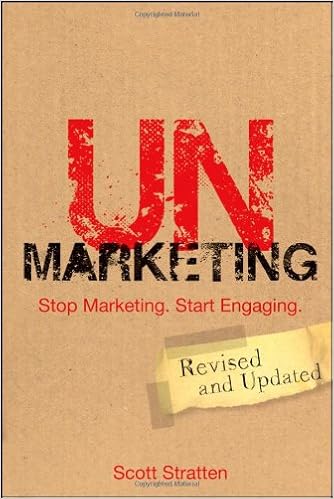
By some strange coincidence, I had found a copy of this book just a few weeks earlier in a Little Free Library. When I told my mom this story, she said, "I bet that's your real estate agent's copy!" The awful wishful thinking thing is that I'd already had that thought. Hey, anything's possible.
What did I learn from UnMarketing?
Well, I'll start by saying it's an amusing book written in a very approachable tone. I breezed through it, and I am not a fast reader. The title (or, rather, the subtitle) is a very accurate description of the overall message. It's a book about connecting with your audience rather than just spewing advertisements at them, with a primary focus on social media (mainly Twitter).
Thing is, any book you write about social media marketing is obsolete before it even hits the market. And the "Revised and Updated" version I read came out in 2012.
The same thing happens to me pretty much every time I read a marketing book: I read the advice, think "yeah, I know I SHOULD be doing all these things, but I'm not gonna," and I never implement anything I've learned.
My Twitter account has been around since 2008 and I've made good use of it, more for socializing than for marketing, but if a new book comes out I try to remember to mention it to my followers. I guess my problem is that the people with whom I socialize on Twitter are people I already know. They're the authors and editors I've known for years.
Any time anyone I don't know @'s me, I freak the fuck out. I am so intimidated by strangers it isn't even funny. If I see a tweet from someone I don't know, I basically close my eyes and chant "Make it go away!" a hundred times, then close my browser.
I'm scared of people. Even well-meaning people who tweet totally innocent stuff at me. I don't know who you are! I don't know what you want! Why are you talking to me?
All my life I've had a reputation for being a snob. My girlfriend says she found me standoffish when we first met. And I'm not surprised! It takes a ridiculous amount of time to earn my trust. What feels to me like scaredy-catness is interpreted by others as everything from aloofness to arrogance.
That's all well and good for your average human, but I'm an author. Perceived arrogance is bad for business. Should I force myself to be better for the good of the brand?
In my real estate agent crush's most recent newsletter, she talks about being inspired by Shonda Rhimes's book Year of Yes to push herself beyond her comfort zone. She says she'd always been really reluctant to do videos even though her business coach had encouraged her to just try it. She took an improv class to get comfortable talking on the fly, tried out videos, and soon she was being contacted by news channels for on-air interviews.
Aren't success stories heartwarming?
They sure are. I don't know what's wrong with me--a fundamental failing or character flaw--but I think I'd rather hear other people's success stories than work to create my own. That or I just have audacity to be satisfied with my little author life in my little author apartment.
Really, it ain't so bad.
Subscribe to:
Posts (Atom)