Showing posts with label Fear. Show all posts

Thursday, March 1, 2018

UnMarketable #AmReading #Author #Marketing

by Giselle Renarde


I've got a bit of crush on this real estate agent in my neighbourhood.  Every so often I get a newsletter from her. In the mail. An actual newsletter on paper. Glossy paper. With lots of pretty pictures.

I always read her newsletters, even though I probably couldn't afford even the cheapest property in the entire city. I doubt if I could afford a parking spot. Not that I need one--I don't have a car. But if I did suddenly have 3 million dollars at my disposal and I wanted to buy a house, I know exactly who I'd call.

And not just because she's pretty. She is pretty, no mistaking it, but that's not why I read her newsletters. I read them because they're about HER.  Yes, she writes about the real estate market in Toronto, but she's also written some pieces that unveiled her vulnerabilities--something you don't expect from anyone in business, much less a woman working in a cut-throat industry.

The reason I'm telling you about this real estate agent and her very engaging newsletter during "What Am I Reading?" week is that her most recent newsletter included a list of books she'd read recently and found interesting and helpful, particularly from a business perspective.

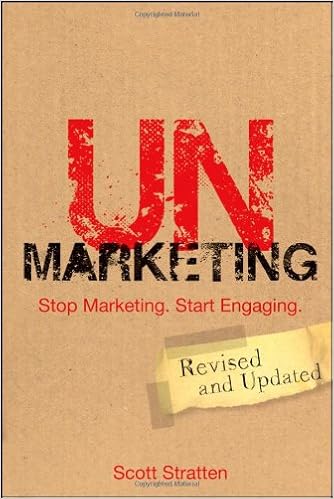
https://www.amazon.com/UnMarketing-Stop-Marketing-Start-Engaging/dp/1118176286?tag=dondes-20
One book on that list is called UnMarketing: Stop Marketing. Start Engaging by Scott Stratten.

By some strange coincidence, I had found a copy of this book just a few weeks earlier in a Little Free Library. When I told my mom this story, she said, "I bet that's your real estate agent's copy!"  The awful wishful thinking thing is that I'd already had that thought. Hey, anything's possible.

What did I learn from UnMarketing?

Well, I'll start by saying it's an amusing book written in a very approachable tone. I breezed through it, and I am not a fast reader.  The title (or, rather, the subtitle) is a very accurate description of the overall message.  It's a book about connecting with your audience rather than just spewing advertisements at them, with a primary focus on social media (mainly Twitter).

Thing is, any book you write about social media marketing is obsolete before it even hits the market.  And the "Revised and Updated" version I read came out in 2012.

The same thing happens to me pretty much every time I read a marketing book: I read the advice, think "yeah, I know I SHOULD be doing all these things, but I'm not gonna," and I never implement anything I've learned.

My Twitter account has been around since 2008 and I've made good use of it, more for socializing than for marketing, but if a new book comes out I try to remember to mention it to my followers. I guess my problem is that the people with whom I socialize on Twitter are people I already know. They're the authors and editors I've known for years.

Any time anyone I don't know @'s me, I freak the fuck out. I am so intimidated by strangers it isn't even funny. If I see a tweet from someone I don't know, I basically close my eyes and chant "Make it go away!" a hundred times, then close my browser.

I'm scared of people. Even well-meaning people who tweet totally innocent stuff at me. I don't know who you are! I don't know what you want! Why are you talking to me?

All my life I've had a reputation for being a snob. My girlfriend says she found me standoffish when we first met. And I'm not surprised! It takes a ridiculous amount of time to earn my trust. What feels to me like scaredy-catness is interpreted by others as everything from aloofness to arrogance.

That's all well and good for your average human, but I'm an author. Perceived arrogance is bad for business.  Should I force myself to be better for the good of the brand?

In my real estate agent crush's most recent newsletter, she talks about being inspired by Shonda Rhimes's book Year of Yes to push herself beyond her comfort zone. She says she'd always been really reluctant to do videos even though her business coach had encouraged her to just try it. She took an improv class to get comfortable talking on the fly, tried out videos, and soon she was being contacted by news channels for on-air interviews.

Aren't success stories heartwarming?

They sure are. I don't know what's wrong with me--a fundamental failing or character flaw--but I  think I'd rather hear other people's success stories than work to create my own. That or I just have audacity to be satisfied with my little author life in my little author apartment.

Really, it ain't so bad.

Thursday, January 4, 2018

How do you know what's right?

by Giselle Renarde


Christmas with my family wasn’t easy this year.

The week before Christmas, I was trying to get in touch with my mother. She’s got 3 phone numbers (work, home and cell) and she wasn’t answering any of them. When I couldn’t get my mom on the phone, I hovered between worried and irritated. It’s pretty common for my mom not to answer my calls because she’s “too busy” but that’s not what was happening this time.

When I finally got hold of her, she sounded awful. I could barely understand what she was saying. It sounded like her whole body was shaking.

She hadn’t answered my calls because she was too sick to get to the phone, too sick to even move. She’d been vomiting for five days.

I had no idea she was sick. Nobody did, except for my brother who’d been taking care of her. My mom has a very strong constitution. She never gets sick. But if you’d heard her voice on the phone, my god, you’d have been as worried as I was.

But here’s the thing about my mother: she doesn’t like doctors. I mean, I don’t either. I get that from her and she gets it from her father. But last year when I was having heart palpitations and chest pains and all sorts of messed up shit, I let my sister take me to the emergency room.

My mother clearly needed health care, immediately and urgently, but she insisted she was “fine” and she’d recover if we just let her lie on the couch long enough.

I called my sister, the one who lives right down the street from my mom, and asked her, “Did you know that mom’s really sick?” Nope. Of course she didn’t. My mom was hiding from us because she knew what we’d say and she didn’t want to hear it.

My sister brought my mother vitamin water and other supplies. At that point my mother couldn’t keep anything down, not even tea.

Christmas Eve, my siblings all assembled at my mother’s house. At that point, my mom had not eaten anything in a week. She was sick as fuck and we were legitimately concerned she was going to die.

My mother refused to participate in the healthcare system.

We called my aunt and uncle. They offered to come over and carry my mom into their car and drive her to the emergency room.

We gave my mom three options: my aunt and uncle could take her to the hospital, we could take her to the hospital, or we were going to call 911.

She freaked the fuck out. Well, as much as she could considering she was unable to even sit up.

Oh, did I mention that all this was happening concurrent with an E. coli outbreak in my region? Yeah, and my mother’s symptoms matched up pretty precisely. One of my sisters happens to be a scientist working on her PhD in disease epidemics, and she was the one who brought the E. coli outbreak to my attention. The fact that she was concerned, and that I know this is something people die from even when they’re in hospital, had me so worried I actually expressed emotions around my family. And I never do that.

I spent Christmas Eve screaming at my mother.

I said, “People care about you! People want to help! We’re not going to let you die just because you’re too stubborn to go to the hospital!”

That’s all it was. Stubbornness.

And fear.

I kept asking, “What are you so afraid of?” and that’s a question she wouldn’t answer. Because I’m pretty sure the answer in her mind was: if I go to the hospital, I’m going to die. That’s what people in hospitals do.

My mother adamantly and belligerently refused medical care. She wouldn’t allow us or my aunt and uncle to take her to the emergency room. Clearly, she needed IV fluids. We needed to know what was wrong with her. But she begged us not to call 911. Begged us. “Just let me stay here on the couch. Please, I don’t want to go to the hospital!”

Ultimately, I guess she won, because we didn’t call 911. We said we were going to… but we didn’t.

I told my mother she’s her father’s daughter, and she accepted that title gladly. My grandfather didn’t like doctors either. He had shrapnel embedded in his lungs from WWII, and toward the end he had tremendous trouble breathing, but he wouldn’t accept medical care or oxygen in-home. He’d signed documents, power of attorney type things, I don’t know, saying that he refused to be admitted to hospital if he was incapacitated. DNR type stuff. He was serious.

But when he had a stroke, my grandmother called 911. Exactly what he didn’t want, but he was incapacitated at the time. In order to admit him to hospital, she had to lie to medical professionals. She told them he had said to her that he changed his mind, that he wanted hospital care. That’s the exact opposite of what he wanted. My grandmother tells me she did it for herself. She wasn’t ready to lose him yet, and she didn’t want him to die in the house.

He died in hospital about a week later.

I don’t know what’s right in this situation. I don’t know what is the right thing to do.

When you’re dealing with a child, you can impose your will on them. You can take your child to the hospital when they’re sick. But when we’re talking about another adult? When it’s your parent? When they clearly require immediate medical attention and they refuse it? What is the right thing to do? Impose my will on my mother? Call 911 even when she’s told us not to?

Acting in someone else’s best interest is a complicated thing. Older doesn’t necessarily mean wiser, but I was also taught to respect my elders.

My mother hasn’t fully recovered from whatever mystery illness is in her body. She’s eating again. My brother is caring for her. But when my girlfriend saw the state of my mom yesterday, the first thing she said when we left was, “Your mother needs to be in a hospital.”

You try telling her that.

Thursday, February 25, 2016

Things I'm Not Good At That I Love

By Annabeth Leong

I've never been good at physical activities in general, but I really enjoy them. They're a big part of my life. This threw me off for a long time.

The narrative of tomboys that I was familiar with when I was growing up was about a girl who was "good enough" to "play with the boys." There wasn't a lot of space for a girl who wanted to spend recess running around, but didn't run particularly fast. I learned to throw a football so it spiraled, but throwing that football far? Or where I wanted it to go? Not so much.

So with our topic being "other skills," I questioned myself for a while. I wanted to write about rock climbing, but I'm not very good at it...

On the other hand, it's the activity besides writing that I'm most devoted to. I go to the climbing gym about three times a week. I'm belay certified. I organized and captained a team for the gym's first climbing league (and, while we did not place well overall, we did win the spirit award!). I've read books about climbing techniques and ways of protecting your body and training antagonist muscles to stave off elbow problems. I have taught several people the basics of climbing (and sometimes watched them surpass me over the following months).

So I think this counts as a skill. I know how to tie the knots. I know all sorts of things about what muscles a person engages while climbing, how to train them, and ways to avoid injury. I know how to read a route—I can often see the moves necessary even when I can't make them myself. I've climbed both inside and outside, and I've practiced bouldering in both settings, as well.

I am always looking for things that will give me relief from the constant flow of words and thoughts in my brain. That's the only real path to relaxation for me. There's nothing like hanging by your fingers from a couple of tiny rocks to get that done... And that's a big part of the motivation to learn this skill. I also enjoy the puzzle elements, the feeling of strength, and the chance to face and overcome fears.

Other than just telling you that this is another skill I've developed and like to spend time practicing, I can also tell you that it's been a source of realizations for me about my character, sometimes in ways that apply to my writing. I think that's common for "other skills."

In my case, I've noticed that I chronically underachieve. I have the strength and knowledge to climb much harder than I do, but I don't have the boldness. Rock climbing moves can be called "static" or "dynamic." For a static move, you get yourself into position and reach for the next hold. If you don't find it, you're still fine and anchored where you were before. For a dynamic move, you go for the next hold in a way that gives up the previous holds. If you miss a dynamic move, you're going to fall off the wall. This isn't really a big deal—because of safety gear, you're unlikely to get hurt—but it still feels scary.

Early on, one of my teachers commented on my incredible strength in the context of a bad habit. I have a way of going for dynamic moves without committing to them, catching and holding myself in awkward midair positions that take, he pointed out, way more muscle and skill than just going all in for the next hold. I've worked hard to break that habit, but it's still a real problem for me. I can't tell you how many times I've gotten to the almost-top of a bouldering route and just... not taken the last move. I've heard people groan in disappointment when I jumped off without even taking a shot.

And I can't help but feel that this says something about my approach to life. As a writer, it's hard for me to try for things that I don't think I'm going to get. I'm incredibly risk-averse.

I hope that, if I can overcome this habit as a rock climber, the boldness I learn will transfer beyond that to other parts of my life.

In the meantime, you can find me clinging to walls around New England, probably not climbing as hard as I should, but still showing up regularly to climb.

Thursday, March 26, 2015

Pride and Joy

by Annabeth Leong

I first encountered her at the tobacco shop and wine bar on the downtown strip. I was technically too young to be in there, but no one questioned me. I smoked Gauloises in an effort to seem sophisticated, but I've always contained too much innocence to hide things like the way she made me feel. She was olive-skinned and tall, strong-jawed and gorgeous. All that faded, though, when the song came.

I was a little girl when Stevie Ray Vaughan first sang that song, so I didn't learn it from him. I learned it from this woman, and the sound of its opening bars is inextricably associated with the thrilling shock of hearing her belt out these words about a female lover. I've heard plenty of women sing songs that way now, taking the words written by a man and not changing them to make them "right," but at the time the audacity seemed incredible. Hearing her declare herself "her little loverboy" opened my eyes to something I'd never been able to describe.

I was obsessed and foolish. The town was small, and I could hear and recognize her voice from a block away. I could walk up and down the downtown strip and listen for it. I could hang out after a show and hope she'd say that I could ride with her to the all-night diner. I could wish for a kiss that never came, wonder if the truth that seemed to live inside her singing voice also lived within her heart. Was this all a ploy, or was there something being confessed here?

***

"You could be friends with women, but you sleep with them, too." The therapist's voice was faintly accusing, and my mind could fill out the rest just fine on its own. I was a slut who slept with too many men, but I was worse than that because I slept with women, too. Not only that, the fact that I wanted to sleep with women was ruining my friendships, making me untrustworthy.

This wasn't only the therapist's idea. I'll never forget the school trip where the girls protested about having to share a room with me. I remember the girls who wouldn't come over to my house and the places I wasn't invited. And before that, I remember other untrustworthy women—the aunt who was only whispered about, her name never mentioned except in tones of disgust, because she'd left my uncle to be with women; the friend of my mother's who had destroyed their connection by declaring her love.

And later, my constant feeling of being a spy. "What's there to worry about?" someone would say as she whipped off her shirt. "It's just us girls."

All that is shame, not pride. All that is grief, not joy.

They were mixed up together for so long. I remember the first time I woke up with a girl, my heart pounding in fierce celebration of everything we'd discovered the night before. We drove around and did ordinary things, but the world was no longer ordinary. I was in her car! She was breathing next to me! But then she almost hit the car in front of us, and it felt like a divine warning that we'd better not get too cocky.

After she left, I wrote in my diary, "I had real sex last night," and then I ripped out the page, tore it to bits, and burned it because I was afraid of my mother discovering it in the trash. It makes me sad to think of that. I wish I had the record of that morning. I remember the painstaking care I took trying to describe my fear and excitement.

***

I feel unqualified to take this twist on this topic. Apart from the gay sex, I've lived most of my life as straight. That's the punchline to a joke somewhere, right?

I once made a girl fall in love with me by buying her a bottle of her favorite scent, which was hard to find before the internet. She was on vacation, and I went to store after store looking for it. When she got back, I wrote her a note to go with the bottle, in which I said, "I wanted to tell the cashier, 'I'm buying this for my GIRLFRIEND.'" She melted and told me that was exactly the right thing to say. But a week later, I had freaked out and locked myself away with a boy.

I could be bold, but I was too cowardly for pride. I was sure that all my desires were wrong—not just the ones for women, but all the things I thought about while I got myself off.

If there's anything that does qualify me to write this way, it's this: I understand why pride is necessary. I have torn myself and others up with shame. I have let people use the word "they" around me, both because I was afraid I didn't belong and because I was afraid I did.

***

"She's shaking." People love to point it out, I think because it's cute to them. But yeah, I'm shaking. I'm on my knees in front of a woman at a BDSM convention.

"I'm shaking because I want this so much," I tell her. I feel like her little loverboy.

What nobody knows is that when I sit back down after it's over, I keep shaking for the next hour. The person next to me tells me, "That was sweet," and all I can do is nod. I go home and lie in bed and shake. For days, I shake whenever I think about it. I'm shaking right now.

***

I'm still not sure what to call myself. The first time I wrote about this subject at The Grip, someone on Twitter described my writing as queer, and I jumped all over that as if, like Adam, they could name me. That felt like permission, and I desperately needed permission.

To me, having a name does matter. If something is a pride and joy, it's got a name. The things I'm afraid to name are things bound up with shame.

And there is something about wearing a thing in public, which I still struggle to do. It was truly dangerous where I used to live. The girls I slept with back then—when we went out together, we pretended to be friends. Then later, I just pretended to be friends.

There was a woman I loved who was my pride and joy. Whenever people realized we'd showed up somewhere together, I wanted to grin and brag. Being in her car, her house, having plans with her—my heart grew larger from every little thing. But I didn't want to touch her. Not like that. I would tell you if you asked. I would cry and swear to it. It was only after I lost all claim to her that I had to admit what I wished the claim had been.

It is only recently that I have been wearing this out in public, making it clear about myself in various ways, spoken and gestured. I volunteered to run an LGBTQ meetup for an event a participate in. I may not be able to say which of those letters is mine, but I'm damn sure one of them is. I feel sheepish about all this, embarrassed to admit how the once-ordinary world is changing around me, afraid that if I confess to the perfect peace in my heart it might come out the wrong way.

It's not that I don't care about specific people, because I do, but it's also not as simple as being struck down by love. I wanted to walk down the street without hiding and being afraid. Pride and joy, even if I'm shaking again.

Monday, December 8, 2014

One Down

By Lisabet Sarai


Our topic for the coming fortnight is “Realizing Goals (or not)”. The theme could hardly be more timely, for me. This past weekend, I realized a goal that had been on my list for a quite a while. Finally, I self-published a book.

It’s not much of a book, mind you – just a 5K holiday short story – but I’m still feeling pretty proud of myself. For years I have been trying to avoid the whole self-publishing issue. I told myself that I didn’t have the time to futz around with formatting and cover creation. That I should be spending my time writing new fiction as opposed to worrying about mechanics. That I needed a publisher to support me via marketing, promotions and cross-over from other authors. That nobody would read my indie books anyway because the whole world knows that self-published fiction is crap.

Excuses, plain and simple. The main reason I didn’t self-publish earlier is that I was scared it would be too much work.

I was wrong. Aside from the inevitable frustration of trying to beat Microsoft Word into submission, everything went smoothly. The Smashwords platform turned out to be amazingly intuitive, with lots of information and guidelines for newbies. Amazon KDP isn’t nearly as well-designed, but after getting things set up for Smashwords, the extra effort required to convert the book for upload to Amazon was almost trivial. The whole process, for both sites, took about half a day, including creation of my cover.

Of course there were extenuating circumstances. I’d already written and edited the story. I’m confident enough in my technical writing skills that I don’t worry too much about grammar and spelling issues. I’d previously found a cover image, too, a single photo that I knew would be easy to convert to a cover simply by adding the title and author text. (When it comes to graphic arts, I know my limitations!)

Other factors helped me realize this goal, too, especially my recent experience publishing through Excessica. The Excessica co-op is halfway between a traditional publisher and self-publishing. The author is responsible for her own editing, formatting and cover. On the other hand, Excessica handles the format vetting, uploading, distribution and financial arrangements.

I started working with Excessica when several of my erotic titles went out of print due to a split with the previous publisher. Both Bangkok Noir and Exposure don’t fit the mold of erotic romance. The first, in particular, is one of my darker, more extreme works. Excessica seemed like the perfect venue.

So I’ve done some book formatting in the past few months, and I’ve made a few simple covers. To go from there to full self-publishing wasn’t such a major step.

However, more important than these concrete experiences, I’ve undergone a change of attitude. I’ve been pretty annoyed over the past year as my erotic romance royalties have dwindled, to the point where they didn’t even cover my marketing expenses. Meanwhile, I often find romance conventions a Procrustean bed; I’m forced to slash, stretch and contort my initial ideas in order to make them acceptable to the romance audience (or the publisher’s perception thereof). The process of editing my most recent romance novel, The Ingredients of Bliss, was especially painful, as the editor required me to suppress my heroine’s (admittedly rampant) sexuality in order to make her more faithful and committed. I did more rewrites on that book than on anything else I’ve written in my entire career.

The book was released in September. I wrote dozens of blog posts. I had articles on national news sites. I did two blog tours. I gave away gift certificates and even a few free copies.

A few days ago, I received my royalty statement for October. Want to know how many copies of The Ingredients of Bliss I sold?

Zero. Zilch. Nada.

As I’ve joked on the ERWA Writer’s list, I’m thinking of changing my tag line. My new slogan? “Too raw for romance, too sweet for smut.”

In any case, I’m ready to try some new approaches, because I’m not getting the benefits I expect from working with a traditional publisher.

Does that mean I’m going to self-publish everything from now on? Probably not. The amount of work involved in self-editing and self-publishing a novel far exceeds what I spent on Slush: A holiday romance. To some extent, this story was a throw-away effort, an experiment. I’d originally planned to give it away free, in fact, a kind of gift to my readers. Then I figured, why not give self-pubbing a go?

I don’t expect to get rich from this. In fact, the royalty percentages in self-publishing are not much different from what I get from publishers. (The only way to get 70% from Amazon is to publish with them exclusively.) I plan to promo this story like crazy, though, then see if it affects my other sales.

Probably my current feeling of self-satisfaction is my greatest reward from this endeavor. I managed to overcome my internal resistance and do it.

The next goal up? Trying to write a series, something else I’ve deferred for a long time due to laziness and fear.

Wish me luck!

[I don’t want to turn this post into promo, but if you’re interested you can see the cover I created for Slush, and read an excerpt, on my blog.]

Friday, August 29, 2014

The Bargain


By Jean Roberta

"Or perhaps in Slytherin,
You'll make your real friends,
Those cunning folk use any means
To achieve their ends."
- The Sorting Hat (in Harry Potter and the Philosopher’s Stone)

“Jeanie, do you know what to do if a snake bites you?”

The grownups in my life asked me this question every time I wanted to leave my grandma’s house in Myrtle Creek, Oregon, when we visited there in the summer. The thought of rattlesnakes in the long grass rattled them. My relatives probably didn’t have a phobia, exactly, but they seemed obsessed.

I never actually saw a rattlesnake in the weedy patches of small-town Oregon. I suspect they stayed away from humans, accurately sensing that they wouldn’t get a warm welcome.

In the spirit of making friends with the monsters in your head or under the bed, I once imagined a conversation with a talking snake:

“Hello, snake.”

“Yesss?”

“Am I in your way?”

“Not now.”

“Are you planning to bite me?”

“Not unless you pissss me off.”

“Oh, good. Thank you. I’ll just leave you alone. Have a nice day.”

That was it. I stayed away from the places where I thought rattlesnakes might hide, and they left me alone. It seems we had a pact.

As far as I know, I’ve never had an irrational fear, called a phobia, but I’ve had several fears that seem entirely rational to me: fear of drowning when out on a lake in a tippy boat, fear of catching fire if too close to a flame or a hot burner on a stove, fear of suffocating when I had pneumonia at age eleven. Fear of being bitten by a spider in a dank basement or stung by a wasp in late summer, or by any other poisonous creature. Fear of an angry man who thinks the world is too full of women who are just asking to be raped and killed.

To calm my fear, I always use the negotiation techniques shown above. Strangely enough, most animals, insects, and even physical elements or processes seem more logical in these discussions than many humans.

“Fire, do you want to burn me?”

“I love to eat, and I love oxygen. Come near me when there’s a breeze, and see what happens.”

“Good warning. I’ll keep my distance, and keep something nearby to smother you.”

“Water, do you want to swallow me?

“Not you in particular, but I’m not fussy. If you can’t breathe in me, it’s not my problem.”

“Okay, I'll always bring an inflatable object.”

Deep breaths, caution, awareness, and some useful props – those always seem comforting.

In the long run, of course, nothing will protect me from dying. All living things are eventually defeated by something. So in some sense, the most debilitating phobia seems more rational than the baseless faith that keeps us going, day after day, as we tell ourselves the lie that the world is a safe place.

People with phobias, as distorted as those fears may be, are probably just more in touch with reality than the rest of us. For the meanwhile, I’ll keep telling myself that non-human forces are willing to negotiate.

Monday, May 12, 2014

Insatiable

By Lisabet Sarai

I dream of heavy-laden banquet tables. Crisp-skinned, savory roast chickens, their walnut-and-raisin-studded stuffing leaking out onto artfully garnished platters. Barbecued lamb skewers arrayed on beds of saffron-scented pilaf. Broiled salmon brushed with tamari and garlic. Brick-colored candied yams piled into gleaming, sticky pyramids. Sweet corn glistening with melted butter. As I wander from room to room in this endless, deserted mansion, I spy a dozen kinds of cheese, two dozen varieties of olives. Dainty pastel-iced pastries tempt me. Massive apple and pumpkin pies tickle my nose with cinnamon and nutmeg. A fountain dispenses an endless stream of vanilla soft ice cream.

The mingled aromas of my favorite foods assault me. Saliva gathers in my mouth. My stomach growls. I want to eat it all. Confronted by such bounty, I don't know where to start.

Then I remember. I can't. I mustn't. Hunger tugs me toward the lusciously-arrayed buffets, but I must resist. Already I feel the flesh ballooning on my thighs and belly, from the mere thought of such indulgence. I run through the corridors, pursued by the scent of spices, roasted meat, caramelized sugar. There's no exit. I'm trapped.

I wake into a full-blown anxiety attack, my heart racing, sweat drenching my skinny, naked body. Calm, I must be calm. It's only a dream. I capture my bony wrist, encircling it with the thumb and forefinger of my other hand to reassure myself. I'm still thin enough. I'm still in control of that terrible hunger. I won't give in to it, ever.

I promise myself that I'll skip the slice of cantaloupe I usually eat for breakfast. Just in case. The gluttonous desires of my dream may have polluted me. Black coffee with artificial sweetener will be enough for today.

This is the nightmare of anorexia.

From the outside, anorexia looks trivial, capricious, especially compared to other forms of psychological illness like bipolar disorder or schizophrenia. “Oh,” people think. “She thinks she's fat. She doesn't like her body. She wants to lose weight. Nothing wrong with that, she's just taken it a bit too far. If she'd only start eating a little more, she'd be fine.”

The fact that our culture equates thinness with beauty makes anorexia seem almost rational. I can assure you from personal experience, though, that an anorexic is as crazy as someone who thinks she's Queen Victoria or who raves about being possessed by aliens. Anorexics suffer from equally disturbing delusions. We see ourselves as eternally fat and feel constantly threatened by our own bodies. When I was anorexic, I was possessed too, by a voracious demon whose hunger could never be appeased.


What the heck? you may be thinking. Hungry? When you're choosing to starve yourself? So if you're so hungry, then eat.

If only it were that simple.

I've come to understand that anorexia is not really about food at all. It's about control, or more precisely the fear of losing control. It's no accident that most cases afflict women in their teens, struggling to deal with all the changes of puberty and the pressures of emerging sexuality. Girls who have a perfectionist attitude tend to be more susceptible – you know, the ones who despair when they receive a grade of 98 instead of 100 or who spend hours every day practicing so that they'll make the varsity gymnastics team or the cheerleading squad or the All-State orchestra. That was me, the grind, the egghead, top of the class in every subject. We want to be good – the very best. And then we realize our bodies, our hormones, our desires are totally haywire. What we really want – oh, but it's unspeakable.

We can't control our carnal needs – indeed, consciously we might not even be aware of them – but food is something concrete, something we can manipulate and ration. We can apply the same discipline we exert in our studies, our athletics or our cultural pursuits, to cut down on the things that will make us “fat”. By depriving ourselves, we can prove how strong and pure we are. As our bodies shed the pounds, they become bright beacons advertising our virtue and self-control.

When I looked like a concentration camp victim, I thought I was beautiful.

Of course food is symbolic of other things as well. Like many mothers, mine equated food with nurturing, comfort and caring. When I rejected the (quite delicious) meals she cooked for me, I was rejecting her love. At least was the way she saw things. Meanwhile, I saw her as the enemy, trying to undermine my resolve to get my appetite under control – trying to “make me fat”.

The superficially rational aspects of anorexia and the hostility that often develops between the sufferer and those who are closest to her make the disease very difficult to treat. If the disease is about control, what is the remedy?

I can't speak for others, but my recovery started when I learned to trust someone else enough to give up control. My therapist, whom I saw for more than four years, somehow convinced me that he could keep me safe, even if I started to eat again. He was the total opposite of the Freudian stereotype, a short, chubby, jolly Latin who had no qualms about giving me a hug. I guess I fell in love with him (Freud's transference, perhaps, or maybe something more genuine). He told me once that I could do anything I wanted, and he would never judge me. “If you decided to go to the moon,” he said, “I'd be here when you got back, applauding.”

It took nearly a decade for me to learn how to trust myself with food and eat “normally”. It was during that recovery period that I was first exposed to dominance and submission. I realized recently that surrendering to my master had much in common with trusting my therapist. Like Dr. R, my master didn't judge me. He embraced and celebrated my deviant desires. When I gave him control, the fear went away, to be replaced with a special peace.

To explore this connection, I recently wrote a short story about BDSM and anorexia. “Sundae, Bloody Sundae” was published in the Goldie-nominated charity collection Coming Together: Girl on Girl. Here's a snippet that captures the horror of being an anorexic who's forced to eat, even by her lover.

****

Ponticelli's was at least as good as I'd remembered. I ordered baked stuffed lobster for both of us, with a Caesar salad and a delightful bottle of fumé blanc. Jana was even livelier than usual, talking with her hands in the way she does when she's really excited. I ache to capture her birdlike wrists in my bonds and force her to stillness.

I must have been a bit drunk. Certainly I was hungry. In no time, I'd transformed my lobster into a pile of polished shell. Leaning back in my chair, satisfied and content, I noticed that Jana was not nearly so far along.

Girl, you're not doing justice to this fine crustacean,” I laughed. “Come here.” I grabbed one of the claws from her plate, extracted a succulent chunk of meat and dunked it in melted butter. I held the dripping morsel to her lips. “Open wide,” I ordered.

If I'd consumed a bit less wine, I'd probably have been able to label her expression. Recalling that instant now, I realize that what I saw on her face was pure terror. At the time, I thought that she was simply being stubborn, refusing to part her rosebud lips.

Jana? Come on now, eat it.”

She shook her head. “Please, I'm not hungry, Mel.”

It's delicious. Have a bite.”

No, really...”

Do I need to pull you onto my lap, flip up your skirt and wallop your skinny ass right here in front of everyone?” A spark of lust mingled with the dread in her eyes, hardening my resolve. “Do as you're told.”

I smeared some of the butter over her lips. She shrank back in her chair, away from the laden fork. “Jana,” I warned, struggling to keep my temper in check. “You're disappointing me. I want you to eat the lobster.”

She knew me well enough by then to recognize that I was not going to back down. Like a slow motion film, she opened her mouth and allowed me to place the butter-drenched meat on her tongue. I watched her chew and swallow, then presented her with another piece.

No...”

Jana...”

Reluctantly, she accepted the tidbit.

That's my girl.” She favored me with a weak smile. “Again, now...” I stopped feeding her after another few bites. She looked so uncomfortable that I thought she might not be well. I wasn't terribly surprised when she excused herself to go to the ladies' room.

When more than fifteen minutes had passed without her returning to the table, though, I started to worry. I paid our check, grabbed my shoulder bag, and headed after her.

I pushed open the restroom door. “Jana? Are you all right?” After the tasteful dimness of the dining room, the glaring fluorescent lights made me blink. It took me a few seconds to locate my lover.

She huddled on the tiled floor, back to the wall, knees drawn up, arms hugging her chest. Her cheeks were chalk white. Her eyes were closed, her lips pressed into a thin line. Her green hem had ridden up, exposing her lean, pale thighs. She looked forlorn and frail, like an abandoned child. A faint whiff of sickness hung in the air.

Comprehension smashed into me like a speeding truck. I crouched next to her and smoothed the fine wheat-blond hair off her clammy forehead. “Why didn't you tell me, baby?”

Jana's face showed far more pain than it ever did when I flogged her. “I – I was ashamed. I thought that if you knew, if you saw the real me, you wouldn't want me anymore... I'm foul, disgusting, an ugly, jiggling lump of blubber...”
****

I believe I'm past the point where I'm terrified by my own hunger. Now I feel tremendous sympathy for the girls and their families still trapped in that nightmare. I'd like to tell them that there is a way out – that I escaped from that haunted mansion to live happy and healthy into my sixties. Perhaps that's a message they need to hear.

Note: the images accompanying this post are drawings I did in art therapy, during the three months I was a resident in a state psychiatric hospital.

Sunday, May 27, 2012

On the Tip of My Tongue


By Lisabet Sarai


It happens more and more often these days. I'll reach for a word, and it isn't there, or at least I can't grab hold of it. Usually there are traces, ghosts that taunt me from the murky depths of my memory. I'll be able to tell you what sound begins the word, or how many syllables it has. If my husband suggests alternatives, I can easily dismiss them. That's not the word I'm thinking of, I confidently assert, but the specific item of vocabulary I'm seeking remains inaccessible.

This happens not only when I'm writing but also when I'm speaking. I'll trail off, unable to summon the word that's dangling there on the tip of my tongue. Occasionally, I'll come out with a related term, knowing that isn't what I really mean. Sometimes these substitutions are bizarre.

I'm an author. My sense of self is inextricably entwined with my ability to weave worlds out of words. I've always been able to rely on my extensive vocabulary. I barely thought about it. Now I worry that my verbal facility has begun to desert me. And that's terrifying.

Is this part of the normal process of aging? I'll be sixty soon, but that doesn't seem that old compared to my ninety year old aunt, who still follows politics and who told me, the day after Obama was elected, that “she felt as happy as if she had a new lover”. Are these lapses the first signs of a more serious deficit, Alzheimer's or some other form of dementia? In the case of the former, I've read that keeping your brain active appears to have some prophylactic effects. I teach kids in their twenties and write computer software; surely that's active enough, isn't it? But it's all a crap shoot, I gather, and worst of all, there's no cure for what the media suggest is an epidemic.

In the past, when I imagined getting older, I expected declines in physical capabilities. I can picture myself blind, deaf, unable to walk, even paralyzed. I've always consoled myself with the notion that however limited my body becomes, I'll still have the life of the mind. I'll be able to read, or listen to, books. I'll be able to write, even if I have to dictate my stories as opposed to typing them.

Now, as with increasing frequency I struggle to grasp the elusive word, the exact term to express both the meaning and the mood I'm trying to set, I glimpse another, far bleaker future – one in which the glorious universe of ideas and their multifaceted expression in language gradually crumbles to dust, until my head is filled with sawdust like the scarecrow of Oz. I honestly think I'd prefer death to that sort of half-life.

Shanna Germain has a magnificent story in The Mammoth Book of Threesomes and Moresomes, entitled “Remember This”, that treats this theme with tremendous sensitivity and depth. A woman joins her husband and long-time female lover in an ecstatic but bittersweet encounter full of echoes from the past. Although she's barely in her fifties, she has a genetic predisposition to memory loss. She comforts herself with the thought of the poison she's secreted from her lovers, not ready for that step yet, but knowing she won't have to endure the dissolution of what is precious.

And of course Garce's much acclaimed tale “An Early Winter Train” goes even further, showing us how desperately sad the physical shell becomes when the mind has mostly departed. These days I can't even think about that story – it's too frightening.

And yet, here I am, penning this blog post, obviously with some verbal memory left. Perhaps I'm overreacting. I sometimes joke that I know so many words, I could forget half of them and still have a normal vocabulary. I know my laughter's a defense, though.

The other thing is – the words aren't gone. I can't deliberately summon them, but later they may sneak up on me, bubbling up from my unconscious while I'm thinking about something completely different. It's as though the glass between my conscious intent and the depths where language resides has grown cloudy – almost like cataracts of the mind.

I try not to think about it, because honestly, I find it too distressing. Instead I muddle along, pretending there's no problem, hoping that I'm being alarmist. And when a word escapes, I chase it, unwilling to let it get away.

Friday, July 8, 2011

When Wish Becomes Will

One of my favorite words is "free"-- it is part of so many wonderful words and phrases: free spirit, freelance, carefree, free will, free gift with purchase, free to good home, free to be me, freestyle... and, of course, freedom. Janis Joplin sang, "Freedom's just another word for nothing left to lose." True enough. When you've hit rock bottom or banged your head against a brick wall or been told "No, you can't do that" for the hundredth time, maybe that is the moment when you're truly free.

I watch my 19-month old toddler experience the world around him. Everything is new and exciting, I watch his eyes widen in wonder at the simplest things, hear him catch his breath at every new discovery. He is untamed, a wild thing. He seems most free after his bath, when he's scampering about on my bed like a monkey, naked and joyous. It's in those moments when I realize how free his spirit truly is-- without self-doubt or worry or concerns about the future to bog him down and box him in.

I forget what that kind of freedom is like, though I call myself a free spirit. I forget that the external voices of judgement and the internal voices of doubt don't control me unless I let them. It's the way of things, I suppose, to forget our limitless potential and the limitless possibilities available to us. I know I forget mine all the time. I say things-- or nod when other people say things-- that deep down I don't even believe. Things that begin, "I'm too old" or "I really can't" or "Maybe" or "I wish." Words can be as limiting as fear. Often, those words are nothing more than expressions of fear. And freedom is squeezed into a smaller and smaller space and labeled a luxury.

Limitless-- it's a daunting word. Exhausting, even. If my life is limitless and I'm not taking advantage of it, what does that say about me? So I put the obstacles in front of me, look for the road blocks most likely to slow me down, put the limits on myself where none need exist. And then I complain about feeling constrained by time and exhaustion and pregnancy and the baby's schedule and the husband's career and life in the suburbs and publishers who aren't acquiring what I write... and... and... and...

Freedom is scary, freedom is about exercising free will. It's about letting go-- not holding on. It's about making choices and not just letting life happen. It's embracing the moment instead of lamenting the moments I've let pass me by. I lose myself in my writing, in my child, in my daydreams. Those are my moments of greatest freedom-- when my world shrinks to the words on the screen, the small hand on my cheek, the mental shift from "I wish" to "I will." That's my freedom. What's yours?

Tuesday, October 27, 2009

Shiver with Fright...or Delight

by Jude Mason

Terror and erotica, the two can definitely go hand in hand. A perfect topic for this time of the year, don't you think?

You may remember me telling you about my Roses. Roses Have Thorns and in this book, they do. Think of a young woman. She's out on her own, unable to find a decent job and thus turns to a life of prostitution. Sure, she's heard the stories about girls being mugged, raped, or worse, but it can't happen to her, right? Or can it?

A storm drenches the city, the johns aren't out, it's too miserable for them. Yet Rose is on her stroll. The rent has to be paid, food bought, she needs the money to survive.

A car approaches and a flash of warning makes her stop, but only for a second. It's cold, she's freezing. The car promises a warm haven if only for an hour or two.

Can you feel your heart racing for my Rose?

Can you imagine the fear she must feel every time she approaches a stranger in a dark car?

Here's a snippet of what happens to my lovely, sexy Rose:

A few short hours later, Rose was no more. In her place was a mindless, mutilated wretch. Naked, almost dead, she crawled. Not feeling the torrential rain or the cold wind, she inched forward. Blood ran in tiny rivulets from the many cuts decorating her too-white flesh and was washed away by the downpour. More trickled from her lacerated sex, and poured from her torn rectum. Several teeth were loose, one in the front gone, lost during her futile attempt to break free. Tears streamed from her eyes, both blackened and swollen almost shut.

Finally, her strength failed. She collapsed. Laying unconscious next to the dumpster, her body gave up. When her spirit fled, something entered and took control of the horrendously abused shell that had been Rose.

No one saw the convulsions that tore at the broken, skeletal frame. No one saw her shudder and rise to a sitting position. And, no one heard the mewling whimpers that spewed like demon-honey from her throat as the pain blossomed and grew, then inexplicably faded. Her eyes, somehow wide and staring, shone much too brightly in the gaunt pale face. And when she smiled, it was as if her face had split. A jagged snagle-toothed grimace, while she maniacally stared at nothing. There was no joy there, just a terrible quest for vengeance.

---

Do you still feel sorry for her? Or perhaps the man who did this to her is the one who should fear.

Then there are the ghosts who bring nothing but pleasure. Ghost of a Chance was one such story. A little shiver at the right moment, a mouth...or what felt like one. There goes that racing heart again...

"Open your legs again. Let me suck you," a deep, masculine voice whispered from inside his mind—from between his legs. Where?

He eased his knees apart, pushing his toes against the bundled sheets, spreading his legs comfortably wide. Cool bedding against his inner thighs sent a shiver of pleasure up his spine. He pushed his hands down his thighs, around to the inside then back up, hands again going to his sac.

"Yeah," he murmured, more asleep than awake. His balls shifted, and he moaned. Felt good. Sleep reached for him, drawing him into its quiet embrace.

A mouth, that man's he was sure, engulfed the head of his cock. He didn't have to move, he knew it, trusted his knowing. Simply laid back and enjoyed the wet suckling of his glans and the tongue delving into the oozing slit. His ass cheeks clenched. Butt cheek rubbed against butt cheek. Anus itched. He wanted—something.

The face was there, the dark eyes peering up at him. Amused, teasing.

His cock pulsed, the head battering at the back of his throat, that man's throat. Swallowed, squeezed, released, deliciously squeezed again on its way into his gullet.

Firmly, his balls caressed, pulled on, milked by the expert touch of another man. Only another man could know how to pull only so far, until a bare hint of pain itched at his inner thighs.

A finger slipped back between is ass cheeks, searching, delving, for the dark, moist hole nestled between his glutes. He knew it. Knew it as surely as he knew he was about to fill that mouth with a load of cum. Touched, pressed against, the relaxed ring accepting, welcoming the digit slowly eased inside.

Groaning, he flexed his butt, his excitement growing yet still he slumbered. A dream, he knew it had to be a dream, and even thinking it made him doubt. The groan came from some distance, couldn't be from him.

"Yes, you like this. You always liked it up the ass," the smooth masculine voice crept into his sub-conscious, pushing his excitement up a notch.

He wanted to shift, to push his hips up, to bury the deliciously wicked digit deeper into his hungry ass. Sweat trickled down his ribs. He felt that, or dreamed it.

"My sweet Daniel, let me fuck you the way we both love it," the voice droned.

Robert knew it was wrong, somehow, but he didn't want it to end. It'd been so long since he'd had anyone, and the sensation was driving him insane. He gripped the sheets, then fought to relax his hands. Who was Daniel?

The intruding finger probed a little deeper, finding the nut-sized prostate gland all too eager and ready to be stimulated. His cock throbbed, wetness touched his stomach.

He pulled his legs up, his knees towards his chest. Asleep, he had to be asleep.

Filled, his ass stretched, the opening pressed against, the membrane taut as something wet and slick and beautifully hard slid inside him. Again, the head of his cock engulfed in smoothness, pulsed.

Close, he was so damn close, his blood raced. His fingers and toes clenched. He wanted to scream. He ached to thrust. He trembled with the desire to grab and hold, and touch, and he knew he was alone.

Do you think fear, terror can add to the excitement? I'd love to know!