Showing posts with label what am I reading. Show all posts

Monday, October 21, 2019

Running Away from the Sad #books #depression #amreading


A post by Giselle Renarde

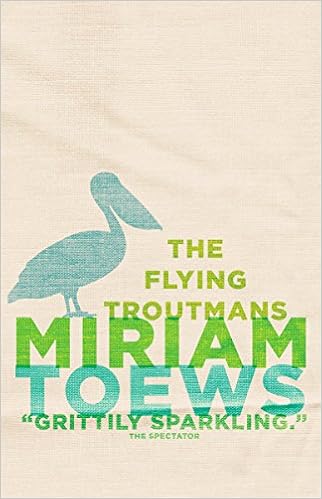
My life's been overwhelmingly eventful lately, so I haven't been carving out as much reading time as I'd like. The book I'm slowly working my way through is Miriam Toews's The Flying Troutmans.

It's a road trip book.

I don't drive, I don't spend much time in cars, and so I find road trips particularly exciting.

I wish I could write like Miriam Toews. I say that every time I read one of her books, but I absolutely love the sardonic tone she uses to approach themes of depression and suicide. I find her books very funny. Depression, suicide... hilarious stuff.

You really have to read her books to understand what I mean.

And you could read any of her books to get it. I haven't read everything she's written, but I get the sense the same types of characters show up in all of them: family members of people who are suicidal or people who have committed suicide.

I remember one time listening to someone rant about how nobody should ever write books about relatives of people with disabilities or mental illness--that writers should only centre the character with the disability.

True, those stories can go wrong in a lot of ways.

But, from my perspective, Miriam Toews's books are a prime example of thoughtful, empathetic, and realistic portrayals of the inner lives of family members. I realize that my depression impacts the people around me, so I'm interested in reading these stories of caring and sometimes exasperated relatives.

I'm very close to the end of The Flying Troutmans, so I don't know what's going to happen. I'm curious to find out whether it's possible to run away from the sad--for these characters, that is. In fiction.

In real life, I know that's not possible.

https://www.patreon.com/audioerotica

Monday, May 7, 2018

Identifying with the enemy - #rightwing #TCBoyle #freedom

Giant Sequoias

As usual I’ve been reading many different books, but today I’m going to talk about only one: The Harder They Come by T.C. Boyle. This one has been next to my bed for many weeks.  I found that this book deserved to be read slowly and thoughtfully, even though it’s a compelling story. Now that I’ve finished, I am recommending it to all and sundry, especially to my liberal friends who believe we’re on the correct “side” of an ideological divide and that people with opposing views are somehow the enemy. The Harder They Come confirmed my belief that it’s not that simple.


Retired high school principal and ex-Marine Sten Stenson is vacationing in Costa Rica with his wife Coralee when their tour bus is hijacked by a trio of thugs. As the native gang threatens the group of senior citizens with knives and a gun, Sten’s military training takes over. On automatic, he grabs one of their attackers by the throat to immobilize him, ultimately choking the other man to death. To his fellow cruise passengers, Sten’s a hero, but all sorts of unpleasantness follows as he is forced to deal with the local authorities and make moral compromises.

Sara Hovarty Jennings is a sovereign citizen. A forty-something divorcee who struggles with her weight, she works hard at her job as a farrier, takes meticulous care of her own personal property, loves her shaggy dog Kutya, and just wants to be left alone. She doesn’t pay taxes. She won’t register or insure her car just because the government says she must. She sure as hell isn’t going to wear a seat belt just because some law requires it. One evening she’s stopped by the police on California Route 20. She refuses to get out of the car as the officer demands. She ends up in jail overnight, with her car impounded and Kutya in quarantine because he hasn’t been vaccinated for rabies as the law demands.

Adam Stenson, Sten’s son, has always been a problem child. Now in his twenties, he’s living in a cabin in the northern California forest, drinking grain alcohol, growing drugs and becoming progressively less connected with reality. He identifies with, and takes the name of, the legendary mountain man John Colter. He’s determined to be as tough and crafty as his hero, to fight against the “aliens” who want to control him, to live free in the wilderness no matter what the cost.

When Sara encounters Adam, she persuades him to help her free her dog from the pound. They become lovers. Though Adam is peculiar, emotionally volatile, maybe dangerous, a bond develops between them. Everything unravels, though, when Adam, in the throes of his Colter-inspired hallucinations, shoots and kills two local men.

T.C. Boyle’s brilliant novel The Harder They Come revolves around these three rather extreme characters. Their beliefs and their actions should make them seem repugnant, or at least very foreign to someone like me, who espouses rather liberal political views. It is a measure of Boyle’s genius that he managed to make me feel sympathy for and warmth toward all three of theme, even the homicidal lunatic Adam.

In the real world I might label these people as right wing kooks. Boyle conveys their emotions with such conviction and their philosophies with such apparent logic that I found myself actually agreeing with them, at least to some extent. I admired Sara’s independence and courage. I felt Sten’s frustration with his aging body and his helpless despair in the face of his son’s psychological impairment, and understood how these feelings could engender deadly anger. I even could understand why Adam felt as he did, why he was so inspired by Colter, in a world where true agency is so difficult to achieve.

It took me a long time to finish The Harder They Come—more than a month, though of course I was reading quite a few other books concurrently. I found that I didn’t want to consume more than one or two chapters at a sitting, not because the book didn’t pull me in, but because I felt I needed a break to digest and to appreciate what I’d just read.

Boyle’s prose is so compact, so evocative, so precisely targeted, that one cannot help but marvel. He’s an expert at conveying the natural world as well as human emotions and behavior. The Harder They Come is set well north of San Francisco, near Mendocino and Fort Bragg, among the redwoods and the rednecks. The area used to be a thriving center of the logging industry, but that prosperity is long gone. Now Mexican gangs grow pot deep in the woods, the old rail line is used for tourist jaunts, the locals struggle, and everyone wonders what the future will bring.

The book beautifully conveys the natural beauty of the area, the wildness that still exists. It also evokes the quiet desperation of the people who inhabit the region, a desperation that expresses itself in prejudice and violence. Boyle focuses on Sten, Sara and Adam, makes them real, living, breathing human beings, but he’s also clear that they’re products of their time and environment. The Harder They Come could be viewed as a microcosm of contemporary American society, a cautionary tale on the consequences of extremism.

But Boyle isn’t on a soap box. He never is. He’s just painting pictures, encouraging us to draw our own conclusions. That’s why I feel that this novel is important. It goes beyond the stereotypes, probes more deeply into how these people—“these people” whom in another context I might be tempted to label as the enemy, as alien to me as the guys Adam murders—reason, think and feel. And my conclusion is that ultimately, we’re not that different after all.

Maybe more so-called liberal Americans should read this book.
Thursday, March 1, 2018

UnMarketable #AmReading #Author #Marketing

by Giselle Renarde


I've got a bit of crush on this real estate agent in my neighbourhood.  Every so often I get a newsletter from her. In the mail. An actual newsletter on paper. Glossy paper. With lots of pretty pictures.

I always read her newsletters, even though I probably couldn't afford even the cheapest property in the entire city. I doubt if I could afford a parking spot. Not that I need one--I don't have a car. But if I did suddenly have 3 million dollars at my disposal and I wanted to buy a house, I know exactly who I'd call.

And not just because she's pretty. She is pretty, no mistaking it, but that's not why I read her newsletters. I read them because they're about HER.  Yes, she writes about the real estate market in Toronto, but she's also written some pieces that unveiled her vulnerabilities--something you don't expect from anyone in business, much less a woman working in a cut-throat industry.

The reason I'm telling you about this real estate agent and her very engaging newsletter during "What Am I Reading?" week is that her most recent newsletter included a list of books she'd read recently and found interesting and helpful, particularly from a business perspective.

https://www.amazon.com/UnMarketing-Stop-Marketing-Start-Engaging/dp/1118176286?tag=dondes-20
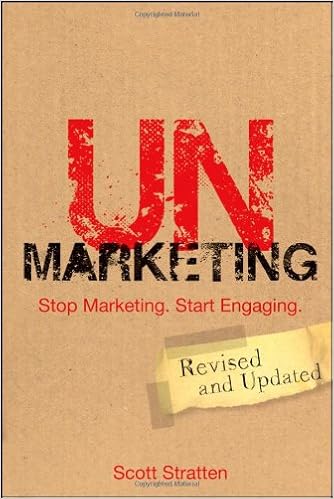
One book on that list is called UnMarketing: Stop Marketing. Start Engaging by Scott Stratten.

By some strange coincidence, I had found a copy of this book just a few weeks earlier in a Little Free Library. When I told my mom this story, she said, "I bet that's your real estate agent's copy!"  The awful wishful thinking thing is that I'd already had that thought. Hey, anything's possible.

What did I learn from UnMarketing?

Well, I'll start by saying it's an amusing book written in a very approachable tone. I breezed through it, and I am not a fast reader.  The title (or, rather, the subtitle) is a very accurate description of the overall message.  It's a book about connecting with your audience rather than just spewing advertisements at them, with a primary focus on social media (mainly Twitter).

Thing is, any book you write about social media marketing is obsolete before it even hits the market.  And the "Revised and Updated" version I read came out in 2012.

The same thing happens to me pretty much every time I read a marketing book: I read the advice, think "yeah, I know I SHOULD be doing all these things, but I'm not gonna," and I never implement anything I've learned.

My Twitter account has been around since 2008 and I've made good use of it, more for socializing than for marketing, but if a new book comes out I try to remember to mention it to my followers. I guess my problem is that the people with whom I socialize on Twitter are people I already know. They're the authors and editors I've known for years.

Any time anyone I don't know @'s me, I freak the fuck out. I am so intimidated by strangers it isn't even funny. If I see a tweet from someone I don't know, I basically close my eyes and chant "Make it go away!" a hundred times, then close my browser.

I'm scared of people. Even well-meaning people who tweet totally innocent stuff at me. I don't know who you are! I don't know what you want! Why are you talking to me?

All my life I've had a reputation for being a snob. My girlfriend says she found me standoffish when we first met. And I'm not surprised! It takes a ridiculous amount of time to earn my trust. What feels to me like scaredy-catness is interpreted by others as everything from aloofness to arrogance.

That's all well and good for your average human, but I'm an author. Perceived arrogance is bad for business.  Should I force myself to be better for the good of the brand?

In my real estate agent crush's most recent newsletter, she talks about being inspired by Shonda Rhimes's book Year of Yes to push herself beyond her comfort zone. She says she'd always been really reluctant to do videos even though her business coach had encouraged her to just try it. She took an improv class to get comfortable talking on the fly, tried out videos, and soon she was being contacted by news channels for on-air interviews.

Aren't success stories heartwarming?

They sure are. I don't know what's wrong with me--a fundamental failing or character flaw--but I  think I'd rather hear other people's success stories than work to create my own. That or I just have audacity to be satisfied with my little author life in my little author apartment.

Really, it ain't so bad.