Showing posts with label what are you reading. Show all posts

Monday, October 21, 2019

Running Away from the Sad #books #depression #amreading


A post by Giselle Renarde

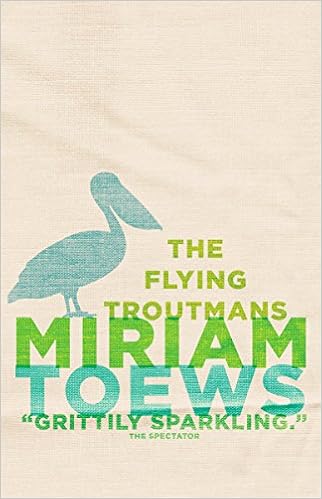
My life's been overwhelmingly eventful lately, so I haven't been carving out as much reading time as I'd like. The book I'm slowly working my way through is Miriam Toews's The Flying Troutmans.

It's a road trip book.

I don't drive, I don't spend much time in cars, and so I find road trips particularly exciting.

I wish I could write like Miriam Toews. I say that every time I read one of her books, but I absolutely love the sardonic tone she uses to approach themes of depression and suicide. I find her books very funny. Depression, suicide... hilarious stuff.

You really have to read her books to understand what I mean.

And you could read any of her books to get it. I haven't read everything she's written, but I get the sense the same types of characters show up in all of them: family members of people who are suicidal or people who have committed suicide.

I remember one time listening to someone rant about how nobody should ever write books about relatives of people with disabilities or mental illness--that writers should only centre the character with the disability.

True, those stories can go wrong in a lot of ways.

But, from my perspective, Miriam Toews's books are a prime example of thoughtful, empathetic, and realistic portrayals of the inner lives of family members. I realize that my depression impacts the people around me, so I'm interested in reading these stories of caring and sometimes exasperated relatives.

I'm very close to the end of The Flying Troutmans, so I don't know what's going to happen. I'm curious to find out whether it's possible to run away from the sad--for these characters, that is. In fiction.

In real life, I know that's not possible.

https://www.patreon.com/audioerotica

Monday, December 3, 2018

A heady mix of eroticism and terror - #Arcanium #review #magic

Spider cover

By Lisabet Sarai

There aren’t too many authors whose books I’ll buy on release day, but Aurelia T. Evans is one of them. When I saw the November 6th announcement in the Totally Bound newsletter, I hesitated only long enough to start up my special e-commerce computer in order to purchase a copy of her latest novel Spider.

Spider, the sixth book in the fascinating and disturbing Arcanium series, brings readers back to the alluring, terrifying circus created and nurtured by ancient jinni Bell Madoc. For Bell, Arcanium is simultaneously a plaything, a work of art and a cosmic mission. The appeal of his edgy big top performances and horrible but fascinating Oddity Row depends on his “people”: captive demons, human misfits, and unfortunate innocents whose unintentional wishes have bound them to the circus. Although Bell is capricious and can be cruel, he’s also exquisitely sensitive to the secrets that haunt visitors to Arcanium. The transformations he works upon those whom he entangles via their wishes make those secrets visible.

Elizabeth, the protagonist of Spider, lives her life in fear: fear of heights, fear of darkness, fear of insects, fear of disease. A member of a conservative, Amish-like religious cult (in fact, the illegitimate daughter of its prophet), in public she covers her hair and every inch of skin apart from her hands and her face. Like many unmarried daughters of the Petrosian Saints, she works as a nanny; Christian parents view the modest, sober, serious Petrosian women as ideal care-takers for their children.

A mistake leads Elizabeth to takes her charges on an afternoon outing to Arcaniuma mistake that will change her life forever. Trying to keep track of a teenager, a ten year old, a toddler and an infant, she idly wishes she had extra hands. Bell pounces upon her figurative statement. He has her abducted, brings her to Arcanium, and magically bestows another pair of arms and another pair of legs, turning her into his human spider. Then he installs her in his dreadful “fun house”, actually a prison he has created to punish evil-doers who have threatened Arcanium. Visitors assume the bloody horrors of the fun house are fake, but Elizabeth soon learns that every terror is real.

However, Bell has not brought Elizabeth into the circus for punishment, but to help her accept her fundamental nature. He knows that her many phobias mask a deeper fearthat she’ll be exposed as the elaborately tattooed porn performer her seductive, abusive former boyfriend had made of her. Indeed, as she adapts despite herself to eight-legged life in Arcanium, she gradually comes to understand that her true self is something even darker, wilder and more forbidden.

Totally Bound is a romance publisher, yet Ms. Evans’ books break every romance rule. That’s probably one reason why I love them. Here’s the publisher’s Reader Advisory for Spider:

This book contains plot-driven dubcon, monster sex, arachnophobia, public sex, extreme violence and horror-related gore, accounts of noncon and sex trafficking, double penetration, sex addiction, alcoholism and religious guilt.

Definitely not a book for the faint of heart! At the same time, none of this content is gratuitous, inserted just for shock value. Like many of the characters in the earlier Arcanium books, Elizabeth is broken inside. Strange as it might seem, her ordeals contribute to a sort of healing.

I find Arcanium’s mix of terror and eroticism refreshing and deeply enjoyable. Even after six books, Bell can still inspire my wonder. He wields incredible power, but he’s constrained by free will. His moral ambiguities fascinate me. He loves his people, yet also tortures them. He leads them to deeper self-understanding even as he selfishly uses them to increase the popularity of his circus. In this book, one character, with powers of his own, comments that Bell came into being before good and evil, that he is born of primordial chaos.

This book is the first in which Bell’s omnipotence is seriously challenged, by a mysterious outsider. I’m assuming that Ms. Evans is working on another volume that will explore this plot twist. I only hope it comes out soon!


My reviews of some of the earlier Arcanium books:


Monday, July 16, 2018

Traveling, Reading

Book and Plane

By Lisabet Sarai

I am writing this two weeks ahead of time because on the day it posts, I’ll be far away from my home and my computer. I’ll be traveling for twelve days, and I won’t be able to access the blog, even to reply to comments.

So far in advance, I’m not sure what I’ll be reading, but I know I will be reading. Indeed, reading is one of the joys of being on the road. A fourteen hour plane trip provides a lot of opportunities to lose oneself in a book—not to mention the hours waiting to board or to make connections. I may be doing an all-day train ride as well. Meanwhile, since I’ll be in a rural area at least part of the time, I expect that there will few activities in the evenings to compete with reading.

What will I bring with me? Well, my tablet, of course, stuffed with at least two dozen titles, many of them erotica. Thank heavens for e-books. They definitely lighten my luggage!

I’ll also be carrying George R.R. Martin’s A Dance with Dragons, the last (so far) volume in the Game of Thrones series. I’ve been rationing my consumption of that series, saving it for long journeys. I read the first half of this volume (five hundred plus pages) on my last international odyssey. I’ll finish it on this one, then feel frustrated, I’m sure, because just like real life, these books never tie up the loose ends.

That won’t be enough, though. After a while, I get tired of reading on a screen. I’m sure I’ll want to bring at least a few more print books, even with our limited luggage allowance (low cost airlines... argh!) But which ones?

At the moment, there are all sorts of candidates on my bookshelf. Riven Rock by T.C. Boyle. Sweet Caress by William Boyd. Books by Umberto Eco and John Crowley, Thomas Pynchon and Salman Rushdie, not to mention half a dozen titles from Janet Evanovich’s Stephanie Plum series and (as a stark contrast) Arundhati Roy’s The Ministry of Utmost Happiness. Lots of less well known writers, too—we have access to some excellent used book stores!

One needs to use special criteria choosing books for travel. They need to long enough to justify carrying them, but small enough not to take up too much space. I look for books that will really hook me and pull me in, to distract me from delays, backaches, hunger, bad smells, and other inevitabilities of travel. At the same time, for me at least, a travel book can’t be too intense, complex or intellectual. I’d rather read those books at home, where I have a wider selection and can put them down to pick up something else.

Anyway, I really can’t tell you in any detail what I’ll be reading as you read this. Very likely, though, I’ll be enjoying it.

Thursday, March 1, 2018

UnMarketable #AmReading #Author #Marketing

by Giselle Renarde


I've got a bit of crush on this real estate agent in my neighbourhood.  Every so often I get a newsletter from her. In the mail. An actual newsletter on paper. Glossy paper. With lots of pretty pictures.

I always read her newsletters, even though I probably couldn't afford even the cheapest property in the entire city. I doubt if I could afford a parking spot. Not that I need one--I don't have a car. But if I did suddenly have 3 million dollars at my disposal and I wanted to buy a house, I know exactly who I'd call.

And not just because she's pretty. She is pretty, no mistaking it, but that's not why I read her newsletters. I read them because they're about HER.  Yes, she writes about the real estate market in Toronto, but she's also written some pieces that unveiled her vulnerabilities--something you don't expect from anyone in business, much less a woman working in a cut-throat industry.

The reason I'm telling you about this real estate agent and her very engaging newsletter during "What Am I Reading?" week is that her most recent newsletter included a list of books she'd read recently and found interesting and helpful, particularly from a business perspective.

https://www.amazon.com/UnMarketing-Stop-Marketing-Start-Engaging/dp/1118176286?tag=dondes-20
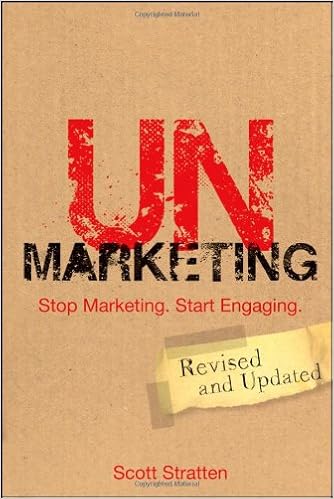
One book on that list is called UnMarketing: Stop Marketing. Start Engaging by Scott Stratten.

By some strange coincidence, I had found a copy of this book just a few weeks earlier in a Little Free Library. When I told my mom this story, she said, "I bet that's your real estate agent's copy!"  The awful wishful thinking thing is that I'd already had that thought. Hey, anything's possible.

What did I learn from UnMarketing?

Well, I'll start by saying it's an amusing book written in a very approachable tone. I breezed through it, and I am not a fast reader.  The title (or, rather, the subtitle) is a very accurate description of the overall message.  It's a book about connecting with your audience rather than just spewing advertisements at them, with a primary focus on social media (mainly Twitter).

Thing is, any book you write about social media marketing is obsolete before it even hits the market.  And the "Revised and Updated" version I read came out in 2012.

The same thing happens to me pretty much every time I read a marketing book: I read the advice, think "yeah, I know I SHOULD be doing all these things, but I'm not gonna," and I never implement anything I've learned.

My Twitter account has been around since 2008 and I've made good use of it, more for socializing than for marketing, but if a new book comes out I try to remember to mention it to my followers. I guess my problem is that the people with whom I socialize on Twitter are people I already know. They're the authors and editors I've known for years.

Any time anyone I don't know @'s me, I freak the fuck out. I am so intimidated by strangers it isn't even funny. If I see a tweet from someone I don't know, I basically close my eyes and chant "Make it go away!" a hundred times, then close my browser.

I'm scared of people. Even well-meaning people who tweet totally innocent stuff at me. I don't know who you are! I don't know what you want! Why are you talking to me?

All my life I've had a reputation for being a snob. My girlfriend says she found me standoffish when we first met. And I'm not surprised! It takes a ridiculous amount of time to earn my trust. What feels to me like scaredy-catness is interpreted by others as everything from aloofness to arrogance.

That's all well and good for your average human, but I'm an author. Perceived arrogance is bad for business.  Should I force myself to be better for the good of the brand?

In my real estate agent crush's most recent newsletter, she talks about being inspired by Shonda Rhimes's book Year of Yes to push herself beyond her comfort zone. She says she'd always been really reluctant to do videos even though her business coach had encouraged her to just try it. She took an improv class to get comfortable talking on the fly, tried out videos, and soon she was being contacted by news channels for on-air interviews.

Aren't success stories heartwarming?

They sure are. I don't know what's wrong with me--a fundamental failing or character flaw--but I  think I'd rather hear other people's success stories than work to create my own. That or I just have audacity to be satisfied with my little author life in my little author apartment.

Really, it ain't so bad.

Thursday, December 21, 2017

We All Love the Beautiful Stories #CanLit #Storytelling #AmReading

A Post by Giselle Renarde


https://www.amazon.com/We-All-Love-Beautiful-Girls-ebook/dp/B01N2QRXQQ?tag=dondes-20
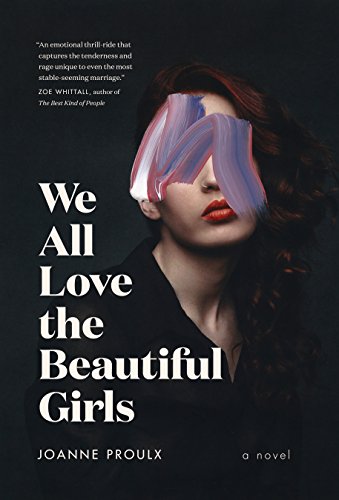
I just finished reading a novel called We All Love the Beautiful Girls. It's Canadian literary fiction by Joanne Proulx. I don't think I've ever read a book the year it came out (I'm very behind the times that way), but I found it in a Little Free Library near my house. The title and the cover appealed to me. I'll admit, I thought there would be lesbians. Spoiler Alert: there weren't.

But instead of talking about the book, I'm going to talk about my family. What else is new?

Okay, I lied.  I'm going to talk about this book a bit.  I'm going to tell you about something that happens in the book. Something fantastically Canadian, come to think of it. Something that touches on the story of my family.

A boy passes out in the snow.  He gets frostbite and loses a hand.

Now, here's why this story hits home for me...

My grandma loved her dad. When her parents divorced, she chose to live with him. When my grandmother married, he came to live with her.  I think he slept in her kitchen. I know my uncle slept in a drawer. But this was the late 40s, so I guess people were just sleeping all over the place.

I never met my great-grandfather, but evidence suggests he was a kind and caring person. He came here from rural Scotland, where he'd been a farmer. During the First World War he worked with horses, and when he came to Canada he continued in that vein, working in stables where milkmen kept their teams.

He wasn't much of a drinker, as far as I know, but one New Year's Eve he went down to the pub.  I guess he drank much more than his body was used to, because on his way back he passed out in a snow bank.  He wasn't far from home.  My grandmother tells me the snow bank was right in front of the house.  She's the one who found him there the next morning.

I'm telling you the story of how my great-grandfather died.

But I'm making choices about how I tell it.  I could stop right there.  Everything I've told you is true.  However, the implication is that, when my grandma found her father in the snow on New Year's Day, he was already dead.  That's not the case.  It's the best version of the story of my great-grandfather's death, but it's incomplete.

Because, when my grandmother found her father in the snow, he was still breathing.  They rushed him to hospital, where he died of pneumonia three weeks later. He never got out of that hospital bed.

When we're creating fiction, we're obviously making choices about how we tell a story. But when we're telling the stories of our lives, we're making choices too.

Good storytellers choose the best possible version of that story.

This is a lesson I learned from my aunt, who, I now realize, is the person who taught me how to be a storyteller.  When I was a child, I found her stories spellbinding. Now, as an adult, I still do.

In fact, just this weekend she told us a very evocative tale that drew on every sense. Her siblings all agreed that, the way she'd told it? Yeah, that's not the way it happened. Nowhere near.  There was a consensus that her facts were way off.

But does that matter? To me? I guess it doesn't. It doesn't make a difference whether my uncle came in through the front door or the back.  That doesn't impact the heart of her story, and my aunt's choices add nuance and build strong images.

Would it do an injustice to my great-grandfather if I led you to believe he died in that snowdrift, in the wee small hours of New Year's Day? When, in reality, he died in a hospital bed three weeks later?

That, I can't answer.  It's his death, not mine.

Giselle Renarde is an award-winning queer Canadian writer. Nominated Toronto’s Best Author in NOW Magazine’s 2015 Readers’ Choice Awards, her fiction has appeared in nearly 200 short story anthologies. Giselle's juicy novels include Anonymous, In Shadow, Seven Kisses, and The Other Side of Ruth.

Monday, December 18, 2017

Reading for Reviews -- #Reviews #Commitments #Community

Stack of Books

By Lisabet Sarai

Since our last “what are you reading?” cycle, I’ve finished all but one the books I discussed. Most of my new reading has focused on titles I plan to or have promised to review. Accordingly, they tend to be in the romance or erotica genres.

I have a pretty significant backlog of to-be-reviewed books on my tablet. They come from two sources. First, I’m a host for an author promotion company that offers review blog tours as one of their products. For these tours, the blog host commits not only to posting cover, blurb and excerpt but also to reading and reviewing the book being featured. I am quite selective about the review tours I accept, but usually I have one or two on my calendar.

Second, I receive many review copies of books from my fellow authors. In some cases, I request them; in others, the writer offers. (I generally ignore unsolicited review copies.)

I have a semi-regular Review Tuesday feature on my blog, for posting the latter reviews. About a week later, I will also put them on Goodreads, Amazon and BN.

I see reviewing other authors’ work as part of our community ecosystem. It’s a way of paying things forward. Hopefully, writers I know will review my books. (I’m always happy to provide copies, by the way. Just ask!)

Reviews also offer the possibility that I’ll expand my own network of readers due to cross-promotion. This doesn’t mean I will post a dishonest review, though. Once a reviewer begins to give every book five stars, she loses her credibility.

Reviewing gets me reading things I might otherwise not encounter. However, knowing I’m committed to a review changes my reading experience. I read more slowly, more consciously, and more critically. I’m less likely to lose myself in a book, because my intellect trumps my emotions. (If a book I plan to review does sweep me away, that’s a really positive sign.)

Anyway in this post, I thought I’d talk about a few recent review books.

Rescuing Prince Charming by Edward Hoornaert

I met Ed (aka “Mr. Valentine”) through our joint participation in the Marketing for Romance Writers group. I was really impressed by his intelligent, humorous blog posts, so when he put out a call for advance readers for his science fiction romance, I volunteered.

I found that his novel was as delightful as his blog posts, written in a sprightly, tongue-in-cheek style but still conveying genuine emotion. I have a love/hate relationship with the romance genre, because so many romances are utterly predictable. This book held my interest and kept me smiling from beginning to end.

If you’re interested, you can read my full review here.


One Too by Sherrie Cronin

I’m more than halfway through this nearly 600 page book, which I’m scheduled to review on February 12th. The genre is a bit difficult to assign (always a recommendation, in my opinion!), but I guess the closest category would be science fiction. Most of the important characters have various super-normal capabilities: telepathy, astral body travel, precognition, the ability to manipulate the flow of time. These powers are treated scientifically rather than as magic. The powers have clear limits. Exercising these powers is physically draining. Also individuals differ in their native abilities, and these abilities can be strengthened through training.

At the core of the book is a conflict between two groups of telepaths with very different values and views of the world. The novel is highly political; although it is set in 2012-2013, the references to the current world situation and media trends are quite transparent. Indeed, this is one of my criticisms so far, that the author wears her politics too much on her sleeve.

The heroine is a break from tradition, a middle-aged mother of three adult children, a scientist and a telepath, married to a high school physics teacher. I like this as well.

The book also has elements of an adventure tale, with kidnappings and daring escapes. At the moment, the main characters are on a tourist cruise ship headed to Antarctica, fleeing the evil telepaths of Enteletechy.

I’m enjoying this read, despite the knowledge that I’ll have to review it. Stop by my blog on the 12th of February to get my final verdict.

No Title Provided...

There’s one dilemma occasioned by accepting review copies from authors whom I know—what if I hate the book? About a month ago, a colleague who publishes with the same co-op I do offered me a copy of her latest novella. I’d read a review by another author whom I generally trust, so I happily accepted. Alas, I really did not like the book at all. The tale is set in a world of extreme lifestyle BDSM, which should interest me, but overall it felt stiff and fake. The main premise and conflict struck me as implausible. The characters, most especially the focus character, had a cardboard quality. I could not identify with any of them. The final straw was a long kink scene between secondary characters that did not advance the plot at all.

What do I do? As I said above, I try to be scrupulously honest in my reviews. If I review a book with flaws, I will try to first highlight the positive aspects. In this case, though, the negative so outweighs the positive that I’ve decided to simply let the book sink into obscurity. Fortunately I didn’t add it to my books on Goodreads before I read it, so there’s no record I ever even opened the file.

I’m not entirely comfortable with this compromise solution, but I guess it’s what I’d prefer if some reader hated one of my books.

And coming up...

The next book I’m scheduled to read for review is called Grinder’s Corner by Ferris H. Craig and Charlene Keel. I was attracted to this because of its unusual setting in the early sixties, in a taxi dance hall. It’s also billed as a romantic comedy, a genre I enjoy but really can’t pull off myself.

Check my blog on February 27th, to find out what I thought.

Meanwhile, in late November, my DH and I visited the semi-annual book sale at a private library near us. These sales feature hundreds of great titles, at rock bottom prices. We spent about twenty five dollars for more than dozen books. Some are by authors new to us, but there are also volumes by T.C. Boyle, William Boyd, Jane Smiley, and Joanne Harris. I’m looking forward to diving into this pool of literary riches.

Tune in next time for my comments!

Monday, January 16, 2017

Magical Realism, Japanese Style (#murakami #amreading #magic)

Murakami cover

By Lisabet Sarai

This fortnight here at the Grip, we tackle our recurring topic “What are you reading?” I’m always in the middle of several books, but lately most have left me with a ho-hum feeling. When I realized that this topic was looming, though, I decided to crack open a novel I’ve been “saving” since I bought it a couple of months ago: Colorless Tsukuru Tazaki and HisYears of Pilgrimage, by Haruki Murakami. I’m now about two-thirds of the way through this three hundred page volume, certainly far enough to chronicle my feelings here.

Murakami has been one of my favorite authors since I first read A WildSheep Chase, more than thirty years ago. I’m not alone in this sentiment; Colorless Tsukuru Tazaki sold more than a million copies in Japan during the first week after its release.

When I try to analyze why I enjoy his work so much, though, I’m left with a bit of puzzle.

One thing that normally attracts me to an author is originality or diversity. For instance, I love T.C. Boyle’s chameleon-like ability to produce a wildly different type of story with each release. Murakami’s books, in contrast, tend to be quite similar to one another in language and tone. His characters also share many characteristics from one book to the next. His heroes tend to be quiet, hard working, nondescript, often lonely, men, drifting almost anonymously through Japanese society.

Thirty-something Tsukuru Tazaki fits this mold exactly. He lives alone in a Tokyo condo and works as an engineer building railroad stations (which happen to be one of his rare passions). He does his own laundry and often cooks his own simple food, drinks alcohol sparingly, swims regularly at the public pool for exercise and to quiet his mind. He has never been outside Japan. He has no friends—in fact an issue at the crux of this story—until he meets Sara, a enigmatic woman to whom he’s strongly attracted, but about whom he knows little.

Hardly an alpha hero. Hardly a hero at all, by the standards of popular literature, but quite typical of Murakami’s protagonists.

I also admire books with intricate and beautifully constructed structure, plots that not only provide interesting conflicts and dramatic resolutions, but which also showcase the author’s awareness of and ability to control the narrative. Examples that come to mind include Barbara Kingsolver’s Flight Behavior and Erin Morgenstern’s The Night Circus. In these books, no detail is insignificant. Themes or events early in the novel turn out to have profound impacts by the end.

Murakami’s books, in contrast, meander from one event to the next, taking side trips along the way, which may or may not turn out to be relevant to the book as a whole. Murakami is also a jazz musician, and sometimes his books feel like improvisations. In addition, there’s little rise in tension. The story arc is so gradual as to be almost undetectable.

Colorless Tsukuru Tazaki follows this pattern, although it begins with an emotional cataclysm. During his high school years in Nagoya, Tsukuru Tazaki (whose first name means “the builder”) enjoyed a remarkable, close relationship with four friends. Studious Akamatsu (“red pine”), athletic Oumi (“blue sea”), beautiful Shirane (“white root”), warm Kurono (“black field”) and Tsukuru were inseparable for much of their teenage life. They spent work and play time together; they shared experiences and ideas; they complemented one another’s personalities. There was something intoxicating, almost erotic about their closeness, although the relations between the male and female members of the group were entirely platonic. Together the five were as much of a whole as the five fingers on a hand. Then during Tsukuru’s first year of university, the four friends whose names include colors suddenly rejected him. They refused to communicate with him. Furthermore, they would not tell him the reason.

Tsukuru almost dies as a result of this sudden amputation from the people he loves. The shock and grief are overwhelming. He stops eating. He sinks into grief and becomes preoccupied with death, as emotional pain totally consumes him. Yet Murakami describes this so calmly that the impact feels muted.

Perhaps he didn’t commit suicide then because he couldn’t conceive of a method that fit the pure and intense feelings he had toward death. But the method was beside the point. If there had been a door within reach that led straight to death, he wouldn’t have hesitated to push it open, without a second thought, as if it were just part of ordinary life. For better or for worse, though, there was no such door nearby.”

This passage offers a sense of Murakami’s graceful, fluid style, as well as the distance he always seems to preserve between the reader and his characters.

The book does have a plot. Indeed, it is in some sense a classic mystery, as Tsukuru finally takes action to discover the truth of why his friends spurned him. He is set upon this quest by the insightful Sara, who recognizes that he can’t fully participate in building his relationship with her because he’s stuck in the past, pinned like a butterfly to an empty life by the pain of his old loss.

Still, it’s not really the plot that’s pulling me forward in the book, making it hard for me to stop reading at night even though I know I’ll be sorry when the alarm clock rings the next day.

What is it about Murakami’s work that excites me? Why am I trying to ration this book, so as not to finish it too quickly?

One answer lies in the richness of ideas the author explores. His characters tend to have long, philosophical conversations full of startling insights (which may or may not be important for the “plot”). Murakami is interested in life, death, talent, music, art, language, evil, logic, fate, luck, spirituality, relationships, and the nature of reality. There’s a deep pleasure in reading these conversations. You think, “Yes, that’s exactly right, that captures the truth.” Or sometimes, “what a remarkable perspective; that’s never occurred to me.” I find it difficult to retain these insights, just as it’s hard to hold on to the details of a dream. All you recall are the emotions. Of course, one joy of a book (especially a print book like this one I’m reading) is the ability to go back and re-visit favorite passages.

Murakami’s language is beautifully precise, whether he is describing inner or outer states of being. He has a gift for creating images that capture the essence of his subject. As an author, I can appreciate both the final effects and the difficulty of achieving them.

However, the main feature that calls me back to this author’s work may be the magic. Every one of his novels incorporates some hint of the miraculous or the unexplained. Don’t misunderstand me; there are no wizards or mages in Murakami’s books, no shapeshifters, blood drinkers or demons that characterize the paranormal genre. Instead, there are synchronicities, coincidences that defy logic, or states of being that take the characters beyond the material world. This is more like the magical realism that characterizes Latin American fiction like that of Gabriel Garcia Marquez or Laura Esquivel.The Latin magic is more vivid, though, portrayed in primary colors. Murakami, in contrast, describes these marvels in the same subdued and measured prose he uses for the rest of his books.

In Colorless Tsukuru Tazaki, for example, Tsukuru has a disturbing lucid dream about his old friends as a well as a new friend, Haida (who vanishes not long after). The dream is a harbinger of reality, foreshadowing the reason his friends cut him off. When Tsukuru travels to Finland, where Kurono has moved, every experience seems edged with magic. He encounters the people he needs to assist him on his quest.

Like many other aspects of Murakami’s work, it’s difficult to pinpoint exactly where the sense of magic comes from. It slips away, leaving a memory, like the refrain of a song that sticks in your mind, whose title you can’t recall. It’s haunting, though, creating a persistent sense that life includes something beyond the bare bones of physical experience. Often we can’t see this something, but it shines through the deceptively mundane events in Murakami’s stories, drawing the mind and the heart.

Thursday, November 10, 2016

Fiction Intended to Titillate

by Giselle Renarde


I just started reading The Namesake by Jhumpa Lahiri, and because I'm not too far into it I don't have much to say yet. But diving into literary fiction after reading a bunch of mystery novels got me thinking about the tears authors so often shed defending the integrity of genre fiction against those big bad litfic bullies.

A couple weeks ago someone found my Donuts and Desires blog by googling "erotica is for morons" and it made me laugh so hard. I laughed because I thought of all you guys, of how ridiculously intelligent you are. I'm not saying every erotica writer is an evil genius, but pretty much all the ones I know are. And some aren't even evil. Just really educated, well-read individuals.

To be honest, I don't feel much need to defend erotica anymore. I'm not sure I ever did, but after writing erotic fiction for 10+ years I really don't care if people think I'm a moron for writing sex. People can think whatever they want about me--doesn't seem to stop them from buying my smut.

https://store.kobobooks.com/ebook/in-shadow-a-novel
But here's the thing: not every book I write is smut. My most recent novel, In Shadow, includes some suggestive content. There's sex it in. But the sex scenes aren't written the way I write sex in my erotica. In fact, I find the sex in In Shadow uncomfortable to read. That's how I intended it, but I know full well that one of the many things that drew me to literary fiction as a young reader was the suggestive piquancy of taboo sexuality.

My main character from In Shadow has repressed a lot of dark shit, and it comes back to bite her in the ass. Actually, it comes back to fuck her up the ass. But no sense splitting hairs.

Ebook retailers that refuse to carry erotica classify it as "fiction intended to titillate," and I guess that's fair... but when automated content reviews flag erotica as such, they're searching the text for keywords. They're looking for pussies and cocks. What if you write a book like In Shadow that's written using suggestive rather than blatant language? Is it erotica? Is it... not erotica?

I didn't classify my new novel as erotica, and now I kind of wish I had. I knew it would be harder to sell literary fiction than erotic fiction, but I figured my regular readers would find In Shadow lacking in erotic content. Most of the book is not about sex. But at the same time most of the book is completely about sex! It's about denying the sexual beast that resides inside the virgin. It's about the dangers of projecting one's sexuality onto another individual, and the even more inglorious dangers about projecting collective sexuality onto a marginalized population.

There's a lot going on in this book.

Ultimately I didn't classify In Shadow as erotica because I worried it wouldn't be blatant enough for a lot of my readers. And then I worried mainstream readers would pick it up and be like... Holy Anal Rape, Batman! (That's my favourite scene. Can you tell?)

Anyway, looks like I've got nothing to worry about. Turns out it's much easier to sell erotica than psychological fiction with a supernatural twist. I don't need to worry about readers accidentally stumbling across this one.

*sigh*

__
Giselle Renarde is an award-winning queer Canadian writer. Nominated Toronto’s Best Author in NOW Magazine’s 2015 Readers’ Choice Awards, her fiction has appeared in well over 100 short story anthologies, including prestigious collections like Best Lesbian Romance, Best Women’s Erotica, and the Lambda Award-winning collection Take Me There, edited by Tristan Taormino. Giselle's juicy novels include Anonymous, Cherry, Seven Kisses, and The Other Side of Ruth.

Thursday, September 1, 2016

You Owe Me BIG

by Giselle Renarde


Glad to see I'm not the only one with three books on the go. I'm such a commitmentphobe I can't even commit to one book at a time! heh.

One of the books I'm currently reading is Margaret Atwood's PAYBACK: Debt and the Shadow Side of Wealth. I'm going to excerpt some of the book blurb to give you a clearer picture not only of what this book is about, but of what it isn't about:

[Margaret Atwood] doesn’t talk about high finance or managing money; instead, she goes far deeper to explore debt as an ancient and central motif in religion, literature, and the structure of human societies. By looking at how debt has informed our thinking [...] from the stories we tell of revenge and sin to the way we order social relationships, Atwood argues that the idea of what we owe may well be built into the human imagination as one of its most dynamic metaphors.

This is a highly academic work. My brain needs to be fully engaged any time I sit down with it, so it's not the book I pick up with my morning coffee, but debt is a topic that's always interested me. I'm the kind of person who pays off their credit cards in full every month, the kind of person who'd rather go without life's frills in favour of squirreling money away.

This book deals with debt as a concept, but it's got me thinking about one particular debt in my life:

A few years ago, my best friend was in dire straits. I know she wouldn't want me to disclose specific details, but if you were to imagine three of the worst things that could possibly happen to a person you probably wouldn't be anywhere close to how bad things were. She needed a considerable amount of money and I loaned it to her.

She wanted to set up a payment schedule, legal contract, interest rate, all above board. I didn't care about any of that. I wrote her a cheque. She could pay me back when her life stabilized.

"Neither a borrower nor a lender be; / For loan oft loses both itself and friend.." Wise words, there, from our man Polonius. As someone who is debt-averse, I've never been a borrower. Except in this particular instance, I've never loaned anyone money. In fact, I don't tend to loan people much of anything. I don't have a lot of stuff--certainly not the kind of stuff anyone would want to borrow.

Here's the thing: I loaned my friend money knowing she would absolutely pay me back if and when she could afford to do so. That said, I wouldn't have loaned her the money if I absolutely needed it to keep a roof over my head. While the money wasn't a gift, I wasn't counting on getting it back. That's not to say she's absolved of her debt. The debt still exists, I just don't let it get to me.

This girl is not a shifty person. We've been friends for over 20 years. She knows me better than anyone, and I know her pretty damn well too. That said, we'll often go long stretches of time without being in contact. Doesn't matter. We have a heart-to-heart connection. If we never spoke again, we wouldn't love each other any less.

My mom and my girlfriend have kind of teamed up on this one. They've decided my friend has pulled a fast one on me. I almost never think about this debt, but they bring it up often. "Have you heard from her lately? Has she mentioned the money?" They have this immense emotion attachment to my money.

Lending money can ruin a friendship. That's what they say. If you know me well, you know I can't be pressured into doing... well, anything, really. I loaned that money because I wanted to. Maybe that's why I'm not boiling over with resentment. And while it might be nice for the debt to be acknowledged every so often, I understand that money is a touchy subject for a lot of people and debt can be a source of shame.

I wish I'd made a note of it because I'm sure to misquote, but somewhere in PAYBACK Margaret Atwood mentions an antiquated notion (from the Bible? from the Romans? I don't remember) that every seven years all debts should be forgiven. Not a bad idea, if you ask me.


Giselle Renarde is an award-winning queer Canadian writer. Nominated Toronto’s Best Author in NOW Magazine’s 2015 Readers’ Choice Awards, her fiction has appeared in well over 100 short story anthologies. Giselle's juicy novels include Anonymous, Cherry, Seven Kisses, and The Other Side of Ruth. 

Thursday, March 21, 2013

Opening Up

posted by Giselle Renarde

A laser canon zapping the school? Maybe? 

When I was in Grade 6, book reports were due every other Friday.  We each had a small "cahier" (workbook) labelled "comptes-rendus" (book reports), and in it we'd write up a blurb about the book--the plot, the characters, whether or not we enjoyed it, that sort of thing.  We also had to draw a picture to illustrate a scene that best caught our imagination.

One Thursday evening, I realized... uh-oh... my compte-rendu is due tomorrow.  Instead of reading a book really fast and writing up a quick report like I'd done a fortnight prior (I read and reviewed a joke book--I kid you not), I decided... hey... there's no way my teacher has read every book in existence, right?  Why don't I make one up?

And that's what I did.  I invented a book.  I made up a title, made up the characters, made up the plot.  Everything.

Luckily, for my first post here at Oh Get a Grip, I don't have to do that.  Not that I would, as an adult.  Let's hope I've learned a little something from past indescretions.  Even if they earned me an A+.  Not that I'm bragging...

The book that is the current apple of my eye is Tristan Taormino's "Opening Up: A Guide to Creating and Sustaining Open Relationships."

It's a real book.  I didn't make it up.  See?


And thank goodness Opening Up is real, because it needs to exist.  I bought the book as a poly-minded person who happens not to lead a very poly life.  If you know me, you know I have one girlfriend (I refer to her as Sweet, online).  Neither of us is really in the market for additions to our couplehood at the moment, but we're not opposed to the idea of sharing our lives with others... in the future... if we wanted to.  It's a not-right-now-but-maybe-someday sort of thing.

Why did I buy a copy of Opening Up?  Well, I've never been a fan of monogamy as a concept.  I don't have a problem with people making an informed decision to be with one person and only one person til death do us part, but I don't feel like people have a good sense of their options.  That's why there's so much cheating in the world--much more than the general population admits to.  I know things.  I was mistress to a married man for ten years of my life.  A lot of people feel trapped in marriage, and don't want to divorce for whatever reason.

It's easy to demonize the unfaithful, but what's the alternative to adultery?  Well, read Tristan's book.  There are plenty of models for open relationship, and she addresses them with knowledge and deft.  I particularly appreciate that she doesn't focus solely on poly for the purpose of sexual variety, but that she broadens the scope and includes platonic models, which I particularly appreciate.

Opening Up is not a book about finding new people to sleep with.  Well, that's part of it, inasmuch as sex part of many relationships, but more than that, it's a book about mindfulness--about being self-aware, being sensitive to partners' emotions, and addressing our own adverse feelings when they pop up.

In fact, one of the main reasons I bought a copy of Opening Up was that I had a suspicion it would address jealousy.  And it does.  There's a whole chapter on jealousy.  Tristan even breaks it down into components:

Jealousy is really an umbrella term for a constellation of feelings including envy, competitiveness, insecurity, inadequacy, possessiveness, fear of abandonment, feeling unloved, and feeling left out. (Opening Up, pg 156)

For me, though I'm not nearly as jealous as I was in my younger years, the green-eyed monster still rears its head in every relationship.  Actually, I've realized that, even in my mid-thirties, I still feel a multitude of child-like jealousy-related emotions with respect to family members (ie. feeling jealous that my mother invited my sister on a vacation, but didn't invite me).  Jealousy and other strong emotions might be more at the surface of open relationships, but they are present, for most people, even beyond romantic relationships. 

Since I started reading Opening Up, I've noticed more mindfulness and recognition of emotions, and I find I'm better at dealing with the feelings in Tristan's jealousy constellation.  For that reason alone, I would recommend Opening Up to anyone.

I would further recommend it because there's so much misunderstanding and lack of respect for the poly mindset.  Even when I was in Grade 6 and faking book reports, it already seemed strange to me that two people could get married, but three or four couldn't.  Maybe I'm somehow predisposed to appreciating open relationships, but for people who want to learn more, Opening Up is an absolute must-read.

Hugs,
Giselle

Monday, December 17, 2012

The Thrill of Discovery

By Lisabet Sarai

For the next two weeks here at Oh Get a Grip, we're going to be talking about what we've been reading lately. The timing is fortuitous, since only a few days ago I finished one of the best books I've read in very long time, The Windup Girl by Paolo Bacigalupi.

My husband picked up this fat science fiction opus at a used bookstore. Although we often confer about our finds before purchasing them (conserving funds – and space – means buying books we both would consider reading), I didn't really look at this one. I think we might have been in a rush. Anyway, he began perusing the book before I did. We'd sit in bed together reading, and I'd hear “Wow!” or “This is really dark!” or “I can't believe this guy isn't Thai” coming regularly from his side. He kept this up through the entire five hundred odd pages. I knew I had to read it.

The Windup Girl takes place in a dystopic world perhaps a hundred years in the future, during “the Contraction”. Humanity has used up all the petroleum on the planet, leaving biomethane, coal and animal (or human) power as the main sources of energy. Much of humanity hovers on the edge of famine as a few Monsanto-like corporations (the “calorie companies”) control most of the world's genetic material, producing sterile (and of course patented) U-Tex Rice, TotalNutrient Wheat, HiGro Corn and SoyPRO. Genetic modification (“genehacking”) has also produced new plagues and pests that have devastated the ecosystem, making the world even more dependent on the calorie companies. The book implies though never states that at least some of these blights were deliberately engineered to decimate natural genetic diversity and increase dependence on AgriGen, PureCal and their ilk.

Thailand, however, has been spared from the worst of this ecological disaster, largely due to the vigilance of the powerful Environment Ministry, which works to keep unauthorized GM products and raw materials for generipping out of the kingdom. Anderson Lake, an AgriGen employee, visits Bangkok under false pretenses, trying to locate the source of the old-fashioned, natural fruits and vegetables (tomatoes, eggplants and other items unseen for generations) that regularly appear in Bangkok's markets. Lake plots with the Ministry of Trade, Environment's traditional enemy, to undermine the Environment Ministry and uncover its hidden seed bank.

The “calorie man” Lake is only one of many vivid characters in this drama, however. There's Captain Jaidee, known as the Tiger, a former Thai boxer who now leads Environment's enforcement – a man who earns both his real name (which means “good heart”), for his generosity and sense of humor, and his sobriquet, due to his ferocity. His somber, dutiful lieutenant Kanya is his polar opposite, grimly pursuing her own understanding of justice. Hock Seng is Lake's lackey at the factory that serves as cover for his genetic researchers. A former wealthy merchant, Hock Seng is now a stateless refugee after horrific massacres of the Malaysian Chinese by Muslim Malays. And at the center of the story is Emiko, the “windup girl” of the title, engineered in Japan as a secretary and companion but then abandoned by her owner in Bangkok. Emiko is in some sense the ultimate fruit of the genetic manipulation that has crippled the earth, but she may also be the planet's future.

The last scifi book I read before The Windup Girl was China Mieville's The Scar. When I reviewed that book, I commented that it included some brilliant ideas – possibly too many of them. Paolo Bacigalupi strikes just the right balance, throwing out fascinating notions about possible futures but never straying too far from his central themes. The book is very tightly written (if you can say that about a 500 page novel!). It kept me on edge to the very last page; I really couldn't predict the (surprisingly positive) ending.

All of the above would be enough to make me recommend The Windup Girl. However, on top of intriguing characters, a shocking yet plausible premise, and plenty of action and intrigue, this book demonstrates an incredible understanding of Thailand – environment, culture, politics and psyche. I know Thailand well. I lived there for several years in the eighties and now I visit it often. I can scarcely believe how perfectly Mr. Bacigalupi has captured the realities and the contradictions of the Thais. They embrace technology and yet they continue to guard their economy from outsiders. They're peaceful Buddhists and violent thugs. The competition between Trade and Environment, the double-dealing and corruption, could have been taken from today's headlines in the Bangkok Post.

Bacigalupi is spot on in his description of the environment, too – the heat and humidity, the vibrant street markets, the noise and the strange oases of quiet. His depiction of Bangkok holding the sea at bay with massive flood walls and coal-powered pumps may be only a decade or two away. Certainly, I could imagine it perfectly, having walked along the banks of the Chao Phaya River and seen the City of Angels meters deep in water.

This amazing verisimilitude made reading The Windup Girl almost a peak experience for me. I do wonder whether readers without my familiarity with Thailand will have the same reaction. On the other hand, the book won both the Nebula and the Hugo awards in 2010, the year it was published (a fact neither my husband nor I knew when we bought it), so I guess a good deal of the brilliance was obvious even to the uninitiated.

When my husband and I have both finished one of our used-book-store finds, we normally donate it to a charity for resale. The Windup Girl, though, has earned a place on our “keeper” bookshelves, along with Arthur Conan Doyle, Edgar Allen Poe, Gilbert and Sullivan, D.M. Thomas, Haruki Murakami, and Shakespeare. We've already sent one copy (new, of course) to a friend as a gift. I expect that will happen again.

If you enjoy intelligent science fiction – if you're concerned about environmental issues – if you have any interest in, or experience with, Thailand – read this book.