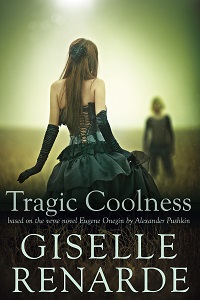
I’m proofreading and I’m obsessed. Obsessed with turning this book I wrote into the best piece of writing it can possibly be. Because, you see, this book of mine has been years in the making.
It’s a contemporary adaptation of Pushkin’s Eugene Onegin, a tale I’ve been into since I was a teenager. That’s when I first heard Tchaikovsky’s operatic version on the radio. Instantly, it became my favourite opera. And it still is. The Canadian Opera Company is mounting a production this fall—a Met production I’ve seen twice on TV and once live… with obstructed view, granted—and I’m going to have to scrounge up a ticket somehow. Just one. I WILL go to the opera alone. I’ve done it before.
Tchaikovsky didn’t even refer to this opera as an opera. I think he called it “lyrical scenes” or something. Which is just as well, considering the work it was based on was a verse novel rather than prose. The whole thing rhymes.
I’ll admit something shameful, here: it’s been 20 years since I read the original Pushkin (in English, not in Russian—I’m not that impressive). When I wrote my adaptation, I shaped it by basically laying my words over the structure of the opera. I had the libretto open beside my computer and I even went line by line, at times, creating this new version. Mine does diverge from the original in many ways, but not in form. When it comes to structure, I need all the help I can get. It’s always been my weak point, so I’m not afraid to steal from opera.
Maybe I should tell you what Eugene Onegin is all about. I think of the story as being popular because I’m aware of it, but I also woke up this morning with a song in my head from a 1992 episode of Jeeves and Wooster because I’ve watched it 6 times this week. This might be niche knowledge. I just don’t know anymore.
The best summary I’ve heard of Pushkin’s story comes from the introduction to the 1979 translation by Charles Johnston and it goes like this: “Tatyana falls in love with Onegin and nothing comes of it. Then he falls in love with her and nothing comes of it. End of novel.”
Sounds like quite a romp, doesn’t it?
But it’s full of angst, and that’s probably why I loved this story as a teenager. I believe it was Turgenev who referred to the character of Eugene Onegin (and those of his ilk) as The Superfluous Man. He’s got money, but it doesn’t make him happy. Everything bores him. He seeks amusement in travel, in gambling, in women, but nothing floats his boat.
Tatyana is a much less cynical individual, but something attracts her to Onegin. She’s infatuated, pretty much in an instant.
I just realized I’m spoiler-ing this story for those of you who aren’t familiar with it. So I guess you could stop reading now, and pick up a copy of Pushkin’s novel… or, better yet, wait for my book to come out and buy that.
But I’m going to continue with my spoiler-y post, because this book was written nearly 200 years ago, so I’d say ample time has passed.
Anyway, Tatyana proclaims her love for Onegin in her famous letter scene, but he rejects her. Hard. He’s a condescending jerk about it.
Years pass. Tatyana marries a prince. When the Fates conspire to put her in the same room with Onegin once more, he decides it’s a good time to return her love. Now he’s infatuated and she’s decidedly not. Also, she’s a princess. Eugene, dude, all the ennui in the world can’t compete with that.
“Tatyana falls in love with Onegin and nothing comes of it. Then he falls in love with her and nothing comes of it. End of novel.”
So that’s that. Interest lies in these characters’ emotional experiences.
I began my adaptation of this work a couple years ago during NaNoWriMo, but I did something weird with it—something I’ve never done with any other book. I wrote my entire first draft as dialogue with the odd stage direction thrown in. I guess I did it that way because I was working from an opera, but also because the contemporary characters existed so strongly in my mind that I was just recording their conversations.
It took me years to come back to my first draft and fill in prose where it was practically non-existent. I wouldn’t recommend this process. Or would I? I’ve got to admit, the dialogue is very snappy, and I think it came out that way because I wasn’t stopping my characters’ conversations while I filled in dialogue tags and descriptions. I just let them run wild.
That said, writing the second draft was a considerable slog. I felt like I’d already written this book and why did I have to write it all over again?
As much as I enjoy this little book of mine, I’ll be glad to close the door on it, and the reason for that is a personal one. Nabokov said, of Onegin, “those most anxious to read a moral into the poem are apt to impose on it not only their own interpretation but even their own version of its events.” I’ve gone so far as to write my own version and, as I look back on the adaptation I’ve created, I can’t help thinking how strongly it reflects one aspect of my life.
I don’t need to go into detail about the man I was once in a “relationship” with. The married man who was my teacher, whose mistress I became. You’re sick of hearing about him and I’m sick of reflecting on that time in my life. I’m ready to close the door on that, too.
Well, I can’t help thinking how much I was like Tatyana, in my younger days. Wanting not only his attention and affection, but wanting more. Wanting a real life together which, thankfully, I wasn’t granted.
Ten years went by. I didn’t marry a prince, but I would make a terrible princess anyway. Plus, I’ve got my girlfriend. I’m happy with her. I don’t want my ex back. At. All.
So when he started sending me all these pleading emails recently, it grossed me out. Big time. Especially the one where he actually wrote the words “You are my bucket list.” Eww. Who wants to be called a bucket list? I shudder.
I asked my girlfriend what to do about this grossness. She agreed that responding was not the answer, since he would take any response as an open door to further communication. She said, “Why don’t you block his email address?” and I was like, “You can do that?!?!” I had no idea. That’s me and technology for you.
So I did it. Immediately. I closed the door on him. I blocked him out of my life for good, and I can’t begin to tell you how empowering that felt. I’m sure you can hear it in my voice. I was so done.
John Bayley, in his introduction to Pushkin’s work, points out that “Eugene Onegin not only tells its own story to the reader but tells a story which feeds the reader’s own particular needs.”
Onegin wants Tatyana back, but nothing’s going to come of it.
She’s closed the door on him.
End of novel.
UPDATE: My Onegin adaptation is now available and it's called TRAGIC COOLNESS. Buy it now! Or ask your local library to acquire a copy. Read it now!
TRAGIC COOLNESS is available from Smashwords: https://www.smashwords.com/books/view/901726?ref=GiselleRenardeErotica
Amazon: https://www.amazon.com/dp/B07JHW2Q2V?tag=dondes-20
Google Play: https://play.google.com/store/books/details?id=NNpyDwAAQBAJ
BN: https://www.barnesandnoble.com/w/tragic-coolness-giselle-renarde/1129759465
Kobo: https://www.kobo.com/ca/en/ebook/tragic-coolness
iTunes: https://itunes.apple.com/us/book/id1439408697
Showing posts with label angst. Show all posts
Thursday, September 27, 2018
Thursday, July 30, 2015
The Way It Feels At the End
by Annabeth Leong
Angst - (in Existentialist philosophy) the dread caused by man's awareness that his future is not determined but must be freely chosen
--from dictionary.com
This is an excerpt from an unpublished early erotic story of mine, “The Way It Feels At the End.” The main characters, Siri and Liz, can’t get over their angst about the events of Siri’s drunken binge a year ago.
###
Siri ran her fingers down Liz’s now-naked calves, a light layer of stubble roughening the smooth curve of the muscle. She wanted to put every part of her lover in her mouth, but had refrained in the past from paying too much attention in odd places. Now, she swirled her tongue over the back of Liz’s knee, and pressed her lips to the swell of the calf muscle and sucked hard.
Liz swayed, gripping the shower curtain rod with one hand and a shelf with the other. Siri looked up. “Don’t move. Stay just like that.”
She rose to her feet, stretching the stockings out so they weren’t lumps anymore. “I’ve heard we should have some word to say in case something goes wrong and you want me to stop.”
“How about ‘tequila?’” Liz said, raising an eyebrow.
Siri dropped her gaze. “It fits,” she said, and busied herself with attaching Liz’s wrists to the bathroom fixtures. When she’d finished, she stepped back to look at her lover. Her chest felt contracted from the reproach in Liz’s choice of safeword. Still avoiding Liz’s eyes, Siri unbuttoned her lover’s shirt, tucking it open and watching the water hit her nipples. She pulled off Liz’s skirt and panties and dropped them on the bathroom floor outside the shower stall.
Then Siri stepped back and stared at the body that had been her object of desire for some seven years now. She knew the trail of beauty marks that went down Liz’s left shoulder. She knew how she’d gotten the scars on her knees. She felt the full force of all her mixed emotions, the build-up of lust and guilt, despair and love. She stepped out of the shower and closed the curtain to put a screen between herself and Liz.
“Where are you going?”
“Wouldn’t you like to know?” Siri said, forcing her voice to stay light and teasing. She watched Liz’s shape through the filmy curtain. Not stopping to question her impulse, Siri reached back into the shower and turned the water all the way to cold. Liz screamed as the water changed, and the sound sent a shiver all the way up Siri’s spine.
“What the hell are you doing?”
Siri tore the curtain off the rod, ignoring the water spraying out of the tub. “Do you want me to turn it off?”
Liz jerked her arms against the restraints. “Jesus! Yes! What the hell?” The sight of her lover wet, cold, and struggling sent a sudden surge of desire through Siri’s body.
“You know what to say if you want me to stop,” Siri said. She pulled off her own soaked clothes and dumped them on the floor, ignoring Liz’s continued shrieks of outrage.
Siri stepped back into the shower, stifling her own shriek when the cold water hit her body. Liz’s skin, covered with gooseflesh, felt stiff and cool to the touch. Siri flicked her fingernails against the hard tips of Liz’s nipples. She kissed Liz hard, shutting off another shriek. Her mouth tasted flame-hot. A shiver rose from deep in Siri’s spine, half from the cold and half lust, and she didn’t know her own hands as they clutched and clawed at Liz’s back, arms, and legs.
Siri pulled back from the kiss, Liz’s panting breath loud and hoarse even above the sound of the shower water. She reached between Liz’s legs and pushed two fingers up inside. “Cold,” Liz gasped. “It’s cold. It’s cold.”
Siri lifted Liz’s chin and looked at her face. “Now tell me whatever it is that’s on your mind.”
“Are you serious?”
Siri shifted so the full force of the cold water fell on Liz again. She forced herself to meet her lover’s eyes and keep her gaze hard and her fingers inside Liz’s pussy harder.
Liz tipped her forehead toward Siri. “I never forgave you,” she said, the words coming out tight and sharp.
Siri closed her eyes and reached for Liz. “Say it all.”
“I don’t trust you. When you go away, I’m always afraid you’re not coming home. I fucking hate that you slept with another woman. When you touch me, I always wonder how you touched her.”
“Keep talking.”
“I left you because you were leaving me,” Liz said. “That’s what you never seemed to understand.” Siri slid her fingers in and out of Liz, toying with her body as the painful words flowed over her with a deeper chill than the water. The words began to slow as the sensations took over. Liz gave a full-body shudder and arched her neck back. Siri leaned forward and bit hard at the base. Liz went quiet. Siri felt her trembling under her hands.
“You’re wet,” Siri said. She continued to work her fingers in Liz’s pussy, and went in for a deep kiss. She rubbed her thumb against Liz’s clit until again she felt Liz surrender something. Her lover’s hips began to swirl, and the chill of the water faded into the background. Siri kissed so hard her jaw began to hurt. She stroked Liz’s tongue, the inside of her cheek. She wanted something from Liz that she didn’t know how to get--to be inside of her, to fuck her, something beyond just making her come.
###
If anyone would like to read the whole story, shoot me an email, and I'll send over the whole file!
Angst - (in Existentialist philosophy) the dread caused by man's awareness that his future is not determined but must be freely chosen
--from dictionary.com
This is an excerpt from an unpublished early erotic story of mine, “The Way It Feels At the End.” The main characters, Siri and Liz, can’t get over their angst about the events of Siri’s drunken binge a year ago.
###
Siri ran her fingers down Liz’s now-naked calves, a light layer of stubble roughening the smooth curve of the muscle. She wanted to put every part of her lover in her mouth, but had refrained in the past from paying too much attention in odd places. Now, she swirled her tongue over the back of Liz’s knee, and pressed her lips to the swell of the calf muscle and sucked hard.
Liz swayed, gripping the shower curtain rod with one hand and a shelf with the other. Siri looked up. “Don’t move. Stay just like that.”
She rose to her feet, stretching the stockings out so they weren’t lumps anymore. “I’ve heard we should have some word to say in case something goes wrong and you want me to stop.”
“How about ‘tequila?’” Liz said, raising an eyebrow.
Siri dropped her gaze. “It fits,” she said, and busied herself with attaching Liz’s wrists to the bathroom fixtures. When she’d finished, she stepped back to look at her lover. Her chest felt contracted from the reproach in Liz’s choice of safeword. Still avoiding Liz’s eyes, Siri unbuttoned her lover’s shirt, tucking it open and watching the water hit her nipples. She pulled off Liz’s skirt and panties and dropped them on the bathroom floor outside the shower stall.
Then Siri stepped back and stared at the body that had been her object of desire for some seven years now. She knew the trail of beauty marks that went down Liz’s left shoulder. She knew how she’d gotten the scars on her knees. She felt the full force of all her mixed emotions, the build-up of lust and guilt, despair and love. She stepped out of the shower and closed the curtain to put a screen between herself and Liz.
“Where are you going?”
“Wouldn’t you like to know?” Siri said, forcing her voice to stay light and teasing. She watched Liz’s shape through the filmy curtain. Not stopping to question her impulse, Siri reached back into the shower and turned the water all the way to cold. Liz screamed as the water changed, and the sound sent a shiver all the way up Siri’s spine.
“What the hell are you doing?”
Siri tore the curtain off the rod, ignoring the water spraying out of the tub. “Do you want me to turn it off?”
Liz jerked her arms against the restraints. “Jesus! Yes! What the hell?” The sight of her lover wet, cold, and struggling sent a sudden surge of desire through Siri’s body.
“You know what to say if you want me to stop,” Siri said. She pulled off her own soaked clothes and dumped them on the floor, ignoring Liz’s continued shrieks of outrage.
Siri stepped back into the shower, stifling her own shriek when the cold water hit her body. Liz’s skin, covered with gooseflesh, felt stiff and cool to the touch. Siri flicked her fingernails against the hard tips of Liz’s nipples. She kissed Liz hard, shutting off another shriek. Her mouth tasted flame-hot. A shiver rose from deep in Siri’s spine, half from the cold and half lust, and she didn’t know her own hands as they clutched and clawed at Liz’s back, arms, and legs.
Siri pulled back from the kiss, Liz’s panting breath loud and hoarse even above the sound of the shower water. She reached between Liz’s legs and pushed two fingers up inside. “Cold,” Liz gasped. “It’s cold. It’s cold.”
Siri lifted Liz’s chin and looked at her face. “Now tell me whatever it is that’s on your mind.”
“Are you serious?”
Siri shifted so the full force of the cold water fell on Liz again. She forced herself to meet her lover’s eyes and keep her gaze hard and her fingers inside Liz’s pussy harder.
Liz tipped her forehead toward Siri. “I never forgave you,” she said, the words coming out tight and sharp.
Siri closed her eyes and reached for Liz. “Say it all.”
“I don’t trust you. When you go away, I’m always afraid you’re not coming home. I fucking hate that you slept with another woman. When you touch me, I always wonder how you touched her.”
“Keep talking.”
“I left you because you were leaving me,” Liz said. “That’s what you never seemed to understand.” Siri slid her fingers in and out of Liz, toying with her body as the painful words flowed over her with a deeper chill than the water. The words began to slow as the sensations took over. Liz gave a full-body shudder and arched her neck back. Siri leaned forward and bit hard at the base. Liz went quiet. Siri felt her trembling under her hands.
“You’re wet,” Siri said. She continued to work her fingers in Liz’s pussy, and went in for a deep kiss. She rubbed her thumb against Liz’s clit until again she felt Liz surrender something. Her lover’s hips began to swirl, and the chill of the water faded into the background. Siri kissed so hard her jaw began to hurt. She stroked Liz’s tongue, the inside of her cheek. She wanted something from Liz that she didn’t know how to get--to be inside of her, to fuck her, something beyond just making her come.
###
If anyone would like to read the whole story, shoot me an email, and I'll send over the whole file!
Monday, July 27, 2015
High Anxiety
Sacchi Green
Sometimes writing what you know is the last thing you want to do, and the last thing people want to read. I’ll tack on a short story excerpt at the end of this, so feel free to skip to that if you’d like. The story is from an historical anthology coming out later this year, and is about PTSD (or shell-shock as it was called during WWI), which may or may not qualify as angst, but is probably close enough.
First, though, before the story excerpt, here's my write-what-you-know tale of angst, or something like it.
I’m not sure how different angst is from common anxiety—maybe an upscale, existential form. In any case, I have all too much of both for comfort. There are valid reasons for my anxiety, but when it extends into unrelated areas of life, becoming the default setting of one’s mood, I think we’re pretty much in angst territory. Situational angst, if that’s even a thing.
I’m not really that badly off, except when I’m semi-awake and it isn’t really quite morning and my defenses are down and I still need more sleep but worries both genuine and imagined get tangled together in dreams that feel too real. Daytimes, most of the time, I cope with whatever needs coping with, which right now means writing about angst.
In a stroke of serendipitous coincidence, I just came this bit of information in a local newspaper, a welcome aid to putting off getting personal:
“Research suggests that anxiety is at least partly temperamental. A recent study of 592 Rhesus monkeys found that some of them responded more anxiously than others and that as much as 30 per cent of early anxiety may be inherited. Yet what is inherited is the potential for anxiety, not anxiety itself.”
How can they tell that a trait like anxiety is inherited rather than learned unless they separate the youngsters from their parents? And wouldn’t doing so quite naturally cause anxiety? Well, never mind. Let’s not get anxious about those poor baby monkeys.
Back to the hereditary theory. My mother was always on the pessimistic side, apparently in the philosophical belief that it was better to expect the worst so that it wouldn’t take you by surprise. That’s not to say that she was always in a state of anxiety, but especially in her later years she went out of her way to find things to worry about. She’d answer my phone calls, even those she was expecting and knew to be on benign topics, with a lugubrious, “What’s wrong?” (I don’t ever recall telling her anything was wrong over the phone.) In her last several years, when her health was declining and there were real things to worry about, she accepted her own condition fairly calmly, but worried all the more about other family members and various other factors. When I semi-kidded her about some really far–fetched idea, she admitted it, but said with a bit of a laugh that worrying was her hobby. “What else do I have to occupy me?”
I have plenty to occupy me, but lately I find myself getting uptight with far-fetched (but not impossible) worries. If family or friends are traveling I’m on edge until I know they’re safely home. My granddaughter is the light of my life, but as soon as she was born I thought of her as another hostage of fate. I think my mother did, too. Well, if anxiety is hereditary, I hope we haven’t passed it on to that next generation.
I’m not obsessed with worries all the time, or if I am, it’s more of an undercurrent. I don’t have a real claim to angst. I’m sitting beside a swift mountain stream right now, enjoying my surroundings, pleased to have harvested at least two gallons of wild blueberries in the last three days, plus a bountiful crop of wild golden chanterelle mushrooms, one of the kinds you can find in Whole Foods, but mine are much fresher, and free.
Life is, on the whole, good. Even when death has to be taken into account. A week from next Saturday I’ll be taking my ninety-five-year-old father for a PETscan, one more test for what looks right now as probably, but not quite conclusively, lung cancer. He knows this. He’s still quite sharp, just a bit on the forgetful side. He tells doctors that I come with him because of his poor hearing, but we both know it’s just as much so that I can remember and keep track of what’s going on. It’s also because he isn’t driving any more, thank goodness!
I know how lucky I’ve been to be on good terms with my parents, and how remarkably lucky I’ve been for them to live so long. My mother made it to ninety-three. What we’re dealing with now usually happens to people far sooner, and is a natural phase of life. But it’s never easy. Uncertainties, tough decisions to be made, questions that can’t be fully answered. If he does have lung cancer, we have to think in terms of how much arduous treatment would be worth it, and what the prognosis would be with treatment or without it. If it turns out that he doesn’t have cancer, he still has recent and worsening breathing problems, even though his health in most other ways is remarkably good considering his age. He was heroic in taking care of my mother the last while before she had to be in a nursing home for care, and he visited her there every single day. (My brothers and I made sure one of us went with him three or four days a week.) But he has a horror of being in a nursing home situation himself. He has so far resisted living with me, an hour or so away from where he lives now and where I grew up, or at an assisted living place near me, but those options are open to him. He wants to stay in the home he shared with my mother, with friends nearby, his church, his twice-a-week bridge games at the senior center.
I want whatever is best for him. I worry about what is best for him. I’m the one he depends on, and however much I worry in those early morning hours when I need to sleep but can’t, and often in the earlier night hours when I’m first trying to get to sleep, I’ll cope with whatever needs coping with. Anxiety is a natural phase of life, too, a repeating one.
Now for the story excerpt. This will be in Through the Hourglass, one of the three anthologies I’ve been editing lately, and isn’t actually erotica, although I’m tempted to expand on it sometime in the future and include the steamy bits I know are there between the lines later in the piece.
Crossing Bridges
Sacchi Green
Upstream the river riffled over stony outcroppings, but under the bridge it ran deep and clear. Reggie leaned over the wooden railing and stared down into those amber-green depths, willing herself to see only the great speckled trout balanced in perfect stillness against the current. An ordinary Midlands English stream, all green shadow and shimmering sunlight and blue reflected sky. Just a big fish. Yet she could not block out visions of bodies submerged in other streams flowing ever redder with blood through the ravaged countryside of France, until they reached the Somme. Even the songs of birds in flight, spilling over with rapture, warped in her mind into cries for help, help that could never be enough.
"Shell-shock," the doctors might say, but it scarcely mattered what one called it. Pure, searing grief, not war itself—though war would have been enough—had breached her defenses. Grief for Vic. For herself without Vic.
Reggie's hands tightened to the point of pain on the railing. By what right did England bask in such a May morning, calm and lovely, while over there artillery’s thunder still shook the fields, and men rotted in muddy trenches? How could she bear to stand idle in the midst of such peace when her place was over there, even…even with Vic gone? All the more with Vic gone.
But she must adjust, must let the peace of home heal her—not that anywhere felt like home now. Or ever could again, without Vic. If Reggie could prove herself recovered, not just from her physical injuries but those of the spirit--capable once more, normal, clear-minded--they just might send her back to the war. An experienced ambulance driver, strong as most men, skilled at repairing motorcars and field-dressing wounded men; here in pastoral England she was of no use, but over there she was desperately needed.
Reggie straightened abruptly, trying to focus on the tender green of new leaves, the glint of sunlight on the flitting gold and peacock blue of dragonflies. She shook herself like a retriever emerging from deep water.
“Don’t move!”
The low, terse command froze her in mid shake.
“There’s a nest…” The voice came from below, less peremptory now, but Reggie’s mind raced. A machine gun nest? She fought the impulse to drop to the wooden planks of the bridge. Surely not gunners, not here. A nest of wasps?
“Sorry, I didn’t mean to startle you.” The speaker was almost whispering. “It’s just that swallows are nesting below you on the supports of the bridge, and I’ve been sketching them, but they get uneasy when you move so suddenly and might leave the eggs.”
A flush of fury heated Reggie’s face. Forced to the verge of panic by some silly schoolgirl! She bent over the wooden railing, an angry shout surging into her throat, and saw, first, a head of tousled light brown hair cut short about the ears. A schoolboy, then! All the worse! “WHAT do you bloody mean—“
The artist looked up. The remainder of Reggie’s words halted, burning like mustard gas in her mouth.
Not a boy. Not a child at all, though she might have been taken for one if it weren’t for tiny lines at the corners of mouth and eyes, and a certain look in those eyes that spoke of a share of pain in her life; rather like what Reggie saw in her own when she was careless enough to look in a mirror. Her hair was really no shorter than Vic’s pale curls had been in France, and Reggie’s own dark thatch had been cropped a good deal shorter then, a necessity in the filth and chaos of battlefields. She realized uneasily that it was about time she cut it again. Five months in hospital had left it just long enough to tie back in a straggly knot, which she would have hated if she had cared in the least about appearance these days.
“I really am terribly sorry,” the woman said. “I shouldn’t have startled you like that. I get too engrossed in what I’m working on; it’s my besetting sin. One of them, at any rate.” A flashing smile turned her rather ordinary face into something quite different, almost enchanting, in the elven manner of an illustration from a fairy tale. “You must be Lady Margaret’s cousin, and this is her bridge, so really you’ve much more right here than I. We’d heard you were spending the summer with her. I’m Emma Greening from downstream at Foxbanks.” She stood from her perch on a mossy rock and made as if to extend a hand, then realized that she couldn’t possibly reach up to where Reggie stood and withdrew it in some confusion. “Just a second and I’ll climb out of here with my gear.“
Reggie found her voice, or at least a version of it just barely suitable for the occasion. The hoarseness couldn’t be helped. Vic had claimed to quite like what being a little too slow to get her gas mask on had done to her tone.
“No, you can go on sketching. I was about to move along at any rate.” Emma Greening…what had Margaret said about her? Something, in all that chatter about the local population, something about being an artist, but Reggie had paid no attention to any of it. No one in this dull, placid, countryside mattered to her.
Now she wondered just how much Margaret had told the local population about her. Or how much Margaret herself understood.
“I should be going myself,” Emma said. “I can sketch swallows in my sleep—it was the bridge itself I wanted to catch in a certain light, and I think I have enough now to be going on with.” She packed her sketchbook and paint box into a satchel slung over her shoulder, and stepped from the rock onto the steep riverbank.
“Here, I’ll give you a hand with that.” Reggie heard the brusqueness in her own voice, and couldn’t quite erase the remnants of her angry frown, but found herself reaching down from the top of the riverbank without remembering how she’d got there. Emma’s sun-browned hand met hers in a firm grip, and she was up the slope so quickly and easily that it was clear she hadn’t needed any help at all.
“Thanks. I’ll be getting along now, and I do apologize for disturbing you.” Her smile now was merely polite.
This would be as good a time as ever to practice behaving normally, Reggie thought. Best to scotch any gossip about her being a bit odd. “Don’t leave on my account, Miss…Greening, is it? I’m Regina Lennox. Make that Reggie. Sketch here all you like. I’m the one who should apologize for being such a troll when you startled me.”
Emma’s smile flashed brilliantly again. “A troll? How funny that you’d say that! This is indeed a perfect troll bridge, which is why I was sketching it, for a book I’m illustrating. A children’s story, the one with the three goats.”
“Trip, trap, trip, trap over the bridge?”
“That’s the one,” Emma confirmed. “For now I wanted to get the bridge itself, rustic and charming, with the swallows, and that wren darting in and out of the bittersweet vines on the other side—she must have a nest there—and the clump of purple orchis just where the bridge meets the bank. All lovely and peaceful before the goats or troll appear. A lull before the storm sort of thing.”
“So the troll got here prematurely.” There was something comfortably familiar about the conversation.
Emma tilted her head, surveying Reggie with mock seriousness. “No, I wouldn’t cast you as the troll, exactly. In any case, I was the one below the bridge, or nearly so, so I’m a better candidate for trolldom.” She leaned her head the other way with a frown of concentration belied by a twitching at the corners of her mouth. “I see you more as the biggest Billy Goat Gruff, stern, shaggy, putting up with no nonsense from any troll.”
“Certainly shaggy…” Reggie stopped short. Memory hit her like an icy blast. Vic used to tease her, rumpling her hair when it got shaggy and needed cutting, calling her a troll—often followed by, ‘Well, get on with it, you slouch, kiss me if you’re going to!’ She felt her face freeze into grim stillness, bracing against the familiar onslaught of grief.
Emma stepped back. “Sorry again,” she said, sounding embarrassed. “I have such a bad habit of blurting outrageous things without thinking.”
“It’s not you,” Reggie got out, but no more words would come.
“I really should be going now, anyhow.” Emma said quickly. “I’ll just leave you in peace. I expect we’ll run across each other in the village from time to time.”
Reggie watched in silence as Emma picked up the bicycle lying beside the lane, settled her art supplies in the canvas panniers at the back, mounted it, and rode away. Her divided skirt revealed a brief glimpse of quite nice lisle-stockinged calves above sturdy boots—and a smudge of moss stain where she’d been sitting on the rock.
So much for behaving normally! Reggie’s spasm of grief was subsiding, and she wished she could call Emma back, but the bicycle had disappeared around a bend edged with dense shrubbery. And what could she have said? “I froze up because you reminded me of someone.” Which wasn’t even true. Emma didn’t particularly resemble Vic. It was more the light, pleasant conversation, the brief exchange of banter…
Ah. That was it. Just as the rehabilitation counselor had said, but Reggie had resisted. Guilt. Survivor’s guilt, they called it. Why should she be the one to survive? How could she deserve, or accept, even the least bit of pleasure?
Well, she had enjoyed herself, if only for a few minutes. Maybe that was a sign of healing. She rubbed her hands across her eyes, then turned back to the bridge. A swallow darted under the arch, and a second bird took flight from the nest on the wooden underpinnings while the first took over hatching duty. On the far side a wren darted in and out between clusters of tiny white flowers on a trailing tangle of vines—bittersweet, Emma had called it. A small butterfly speckled like polished tortoiseshell flitted between masses of ferns on the upper bank. Emma would probably know what it was called.
It occurred to Reggie that this side of the bridge was the farthest she’d been from Margaret’s house since she’d come here, and also that it must be close to time for lunch. A quick sound in the water and a spreading ring of ripples showed that the trout concurred, and had snatched a mayfly from the surface.
She went back across the bridge, pausing to look down into the water. Only when she was well along the lane did she realize that her mind had played no tricks this time, and she’d seen only the river, and the fish, and reflections of a swallow in flight.
__________

Sometimes writing what you know is the last thing you want to do, and the last thing people want to read. I’ll tack on a short story excerpt at the end of this, so feel free to skip to that if you’d like. The story is from an historical anthology coming out later this year, and is about PTSD (or shell-shock as it was called during WWI), which may or may not qualify as angst, but is probably close enough.
First, though, before the story excerpt, here's my write-what-you-know tale of angst, or something like it.
I’m not sure how different angst is from common anxiety—maybe an upscale, existential form. In any case, I have all too much of both for comfort. There are valid reasons for my anxiety, but when it extends into unrelated areas of life, becoming the default setting of one’s mood, I think we’re pretty much in angst territory. Situational angst, if that’s even a thing.
I’m not really that badly off, except when I’m semi-awake and it isn’t really quite morning and my defenses are down and I still need more sleep but worries both genuine and imagined get tangled together in dreams that feel too real. Daytimes, most of the time, I cope with whatever needs coping with, which right now means writing about angst.
In a stroke of serendipitous coincidence, I just came this bit of information in a local newspaper, a welcome aid to putting off getting personal:
“Research suggests that anxiety is at least partly temperamental. A recent study of 592 Rhesus monkeys found that some of them responded more anxiously than others and that as much as 30 per cent of early anxiety may be inherited. Yet what is inherited is the potential for anxiety, not anxiety itself.”
How can they tell that a trait like anxiety is inherited rather than learned unless they separate the youngsters from their parents? And wouldn’t doing so quite naturally cause anxiety? Well, never mind. Let’s not get anxious about those poor baby monkeys.
Back to the hereditary theory. My mother was always on the pessimistic side, apparently in the philosophical belief that it was better to expect the worst so that it wouldn’t take you by surprise. That’s not to say that she was always in a state of anxiety, but especially in her later years she went out of her way to find things to worry about. She’d answer my phone calls, even those she was expecting and knew to be on benign topics, with a lugubrious, “What’s wrong?” (I don’t ever recall telling her anything was wrong over the phone.) In her last several years, when her health was declining and there were real things to worry about, she accepted her own condition fairly calmly, but worried all the more about other family members and various other factors. When I semi-kidded her about some really far–fetched idea, she admitted it, but said with a bit of a laugh that worrying was her hobby. “What else do I have to occupy me?”
I have plenty to occupy me, but lately I find myself getting uptight with far-fetched (but not impossible) worries. If family or friends are traveling I’m on edge until I know they’re safely home. My granddaughter is the light of my life, but as soon as she was born I thought of her as another hostage of fate. I think my mother did, too. Well, if anxiety is hereditary, I hope we haven’t passed it on to that next generation.
I’m not obsessed with worries all the time, or if I am, it’s more of an undercurrent. I don’t have a real claim to angst. I’m sitting beside a swift mountain stream right now, enjoying my surroundings, pleased to have harvested at least two gallons of wild blueberries in the last three days, plus a bountiful crop of wild golden chanterelle mushrooms, one of the kinds you can find in Whole Foods, but mine are much fresher, and free.
Life is, on the whole, good. Even when death has to be taken into account. A week from next Saturday I’ll be taking my ninety-five-year-old father for a PETscan, one more test for what looks right now as probably, but not quite conclusively, lung cancer. He knows this. He’s still quite sharp, just a bit on the forgetful side. He tells doctors that I come with him because of his poor hearing, but we both know it’s just as much so that I can remember and keep track of what’s going on. It’s also because he isn’t driving any more, thank goodness!
I know how lucky I’ve been to be on good terms with my parents, and how remarkably lucky I’ve been for them to live so long. My mother made it to ninety-three. What we’re dealing with now usually happens to people far sooner, and is a natural phase of life. But it’s never easy. Uncertainties, tough decisions to be made, questions that can’t be fully answered. If he does have lung cancer, we have to think in terms of how much arduous treatment would be worth it, and what the prognosis would be with treatment or without it. If it turns out that he doesn’t have cancer, he still has recent and worsening breathing problems, even though his health in most other ways is remarkably good considering his age. He was heroic in taking care of my mother the last while before she had to be in a nursing home for care, and he visited her there every single day. (My brothers and I made sure one of us went with him three or four days a week.) But he has a horror of being in a nursing home situation himself. He has so far resisted living with me, an hour or so away from where he lives now and where I grew up, or at an assisted living place near me, but those options are open to him. He wants to stay in the home he shared with my mother, with friends nearby, his church, his twice-a-week bridge games at the senior center.
I want whatever is best for him. I worry about what is best for him. I’m the one he depends on, and however much I worry in those early morning hours when I need to sleep but can’t, and often in the earlier night hours when I’m first trying to get to sleep, I’ll cope with whatever needs coping with. Anxiety is a natural phase of life, too, a repeating one.
Now for the story excerpt. This will be in Through the Hourglass, one of the three anthologies I’ve been editing lately, and isn’t actually erotica, although I’m tempted to expand on it sometime in the future and include the steamy bits I know are there between the lines later in the piece.
Crossing Bridges
Sacchi Green
Upstream the river riffled over stony outcroppings, but under the bridge it ran deep and clear. Reggie leaned over the wooden railing and stared down into those amber-green depths, willing herself to see only the great speckled trout balanced in perfect stillness against the current. An ordinary Midlands English stream, all green shadow and shimmering sunlight and blue reflected sky. Just a big fish. Yet she could not block out visions of bodies submerged in other streams flowing ever redder with blood through the ravaged countryside of France, until they reached the Somme. Even the songs of birds in flight, spilling over with rapture, warped in her mind into cries for help, help that could never be enough.
"Shell-shock," the doctors might say, but it scarcely mattered what one called it. Pure, searing grief, not war itself—though war would have been enough—had breached her defenses. Grief for Vic. For herself without Vic.
Reggie's hands tightened to the point of pain on the railing. By what right did England bask in such a May morning, calm and lovely, while over there artillery’s thunder still shook the fields, and men rotted in muddy trenches? How could she bear to stand idle in the midst of such peace when her place was over there, even…even with Vic gone? All the more with Vic gone.
But she must adjust, must let the peace of home heal her—not that anywhere felt like home now. Or ever could again, without Vic. If Reggie could prove herself recovered, not just from her physical injuries but those of the spirit--capable once more, normal, clear-minded--they just might send her back to the war. An experienced ambulance driver, strong as most men, skilled at repairing motorcars and field-dressing wounded men; here in pastoral England she was of no use, but over there she was desperately needed.
Reggie straightened abruptly, trying to focus on the tender green of new leaves, the glint of sunlight on the flitting gold and peacock blue of dragonflies. She shook herself like a retriever emerging from deep water.
“Don’t move!”
The low, terse command froze her in mid shake.
“There’s a nest…” The voice came from below, less peremptory now, but Reggie’s mind raced. A machine gun nest? She fought the impulse to drop to the wooden planks of the bridge. Surely not gunners, not here. A nest of wasps?
“Sorry, I didn’t mean to startle you.” The speaker was almost whispering. “It’s just that swallows are nesting below you on the supports of the bridge, and I’ve been sketching them, but they get uneasy when you move so suddenly and might leave the eggs.”
A flush of fury heated Reggie’s face. Forced to the verge of panic by some silly schoolgirl! She bent over the wooden railing, an angry shout surging into her throat, and saw, first, a head of tousled light brown hair cut short about the ears. A schoolboy, then! All the worse! “WHAT do you bloody mean—“
The artist looked up. The remainder of Reggie’s words halted, burning like mustard gas in her mouth.
Not a boy. Not a child at all, though she might have been taken for one if it weren’t for tiny lines at the corners of mouth and eyes, and a certain look in those eyes that spoke of a share of pain in her life; rather like what Reggie saw in her own when she was careless enough to look in a mirror. Her hair was really no shorter than Vic’s pale curls had been in France, and Reggie’s own dark thatch had been cropped a good deal shorter then, a necessity in the filth and chaos of battlefields. She realized uneasily that it was about time she cut it again. Five months in hospital had left it just long enough to tie back in a straggly knot, which she would have hated if she had cared in the least about appearance these days.
“I really am terribly sorry,” the woman said. “I shouldn’t have startled you like that. I get too engrossed in what I’m working on; it’s my besetting sin. One of them, at any rate.” A flashing smile turned her rather ordinary face into something quite different, almost enchanting, in the elven manner of an illustration from a fairy tale. “You must be Lady Margaret’s cousin, and this is her bridge, so really you’ve much more right here than I. We’d heard you were spending the summer with her. I’m Emma Greening from downstream at Foxbanks.” She stood from her perch on a mossy rock and made as if to extend a hand, then realized that she couldn’t possibly reach up to where Reggie stood and withdrew it in some confusion. “Just a second and I’ll climb out of here with my gear.“
Reggie found her voice, or at least a version of it just barely suitable for the occasion. The hoarseness couldn’t be helped. Vic had claimed to quite like what being a little too slow to get her gas mask on had done to her tone.
“No, you can go on sketching. I was about to move along at any rate.” Emma Greening…what had Margaret said about her? Something, in all that chatter about the local population, something about being an artist, but Reggie had paid no attention to any of it. No one in this dull, placid, countryside mattered to her.
Now she wondered just how much Margaret had told the local population about her. Or how much Margaret herself understood.
“I should be going myself,” Emma said. “I can sketch swallows in my sleep—it was the bridge itself I wanted to catch in a certain light, and I think I have enough now to be going on with.” She packed her sketchbook and paint box into a satchel slung over her shoulder, and stepped from the rock onto the steep riverbank.
“Here, I’ll give you a hand with that.” Reggie heard the brusqueness in her own voice, and couldn’t quite erase the remnants of her angry frown, but found herself reaching down from the top of the riverbank without remembering how she’d got there. Emma’s sun-browned hand met hers in a firm grip, and she was up the slope so quickly and easily that it was clear she hadn’t needed any help at all.
“Thanks. I’ll be getting along now, and I do apologize for disturbing you.” Her smile now was merely polite.
This would be as good a time as ever to practice behaving normally, Reggie thought. Best to scotch any gossip about her being a bit odd. “Don’t leave on my account, Miss…Greening, is it? I’m Regina Lennox. Make that Reggie. Sketch here all you like. I’m the one who should apologize for being such a troll when you startled me.”
Emma’s smile flashed brilliantly again. “A troll? How funny that you’d say that! This is indeed a perfect troll bridge, which is why I was sketching it, for a book I’m illustrating. A children’s story, the one with the three goats.”
“Trip, trap, trip, trap over the bridge?”
“That’s the one,” Emma confirmed. “For now I wanted to get the bridge itself, rustic and charming, with the swallows, and that wren darting in and out of the bittersweet vines on the other side—she must have a nest there—and the clump of purple orchis just where the bridge meets the bank. All lovely and peaceful before the goats or troll appear. A lull before the storm sort of thing.”
“So the troll got here prematurely.” There was something comfortably familiar about the conversation.
Emma tilted her head, surveying Reggie with mock seriousness. “No, I wouldn’t cast you as the troll, exactly. In any case, I was the one below the bridge, or nearly so, so I’m a better candidate for trolldom.” She leaned her head the other way with a frown of concentration belied by a twitching at the corners of her mouth. “I see you more as the biggest Billy Goat Gruff, stern, shaggy, putting up with no nonsense from any troll.”
“Certainly shaggy…” Reggie stopped short. Memory hit her like an icy blast. Vic used to tease her, rumpling her hair when it got shaggy and needed cutting, calling her a troll—often followed by, ‘Well, get on with it, you slouch, kiss me if you’re going to!’ She felt her face freeze into grim stillness, bracing against the familiar onslaught of grief.
Emma stepped back. “Sorry again,” she said, sounding embarrassed. “I have such a bad habit of blurting outrageous things without thinking.”
“It’s not you,” Reggie got out, but no more words would come.
“I really should be going now, anyhow.” Emma said quickly. “I’ll just leave you in peace. I expect we’ll run across each other in the village from time to time.”
Reggie watched in silence as Emma picked up the bicycle lying beside the lane, settled her art supplies in the canvas panniers at the back, mounted it, and rode away. Her divided skirt revealed a brief glimpse of quite nice lisle-stockinged calves above sturdy boots—and a smudge of moss stain where she’d been sitting on the rock.
So much for behaving normally! Reggie’s spasm of grief was subsiding, and she wished she could call Emma back, but the bicycle had disappeared around a bend edged with dense shrubbery. And what could she have said? “I froze up because you reminded me of someone.” Which wasn’t even true. Emma didn’t particularly resemble Vic. It was more the light, pleasant conversation, the brief exchange of banter…
Ah. That was it. Just as the rehabilitation counselor had said, but Reggie had resisted. Guilt. Survivor’s guilt, they called it. Why should she be the one to survive? How could she deserve, or accept, even the least bit of pleasure?
Well, she had enjoyed herself, if only for a few minutes. Maybe that was a sign of healing. She rubbed her hands across her eyes, then turned back to the bridge. A swallow darted under the arch, and a second bird took flight from the nest on the wooden underpinnings while the first took over hatching duty. On the far side a wren darted in and out between clusters of tiny white flowers on a trailing tangle of vines—bittersweet, Emma had called it. A small butterfly speckled like polished tortoiseshell flitted between masses of ferns on the upper bank. Emma would probably know what it was called.
It occurred to Reggie that this side of the bridge was the farthest she’d been from Margaret’s house since she’d come here, and also that it must be close to time for lunch. A quick sound in the water and a spreading ring of ripples showed that the trout concurred, and had snatched a mayfly from the surface.
She went back across the bridge, pausing to look down into the water. Only when she was well along the lane did she realize that her mind had played no tricks this time, and she’d seen only the river, and the fish, and reflections of a swallow in flight.
__________

Friday, July 24, 2015
Size Doesn't Matter
Angst can be a ravenous and insatiable beast. Whilst in an overall sense, it’s quite an unfocussed and global fear, the less formal usage of the word is applied to a fear both quite personal and at times, quite trivial. When it comes to the source of angst, though, truly size does not matter.
I was a difficult child. Not in a running-around, tearing-the-place-apart way. More in a quiet and sulky way. I slept poorly as a baby, and had rather particular rules to which only I was privy–until those rules were broken. Suddenly everyone else knew the rules too! Behaviour needed to be patterned and predictable. Peas could not be mixed with carrots once on my plate (though if they arrived mixed, that was no trouble). Biscuits (the cookie kind) needed to be whole, not broken. My mother, in fact, was concerned that I might be autistic.
From my perspective, which is the only one I have regular access to, I felt the world had a certain sense of order, yet it seemed nobody else understood just how important it was to keep that order. The doody-heads.
It all came to a head once I began school. I’d attended kindergarten, and had been in child care many times, but school somehow overwhelmed me; to the point that I didn’t speak out loud that first day.
That, then, became the trend for the whole year. My not speaking that first day had a few of the kids looking at me funny. At least, in my own perception, it did. From the perspective of an extra 40+ years of experience, I can recognise that they were all sunk just as deeply in their own psyches at that moment.
So, because I’d not spoken out loud in the classroom that first day, when day two arrived I just knew that if I spoke out loud, all eyes would suddenly be staring in my direction. “He spoke! At last!” It was one of those snowball effects, where every day of silence built up the pressure—in my own head and nowhere else, of course—to ultimately verbalise.
I hasten to add that at home, and in the playground, and even in the hallways, I was an average kid who spoke and shouted and played around. It was just the formalised nature of the classroom, I think, which gave me initial pause.
I lasted the whole of the first year without speaking out loud in class. At show and tell I would whisper in the teacher’s ear. My friends simultaneously acted as helpers and enablers. They would get up and ask the teacher if I could go to the toilet, rather than forcing me to confront whatever damned cat it was that had my tongue.
Despite being an on-stage musical performer, that kind of angst is still a part of who I am and what I do. It’s made a few appearances in my stories, as is always the way for anyone who writes.
Most notably, there’s a small section in my FF story, “Her Majesty” (edited by the lovely Lisabet!) It’s a first person story, which has long been my go-to POV (which is probably a branch of the same tree from which all this initial angst grew–a self-centredness which feels like protection).
This paragraph is, to my mind, my most accurate description of how that angst manifested in my mind. I wrote earlier of my childhood need for patterning and predictability, for vegetable segregation unless already intermingled. The last two lines of this paragraph…that sums up what was going on in my head.
“With a fortifying breath, I walked out until the water tickled the tops of my knees. Every passing wave slipped up my thighs like a drunken jerk’s hands until finally I bit the bullet and sat, squealing and shivering as the cold water coated my skin. It wasn’t just the temperature. Change has always been hard for me. Even when it’s just the change from dry to wet.”
Thankfully, life and experience and the arrival of genuine things to be scared of have broken those early fears and left them sprinkled on the floor of my mind. I could easily pick them up and weld them back together. But I have too much else to do right now.
Thursday, July 23, 2015
You don't really care for music, do you?
by Giselle Renarde
I couldn't remember the last time I'd heard my mother sing. Had I EVER heard her sing? Happy Birthday, I guess. Even then, she sings very softly. She's self-conscious about her teeth, so she tends to cover her mouth a lot.
When I was in Grade Twelve, I remember my mother bursting into my bedroom and demanding to know why I hadn't told her about parent/teacher interviews. Her best friend worked at my school. I guess she found out after the fact.
I was surprised she even cared. I'm not exactly an only child, and my mom devoted much of her energy to the younger ones. I was doing fine on autopilot. I didn't think she was interested in my education.
But that's not why I didn't tell her about parent/teacher interviews.
I can't remember how I answered her question, but she obviously didn't buy it because she burst into tears. My mother isn't exactly dramatic, or even overly emotive (I don't think we've ever told each other "I love you" even though we obviously do), so this was a strange occurrence.
After bursting into tears, my mother covered her mouth and said, "It's my teeth, isn't it? You're ashamed of me. You don't want anyone knowing your mother has such awful, ugly teeth!"
I've mentioned before that I was a pretty steely teen, but in that moment I felt so... so BAD for my mom. It had nothing to do with her teeth. That thought would never have crossed my mind. Not in a million years.
The truth is, I hadn't told her about parent/teacher interviews because I had a massive crush on one of my teachers--a married man who fell for me too, I guess, because I later became his mistress. Our relationship lasted ten years--ten too many, some might say, but I try not to punish myself for my past. (He still emails me once a year to commemorate the anniversary of the last time we had sex. Ummm... gross.)
My mom would have seen it coming. Even if nothing had "happened" yet, she'd have foreseen it when she met him. Moms are like that. I hear they have eyes in the back of their heads.
That's why I didn't want her meeting my teachers. I was a teenager in love. It was a BIG SECRET. If my mom found out, she'd ruin everything.
Nothing to do with teeth.
Have you ever heard of Orchestra Karaoke? It's karaoke where the singer is backed by a full symphonic orchestra. Cool, right? They staged an event this year at Luminato--an arts festival in Toronto that happens to be chaired by Rufus Wainwright's husband--and I went my mom and my sister.
Being a free outdoor event (and also being karaoke), etiquette was a little different than you might be used to. The audience wasn't silent during performances. People sang along. A lot. Not in a way that overshadowed the karaoke-ist, but in a way that supported the soloist--like a choir.
Yeah, like a choir. We're backing you up, good buddy. You sing your little heart out. We got your back.
My sister is a musician and I used to sing
And then Leonard Cohen's Hallelujah came up and my mom jumped in her seat. She said, "I love this song."
Weird. I got into Leonard Cohen at university, as one does, but my mother didn't even go to university. Ergo, thus, therefore, I naturally assumed she'd never heard of Leonard Cohen.
I can't remember which audience member was selected to take the lead. I don't think I listened to her, or him (reaaaaally don't recall). The only voice I heard was my mother's.
At first, I almost felt... uncomfortable, maybe? It was strangely intimate. But my mom had a pretty voice. Reminded me of a bird, or of nature. It sounded like HER. I knew that voice, and I couldn't remember ever hearing it before that.
She sat beside me and sang Hallelujah the whole way through. The lyrics were posted on a screen, but she seemed to know them already. She didn't sing loudly, but she didn't need to. She wasn't singing for anyone else's ears.
And you know what? I didn't see her cover her mouth once. Not ONCE.
Monday, July 20, 2015
Help Me Make It Through the Night
I
don’t think I really intended to kill myself that morning. I just
couldn’t face what seemed like the insurmountable challenges of the
day. So I swallowed half a bottle of my anti-depressants. Then I
stumbled out of the bedroom to tell my father what I’d done.
If
I’d actually wanted to die, I would have simply stretched out on my
bed and let the pills take over. Dad wasn’t about to barge in while
I was getting ready for work.
So
I guess I must not have been ready. Still, at the moment I gulped
down all those tablets, all I wanted was for the world to go away.
It
did, for a couple of hours. I woke up in the hospital with a tube
down my throat. Fortunately I was barely conscious. I don’t
remember any discomfort, not until later when my mind cleared a bit
more and I saw the desperate concern on my father’s face. The taste
of vomit and the raw fire in my throat from the stomach pump were
nothing compared to the guilt that slammed into me—along
with twice the anxiety I’d felt that morning.
I
was stuck in this life, I realized, stuck dealing with the old
feelings of dread and self-disgust, along with new remorse for the
blind, self-centered cruelty with which I’d inflicted my pain upon
him. Talk about angst.
Probably
I shouldn’t have been working in the first place. I’d only been
out of the psychiatric hospital for a few months. But what was I
supposed to do with myself? My family and I both knew I couldn’t
yet handle college, living away from home, trying to keep my weight
up, constantly tempted to skip meals or fill my stomach with cabbage
or cantaloupe. I took a full time position as a nurse’s aide at a
rehab hospital three subway stops from my dad’s apartment where I
was staying, as a way to fill the empty days.
The
job really stressed me, though, both physically—after
all, I was barely five foot two and weighed about eighty five
pounds—and
psychologically. The patients were mostly recovering from surgery or
strokes, not terminal but hardly the most cheerful people to be
around. Though I was just an aide, I had a good deal of
responsibility. Furthermore, I was on my own all day, fighting the
food demons, drinking can after can of the free diet ginger ale
available to employees and trying not to be lured by the fried
chicken and ice cream on the patients’ meal trays. It was an
unending battle.
My
“suicide attempt” put an end to that job. I’d be lying if I
said I wasn’t thankful. My parents shipped me back to the
psychiatric crisis ward for evaluation. My therapist seemed to be the
only one who wasn’t alarmed by my rash action. I realize now that
he understood my motives, better than I did myself. Plus he’d dealt
with truly suicidal individuals. I knew that from personal
experience.
Carol
flashed through my life, spending two weeks on the ward during my own
two and a half month sojourn in the institution. She arrived with
bandages on her wrists. I couldn’t believe this woman had tried to
kill herself. Beautiful, brilliant, vivacious and talented, she
charmed both the staff and the other patients. Though I was at least
a decade younger than she—she
had a good-looking husband and two cute kids who came to visit—we
seemed to connect. We loaned each other books. She’d brought her
guitar, and we’d sit in the common room together singing. Why, I
wondered, would someone suicidal make music?
She
taught me several songs I still sing. They all had a sort of wistful,
bittersweet quality, even (I now see) a hint of desperation. The one
I associate with her most strongly has the following lyrics.
“I
don’t care what’s right or wrong.
I
don’t try to understand.
Let
the devil take tomorrow,
But
right now I need a friend.
Yesterday
is dead and gone,
And
tomorrow’s out of sight,
And
it’s sad to be alone.
Help
me make it through the night.”
This
tune resonated. I felt equally lost sometimes. Plus the sexual
undertones of the song—especially
when expressed in her rich alto voice—gave
me a bit of a thrill.
Carol
and I were both patients of Dr. R. But whereas I occasionally acted
crazy (running up and down eight flights of stairs ever day, for
example, to avoid gaining weight), she seemed psychologically
healthier than anyone in the ward, including the people who worked
there. Her wrists healed. She was released after two weeks and left
with a smile.
I
sensed something wrong during my next appointment with Dr. R. His
normal ebullience was subdued. I can’t remember whether I asked, he
volunteered the news, or I heard it somewhere else, but the gist was
that Carol had succeeded in her most recent attempt.
It’s
difficult to recall, too, how I felt when I heard about Carol.
Indeed, those anorexic years have a hazy quality, the images blurred,
the emotions, for the most part, muted—aside
from the intense fear and confusion around food. I believe that
malnutrition or hormone imbalance may have affected my cognitive
abilities.
Now,
though, I understand that my sense of emptiness, my guilt and my
awful terror, were nothing compared to the emotional pain she must
have endured. Yet she hid it all under a mask of normality. To escape
that pain, she left us all behind—her
husband, her children, Doctor R., me. Our love just wasn’t enough
to help her make it through.
Looking
back, I am full of sadness at the waste of her vibrant life—
but newly grateful for my own survival.
Subscribe to:
Posts (Atom)