Thursday, September 27, 2018
Closing the Door on The Superfluous Man: Eugene Onegin, a post by @GiselleRenarde.
It’s a contemporary adaptation of Pushkin’s Eugene Onegin, a tale I’ve been into since I was a teenager. That’s when I first heard Tchaikovsky’s operatic version on the radio. Instantly, it became my favourite opera. And it still is. The Canadian Opera Company is mounting a production this fall—a Met production I’ve seen twice on TV and once live… with obstructed view, granted—and I’m going to have to scrounge up a ticket somehow. Just one. I WILL go to the opera alone. I’ve done it before.
Tchaikovsky didn’t even refer to this opera as an opera. I think he called it “lyrical scenes” or something. Which is just as well, considering the work it was based on was a verse novel rather than prose. The whole thing rhymes.
I’ll admit something shameful, here: it’s been 20 years since I read the original Pushkin (in English, not in Russian—I’m not that impressive). When I wrote my adaptation, I shaped it by basically laying my words over the structure of the opera. I had the libretto open beside my computer and I even went line by line, at times, creating this new version. Mine does diverge from the original in many ways, but not in form. When it comes to structure, I need all the help I can get. It’s always been my weak point, so I’m not afraid to steal from opera.
Maybe I should tell you what Eugene Onegin is all about. I think of the story as being popular because I’m aware of it, but I also woke up this morning with a song in my head from a 1992 episode of Jeeves and Wooster because I’ve watched it 6 times this week. This might be niche knowledge. I just don’t know anymore.
The best summary I’ve heard of Pushkin’s story comes from the introduction to the 1979 translation by Charles Johnston and it goes like this: “Tatyana falls in love with Onegin and nothing comes of it. Then he falls in love with her and nothing comes of it. End of novel.”
Sounds like quite a romp, doesn’t it?
But it’s full of angst, and that’s probably why I loved this story as a teenager. I believe it was Turgenev who referred to the character of Eugene Onegin (and those of his ilk) as The Superfluous Man. He’s got money, but it doesn’t make him happy. Everything bores him. He seeks amusement in travel, in gambling, in women, but nothing floats his boat.
Tatyana is a much less cynical individual, but something attracts her to Onegin. She’s infatuated, pretty much in an instant.
I just realized I’m spoiler-ing this story for those of you who aren’t familiar with it. So I guess you could stop reading now, and pick up a copy of Pushkin’s novel… or, better yet, wait for my book to come out and buy that.
But I’m going to continue with my spoiler-y post, because this book was written nearly 200 years ago, so I’d say ample time has passed.
Anyway, Tatyana proclaims her love for Onegin in her famous letter scene, but he rejects her. Hard. He’s a condescending jerk about it.
Years pass. Tatyana marries a prince. When the Fates conspire to put her in the same room with Onegin once more, he decides it’s a good time to return her love. Now he’s infatuated and she’s decidedly not. Also, she’s a princess. Eugene, dude, all the ennui in the world can’t compete with that.
“Tatyana falls in love with Onegin and nothing comes of it. Then he falls in love with her and nothing comes of it. End of novel.”
So that’s that. Interest lies in these characters’ emotional experiences.
I began my adaptation of this work a couple years ago during NaNoWriMo, but I did something weird with it—something I’ve never done with any other book. I wrote my entire first draft as dialogue with the odd stage direction thrown in. I guess I did it that way because I was working from an opera, but also because the contemporary characters existed so strongly in my mind that I was just recording their conversations.
It took me years to come back to my first draft and fill in prose where it was practically non-existent. I wouldn’t recommend this process. Or would I? I’ve got to admit, the dialogue is very snappy, and I think it came out that way because I wasn’t stopping my characters’ conversations while I filled in dialogue tags and descriptions. I just let them run wild.
That said, writing the second draft was a considerable slog. I felt like I’d already written this book and why did I have to write it all over again?
As much as I enjoy this little book of mine, I’ll be glad to close the door on it, and the reason for that is a personal one. Nabokov said, of Onegin, “those most anxious to read a moral into the poem are apt to impose on it not only their own interpretation but even their own version of its events.” I’ve gone so far as to write my own version and, as I look back on the adaptation I’ve created, I can’t help thinking how strongly it reflects one aspect of my life.
I don’t need to go into detail about the man I was once in a “relationship” with. The married man who was my teacher, whose mistress I became. You’re sick of hearing about him and I’m sick of reflecting on that time in my life. I’m ready to close the door on that, too.
Well, I can’t help thinking how much I was like Tatyana, in my younger days. Wanting not only his attention and affection, but wanting more. Wanting a real life together which, thankfully, I wasn’t granted.
Ten years went by. I didn’t marry a prince, but I would make a terrible princess anyway. Plus, I’ve got my girlfriend. I’m happy with her. I don’t want my ex back. At. All.
So when he started sending me all these pleading emails recently, it grossed me out. Big time. Especially the one where he actually wrote the words “You are my bucket list.” Eww. Who wants to be called a bucket list? I shudder.
I asked my girlfriend what to do about this grossness. She agreed that responding was not the answer, since he would take any response as an open door to further communication. She said, “Why don’t you block his email address?” and I was like, “You can do that?!?!” I had no idea. That’s me and technology for you.
So I did it. Immediately. I closed the door on him. I blocked him out of my life for good, and I can’t begin to tell you how empowering that felt. I’m sure you can hear it in my voice. I was so done.
John Bayley, in his introduction to Pushkin’s work, points out that “Eugene Onegin not only tells its own story to the reader but tells a story which feeds the reader’s own particular needs.”
Onegin wants Tatyana back, but nothing’s going to come of it.
She’s closed the door on him.
End of novel.
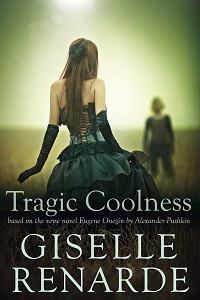
UPDATE: My Onegin adaptation is now available and it's called TRAGIC COOLNESS. Buy it now! Or ask your local library to acquire a copy. Read it now!
TRAGIC COOLNESS is available from Smashwords: https://www.smashwords.com/books/view/901726?ref=GiselleRenardeErotica
Amazon: https://www.amazon.com/dp/B07JHW2Q2V?tag=dondes-20
Google Play: https://play.google.com/store/books/details?id=NNpyDwAAQBAJ
BN: https://www.barnesandnoble.com/w/tragic-coolness-giselle-renarde/1129759465
Kobo: https://www.kobo.com/ca/en/ebook/tragic-coolness
iTunes: https://itunes.apple.com/us/book/id1439408697
Thursday, October 26, 2017
The journey toward paying the rent starts with a single sale
by Giselle Renarde
Sometimes I lose sight of what's really important.
It's very easy to be swayed by all sorts of factors, even when you're a strongheaded person. Greed is a communicable disease. If you surround yourself with people who always want more, more, more, you're bound to catch it.
Humility is a quality I greatly admire, but it's never been my strong suit. The thing about selling books for a living is that books don't cost a lot of money. Each individual sale doesn't bring in a ton of dough. If you make your living as a writer, as I do, you have to sell a lot of books to pay the rent. Each individual sale is a drop in the ocean.
It's taken a drastic downturn in book sales for me to realize what a huge compliment every single sale is.
I don't know why it's taken me so long to realize this. I don't buy a lot of books myself. I read every day, but I get my books from libraries. The last book I bought was Janet Mock's Redefining Realness. In Canadian dollars, it was just over $20. I'm a low income earner. I saved up to buy it. I love that book. It's outstanding. I held it in such high esteem that, when the audiobook came out, I encouraged my library system to purchase a copy. They did. Sweet did the same with her library system, and they purchased the audiobook too.
Buying Redefining Realness was important to me. It was an experience. I still read in print, but the first bookstore I went to didn't carry it. Saving for the book, going out on multiple excursions to find it in the world, and then buying my own copy... this was all very meaningful to me.
That was one sale of one book for Janet Mock. It was a memorable experience for me. I cherish that my copy.
![]() |
| My copy of Redefining Realness, with my favourite sections flagged. |
I'd never considered that, when readers buy my books, they might be having similar experiences--and if not similar experiences, at least similar feelings. There's so much hope and anticipation infused into a book purchase. Readers are really hoping to find what they're looking for inside your story. Your words matter to them.
It's hard for me to imagine readers holding my words in high esteem, because I don't hold myself in high esteem. When I think there are people out there, people like me, who don't earn a lot of money but they've saved up to buy a book I've written, I feel humbled. I take that as such a huge compliment.
And it's not just the spending money aspect. It's the spending time aspect, too. So many people are so busy, and there's so much entertainment out there in the world, and in here in our computers. There are so many ways to be entertained and amused. It blows me away that people spend their time with my words, with my work.
In order for me to pay my rent and put food on the table (and in my cats' bowls), I need to sell hundreds of books every month. If I only sold one, I'd be in trouble. I think that's why I lost sight of how incredibly important every single sale is. The journey toward paying the rent starts with a single sale.
I never used to feel particularly emotional about book sales. I do now, more and more. The fewer books I sell, the more I value each individual sale. Each reader. Each minute spent consuming my work.
I need readers. I need sales. Without them, I wouldn't have anything to eat. I wouldn't have a roof over my head. But I'd lost sight of two very important truths: each reader is a blessing; each sale is a compliment. I hope to hell I don't lose sight of that again.
Thursday, September 14, 2017
Leave It All Behind
by Giselle Renarde
For more than 50 years, my grandmother was married to a man with unchecked mental health issues.
My grandfather didn't believe in doctors. I want to say he hadn't seen one since WWII, when shrapnel was embedded in his lungs (where it remained until he was cremated), but I think I'm romanticizing the past a bit. Because in the late 1950s my grandfather was incarcerated for committing a violent crime against his family. Since he was institutionalized in psychiatric correctional facility, I suppose he would have seen doctors then.
I can't imagine that helped matters any.
Point being: my grandfather didn't see doctors if he wasn't being forced to. But he did self-medicated. With alcohol.
I spent a great deal of time with my grandfather, in my youth. I remember him very fondly. After his death, my grandmother revealed to me that he'd been abusive toward her in every way possible. I was shocked to hear this. It didn't sound at all like the grandfather I'd known and loved. In fact, it sounded more like my father... who was also institutionalized after committing criminal acts, in what's now known as a forensic psychiatric hospital.
When I started working in the domestic violence sector, I learned more about the cycle of violence that plays out through the generations. That's when the pieces started coming together. My mother was "daddy's little girl"--her words. So she married a man just like her father. She saw no reason not to.
When my grandmother began speaking more openly about the family violence that had taken place throughout the years, my aunts started talking too. Not my mom. My mother doesn't like to talk about unpleasant things. She says the past is in the past. It isn't, and perhaps one day she'll come to that realization, but she hasn't yet and it's not an issue that's easy to push.
Throughout my childhood, my mom's two younger sisters were an endless source of funny family stories. I remember taking the subway with them when I was six or seven years old and saying, "Tell me another story about when you were kids!" I couldn't get enough. I loved their hilarious stories about my aunt's pet rooster and the family of ducks that lived under their house.
So when the darker stories started coming out, I was really amazed. All those sunny family stories were still true. They'd just left out the unpleasantness until now.
My younger aunts told me about coming home for lunch on school days. My grandfather did shift work and he was home during the day. My older aunts were in high school, and their lunch period started a little earlier than the lunch hour at the elementary school. So my younger aunts would walk home together, and on certain days they'd find my older aunts leaving the house. No words would be exchanged. Only a frown and a shake of the head. That was enough to inform the younger kids that it wasn't safe to go inside. On those days, my aunts didn't get to eat lunch. They went into the field across the road, and they played or gleaned grains for their pets.
The new stories, the dark stories, don't go into detail the way the sunny ones had. But they don't have to. I know now that my mother grew up in much the same family environemnt I did. There are so many nuances to the type of fear a child experiences growing up in a household that could spiral into violence at any moment. You can feel it all around you. The air is too still.
My grandmother once told me about a book she read some time in the 1950s. It was a novel about a woman she identified with, a housewife with a whole bunch of kids. Not a bad mother, but not a happy housewife. A woman who'd had enough of the pressures at home.
The character in this book packed a suitcase and left it all behind. Left her husband, left her kids. Took off and had adventures of her own.
I remember my grandmother telling me how much that book meant to her. That character was her hero, because every day of her life she wanted to do the same thing: pack a suitcase, leave it all behind.
But my grandmother... she never did leave.
Giselle Renarde is an award-winning queer Canadian writer. She was nominated Toronto’s Best Author in NOW Magazine’s 2015 Readers’ Choice Awards, and her book The Red Satin Collection won Best Transgender Romance in the 2012 Rainbow Awards. Giselle has contributed erotica and queer fiction to nearly 200 short story anthologies and written dozens of juicy books, including Anonymous, Seven Kisses, Bali Nights, In Shadow, and Nanny State.
Visit http://donutsdesires.blogspot.com for free erotica and exciting new releases.
Thursday, March 30, 2017
What Next? #amreading
by Giselle Renarde
Today I finished reading a boring book that's not worth mentioning, but that means tomorrow morning I'll need to choose a new book to read. I've got a stack to select from. Maybe help me pick?
Most of the books on my to-be-read list came to my from library sales and other people's garbage. (That's right--I'm not above reading garbage!) I grabbed this particular garbage book because I have no friends or influence and it's so notorious it naturally piqued my curiosity:
Another potential read jumped out at me at a sale of discarded library materials. God, I love libraries. They provide me with novels like:
This next one's from a Little Free Library. I couldn't believe my luck in finding a Robertson Davies book I haven't read. Only thing is it's a really thick book and I'm a slow reader so I'm scared once I start on it I'll be married to it until the year 2525:
The only Stephen King book I've ever read is On Writing. Considering he's my girlfriend's favourite author I'd say it's high time I read some of Stephen King's... you know... fiction. I picked this one up at a shop called Books Ends, which is a permanent location that sells discarded library materials and donated books, CDs and DVDs to raise funds for library programming:
There we have it. What should I read? After looking over the book blurbs when I was pulling those cover images from Amazon just now, I'm leaning toward American Dervish. Anybody read it, or any of the other books on my little list?
Thursday, April 21, 2016
On Marriage, Italian, Detectives, and the Internet of Trees
Here are some of the books I've read recently that I've liked best. Apologies to those who follow me on Goodreads, since I've lifted the descriptions I wrote there.
Untangling the Knot: Queer Voices on Marriage, Relationships, and Identity
Edited by Carter Sickels
I wanted a book like this to exist so badly, and I was so excited to find it. This is a collection of essays that seeks to go beyond the simplistic "Love Wins" message that I've seen all over the place since marriage equality was instated throughout the U.S. I knew from the first line that this would discuss and engage with a lot of the discomfort I feel about how the marriage equality movement has played out in popular culture.
I have had a number of conversations with people who think that civil rights for queer people have been achieved because of that Supreme Court decision, so I know there are at least some people who have that impression. If so, they should read this book and get a fuller view of the landscape. For those who already know that marriage doesn't solve everything, who may have questions about marriage as an institution, who may want to think more about trans issues, race issues, class issues, bi issues, polyamory, and so on, this is also a great book to read.
I thought the collection splendidly avoided the echo chamber effect that can come about in collections of political works. All the authors are thinking beyond the obvious implications of same sex marriage, but they don't agree with each other, and their viewpoints are very diverse. That made this a compelling read throughout.
The editor notes in the introduction that trans women and people of color are underrepresented in the collection... and then I found myself pleasantly surprised by how many essays were written by trans women and people of color. It probably says something sad about the state of anthologies in general that what could be called underrepresented by the editor actually felt like rich diversity compared to what I'm used to reading.
I found myself constantly checking the contributor's notes to see if the authors had written other work or longer work, and I have a long list of books I now want to read. This book has introduced me to a lot of interesting thinkers and lyrical writers. While some pieces are dry, nonfiction takes on the subject, for the most part each piece is deeply poetic, which very much enhances the philosophical and political points being made.
I really needed this book.
All the Birds in the Sky
by Charlie Jane Anders
All the Birds in the Sky is full of an exhilarating weirdness that constantly blew me away. The creative details of this weird world are vividly drawn, just askew enough from the world I know that it injects a sense of magic into my everyday life. But anchoring all that weirdness is one of the tightest, loveliest, Love Conquers All metastories that I've seen. I'd read a review that said there was something scattered about the book but that it's so cool you sort of won't care. I disagree with that review, though. To me, there was a beautifully simple underlying structure that anchored all the world's wild details and the story's far-ranging explorations.
The writing is absolutely lovely. Sometimes I felt so much for the characters that I was afraid I wouldn't be able to read on, but every part of the story was so worthwhile that I quickly learned to trust the author. The sex scenes were full of a pleasing, quirky emotion that made the romance feel real, personal, and intimate.
I stayed up late reading this one. I would instantly buy any book with this author's name on it in the future.
(Also, go look up the Internet of trees after you read this one. Articles about that came out at an oddly appropriate time.)
The Tattered Heiress
by Debra Hyde
Debra Hyde has produced a really satisfying lesbian historical. In Charlotte Olmes, we have the mind and obsession of Sherlock Holmes, with attention to the political and social realities of the times. In The Tattered Heiress, the central mystery is intercut with a narrative about how Charlotte and her partner Joanna were able to break free of society and be together, and that story is as perilous and suspenseful as the twisted gothic tale they're investigating.
Hyde obviously loves the New York setting, and peppers the story with rich detail that feels authentic. She hits all the beats of a classic mystery story, and provides a generous amount of scorching lesbian sex at the same time.
The only thing that mars my happiness is that the book really needed copy editing. It is rife with distracting errors—repeated words, spelling problems, and so on. A blurb on the cover claims that the series contains the hottest lesbian sex since "Nina" Gershon and Jennifer Tilly, and that bothered me every time I picked up the book. I don't want to hold the author responsible for that, but it made me sad to see it. I couldn't help wondering what this book could have been if it had been given the strong, careful edit it deserved.
In Other Words
by Jhumpa Lahiri
I think this might be the book I spend the whole year talking about. It fascinates me in multiple ways, for multiple reasons, and it's so well-written on top of that.
I picked it up as a language geek, because I'm really interested in the question of what fluency is, how one gets there, and what it feels like to function in another language. I was also attracted to the randomness of Jhumpa Lahiri's love of Italian. I'm currently studying Danish, which has a similar inexplicability, and I really liked her description of how it feels to be drawn to a language that one has no obvious connection to.
As a writer myself, I was fascinated by the fact that Lahiri wrote this book in her non-native language. That's an undertaking that awes me. I loved her descriptions of the process of writing and how it changed as she took it on in Italian rather than English.
Finally, I was pleasantly surprised to find that this book contains a lot of discussion of living between worlds and cultures. Lahiri talks about how loaded language has always been for her—what does it mean at a given moment if she's speaking Bengali or English. Italian gives her an escape from being caught between cultures, and I felt that deeply. It really fascinates me that she notes that her writing is more abstract and universal in Italian, that she finds she gives her characters less cultural detail. I'll be thinking about that for a while.
At the same time, I was moved by the pain she describes of always being seen as a foreigner in Italy because of her looks, despite her love and devotion for the language.
This book is a complex and thoughtful discussion of language and all that comes with it. It's framed around a premise that seems quirky on the surface but that gets deep with examination. I relate to it in a very personal way, but I have the feeling that this is one of those magical books that's universal at the same time and open to giving a lot of readers that feeling.
I couldn't have been more interested in this, or more absorbed by it.
I'm embarrassed to say I've never read Lahiri before, but I'm definitely going to look for more of her work now, whatever language it's in.
(And I'll have comments coming to others later today. I saw your request, Suz!)
Tuesday, December 16, 2014
"Set Goals, Smash Them" by Suz deMello
November through early December were insane. I had shepherded a new anthology group into life and we were busy writing, editing and planning our first publication, a boxed set of holiday tales called the Naughty List, which includes one of my short stories, Viking in Tartan. The boxed set was published on December first and is doing well. 
I also like working with groups. I was lucky enough to be invited to contribute to the latest volume of What to Read After Fifty Shades of Grey--it's volume eight. I provided a fictionalized memoir of my experiences in BDSM. Perilous Play and the rest of the anthology have done well after its publication on November 23d.Thursday, January 2, 2014
By Way of Introduction
The bookshelf voyeur in me loved Lisabet's list of specific books, so I'll take a cue from her and give you the contents of a special corner of one of my bookshelves. It's the shelf I think of as "mine" because it has my work on it (though the other shelves also belong to me). Beside my work, I have my favorite printed books of erotica, the ones I've carried around forever and wouldn't give up. Here they are, in the order they appear:
My Secret Garden: Women's Sexual Fantasies by Nancy Friday
Pocket Books, 1973
This book isn't exactly erotic to me because the psychological speculation frequently interrupts the hotness, but I like it because I find it shocking. With chapters such as "The Zoo" this book revels in erotic fantasies that many publishers today won't accept. As a person who has struggled all my life with shame about my fantasies, I take great comfort in the unabashed wildness of this thing.
Delta of Venus by Anaïs Nin
Pocket Books, 1969
Honestly, it ought to be Little Birds in this spot because I like that one more, but a woman stole my copy years ago and I never replaced it. Nin's style doesn't always do it for me, but this was one of the first erotic books I owned, partly because I could take refuge in the idea that it was literary. And again, I relish how taboo it seems next to much of today's erotica.
Herotica 4 edited by Marcy Sheiner
Plume, 1996
This is a book that I stole from someone (terrible of me, I know). Perhaps there are collections that would be hotter to me as a whole now, but this book contains some very formative stories for me, particularly Mary Maxwell's "The Café of the Joyous Women" (a lovely lesbian fantasy), "Honeymoon on Cobale" by Emily Alward (my introduction to polyamory), and (the reason I will never get rid of it) Serena Moloch's "Behind the Mask" which hits many of the best spots for me. That story is lesbian femdom with a lot of attitude and reversals and bisexuality, it's set in Victorian times, and it includes piercing and feminist theory. Serena Moloch, what has become of you? Where can I find more?
Three Kinds of Asking for It edited by Susie Bright
Touchstone, 2005
Kept for Greta Christina's "Bending," which is one of the pieces of erotica that made me realize that while erotic writing could turn me on, it could also move and bother me and make me wonder about who people are and what they're about. This is the story of a woman who thinks she only wants one thing and what happens when she gets that thing. As years have passed and my own fetishes and interests have shifted before my eyes, the story becomes more and more meaningful to me. Also, "Bending" is so hot and it's that rare story that feels truly bisexual (something I'm always looking for).
Switch Bitch by Roald Dahl
Penguin, 1965
These stories are naughty, weird, and even cruel, but again I like them for their transgression and because it pleased me a great deal to find that Roald Dahl, who I knew as a children's author, had written dirty things as well.
Story of the Eye by Georges Bataille
City Lights Books, 1987
I remember exactly where I was when I bought this, where I was when I read it, how the pages smelled and which ones affected me and how I hid the book from the person I shared a room with at the time. There is no book that has changed me more because this is the book that busted, once and for all, my conception that my sexual desires doomed me to endless depravity and steady decline (that oh-so-popular narrative of the erotic). It's not that I think it's all incredibly hot. While it does turn me on in places, it also disgusted and horrified me. This book showed me where my limits were (and taught me various important distinctions between things I did or didn't want to do and did or didn't want to think about). For the first time, I glimpsed the bright line beyond which my fantasies would not go, and I can't tell you how relieved I was to find that there was a limit. I love this book for being too much for me (though I did read it all), and I will keep it forever as a reminder.
The Best American Erotica edited by Susie Bright
Touchstone, 1996
I was so ashamed when I bought this at a library sale, and yet the fantasies it presented became such an essential part of me. I think my interior erotic landscape would be shaped differently without this book. There's Katya Andreevna's "The Perfect Fit" which introduced me to the idea of a shoe fetish, David Shields's "Girls Who Wear Glasses" which has always encouraged me, and Cecelia Tan's "Pearl Diver" which is frankly one of the hottest things ever. I love the dark dirtiness of Lucy Taylor's "Choke Hold" (and again marvel at how I can't imagine this story being published now), and the gleeful naughtiness of Amelia Copeland's "His Little Plan Backfired" which is a story of a chastity belt turned sex toy. Most of all, deepest of all, I love "The Hit," by Steven Saylor under his pseudonym Aaron Travis, which was and is the quintessence of the dirty cruelty that turns me on most intensely and has caused me so much uncertainty and shame.
Named and Shamed by Janine Ashbless
Sweetmeats Press, 2012
A recent addition, but this book struck me like a revelation. Until this, I thought I was past the sweaty-palmed desperation I felt when I was first discovering erotica. I thought no book would ever crawl into me the way the others on this list did, and yet here this book came along, showing me that I am far from jaded.
Coming Together Presents: Remittance Girl edited by Lisabet Sarai
Coming Together, 2010
Can this be so recent? It feels as if it came out a lifetime ago. Remittance Girl's writing was another key part of making me realize that there is meaning in erotica, that this thing we do isn't just about having an orgasm, it's also about honestly exploring forbidden territory and speaking aloud about things that have always been whispered. I used to like the darker stories in this book, such as "Shellshock," but these days the one that's most vivid to me is "Motorcycle Hug," which mixes its sweetness with considerations of race and culture that still get under my skin.
Radical Encounters by Radclyffe
Bold Strokes Books, 2009
This is another new addition to the place of honor on my shelf because I'm sorry to say I only discovered it recently. How, I wondered, after all the sex I've had and all the erotica I've read and written, could Radclyffe make me feel as if she was introducing me to my own body? I'm not often surprised anymore by how things are described in erotica or how they're understood, but this book was different. It's so hot I almost can't bear to read it.
The Decameron by Boccaccio
Garden City Publishing Company, 1930
One of my most prized possessions, though it's in terrible condition (and was when I bought it). I've heard that Boccaccio later regretted the bawdiness of the stories here, but they're so delightfully dirty that I've loved them since the moment I discovered them. This is full of affairs and trickery and suggestive and titillating ideas. Even the descriptions of the stories are excellent. For example, here's the Seventh Tale of the Second Day: "The Sultan of Babylon sends his daughter to marry the King of Garbo. In the space of four years she passes through many adventures in different lands and lies with nine men. She is finally restored to her father who is made to believe she is still a virgin, and marries the King of Garbo."
***
As I conclude, I see notable absences. Many of those are in my special folder for great e-books, which we'll perhaps discuss another time. As is my wont, I've gone on a bit (I apologize in advance for that habit).
Thank you so much for inviting me to join you here. I'm so pleased to be part of this group, and I can't wait to get to know you all better.
Monday, December 23, 2013
Halfway Around the World, Halfway Through a Century
By Lisabet Sarai
Friday, January 29, 2010
What kind of fire are we talking about here?
Let me get this straight. There is a fire, one that's burning books ala Ray Bradbury's Fahrenheit 451, and I'm supposed to pick the one book that I would save from said fire? Is that right? Because if it is, I got problems with that scenario.
For starters, what kind of fire are we really talking about here? In Fahrenheit 451, the government has outlawed the reading of books to prevent critical thought and employs fire as the method of choice for dealing with such dangerous material. As much as I love Ray Bradbury and his work (and I do really, really love the man's books; Something Wicked This Way Comes is one of my all time favorites), I don't buy this idea at all. Fahrenheit 451 was written back in the 50s, well before the internet and e-books and Project Gutenberg. Now the internet may not be any great bastion of intellectualism, but its main means of conveying info is via text, which means reading: blogs, zines, and yes, books. And there are lots of books available on the internet, some legally, some not. You can buy e-books from Amazon.com, Barnes & Nobles online, and dozens, maybe even hundreds of small independent e-publishers these days. And then there's Project Gutenberg, which offers public domain books for free download. Plenty of great classics there to read. And let us not forget the URLs of those darling swashbucklers who love to post entire books illegally on the web. Argh, me hearties! If the government can't stop people from pirating books by the thousands on a daily basis, what the hell makes anyone think they could successfully outlaw reading altogether? Nuh-uh, not buying it.
So forget the plot to Fahrenheit 451. The government is not going to stop any of us from reading books. Reality TV might succeed, by turning our brains to such mush that we can't even remember the damn alphabet, but the government isn't about play out Bradbury's classic novel.
So if we're not talking about the government burning all the books, what kind of fire are we talking about here? Maybe an act of God? Would some all powerful deity reach out and zap all the books in a fit of pique? If that's the case, then why am I being asked to save that one book? I can't imagine anyone expecting me to do something like that because if it really is an all powerful deity out to destroy all books, then we all no there's not a damned thing I can do to save just one precious volume. Me versus God? One of two things would happen in that fight. Either God would zap my ass too, or we'd all come to our senses and remember that I don't believe in God and thus the whole argument would blow apart like a house of cards in a late summer hurricane. Ain't atheism great?
So with no holy fires from the Almighty coming to rain down on our local library, we are back again to the original question. What kind of fire are we talking about here? A natural disaster? California wildfires gone completely out of control? No, that would only destroy all the books on the North American continent. We need something worldwide and cataclysmic. How about a comet hitting the Earth! No, too cataclysmic. That wouldn't just wipe out all the books; that'd take out all the people too and then there'd be no point in saving that lone book. Think, think, think... Uuuuuuuuuh... massive tectonic shifts across the world that destroy all of civilization without somehow killing all the people. No, even that wouldn't destroy all the books. I mean, if some people survived, then some buildings would probably also survive, and there'd probably be a few books in some of those, and that leaves us with more than one book and those would have survived without my intervention...
Okay, I'm over-thinking things here. Let's go simple. Let's talk about a fire that could happen, but one I hope never will. A house fire. Let's say I burned dinner and my house is now on fire. First off, the one book I would not save would be the cookbook I was cooking from because the house fire is all the fault of that book. That just leaves several hundred other books to choose from. Of course, books wouldn't be my priority. Depending on the time of day... we said I was burning dinner, right? Okay, it's evening then. Evening is when the kids are home. The Hubster might be home, too. So first priority is to save the kids and the Hubster. Now the Hubster is like a walking encyclopedia. The man has two degrees in aerospace engineering and has pretty much memorized every tech book he's ever read. If I save the Hubster, I do not have to save any computer or science books from the house, because those would already be stored in that immense brain of his. So that narrows down the list by about... let's say a third.
The kids, of course, have memorized all their board books and easy readers because you know, kids like to read the same thing over and over and over and over and over and... what? What was I talking about? Oh yeah, kids' books. The kids (and I, since I'm the one who has to read those books aloud over and over and over and over and...) have pretty much memorized all their books, and can recite most of them by heart, so no need to save those. Sure, they have sentimental value, but so do the kids and if I save the kids I'm sure I'll be hearing those stories told to me at any odd moment all throughout the next few years, like at 2AM when the littlest one can't sleep so she climbs into my bed and starts reciting Sandra Boyton's The Going to Bed Book at the top of her lungs. ("THE SUN HAS SET NOT LONG AGO... NOW EVERYBODY GOES BELOW... TO TAKE A BATH IN ONE BIG TUB... WITH SOAP ALL OVER, SCRUB SCRUB SCRUB!")
So, nonfiction? Check. Kids' books? Check. No need to save either of those categories. That brings down the number of books I have to choose from to about one third of the household library.
Now we reach the tricky part. Now we are talking about MY books. MY precious tomes which I have collected over the last several years. Like Michelle and Lisabet, I have had on occasion to thin my library. Honestly, I can't tell you the number of books I've given away. When I knew child number two was on the way, I was forced to give up my office and convert it into a bedroom for child number one. That required a massive thinning of my books, though to this day there is only one title out of all those I gave away that I still remember -- A Distant Soil by Collen Doran. It was a graphic novel, and a damned good one, and someday I'll probably get another copy of it. But it ain't in the library of my hypothetically burning house right now and so not eligible for this discussion.
What is in the library that would I save? Hmm... My first thought is Delusion's Master by Tanith Lee. This was my first introduction to the world of adult high fantasy, a lush book about the demon prince Azhrarn, Lord of Night, who courted a beautiful mortal maiden, and Azhrarn's un-cousin, Chuz the Lord of Chaos, who brought madness upon them both with his brass rattle and the clacking jawbones of an ass. It's one of the few books I own that I have re-read, and of those one of the few that stood up to the test of time. I loved it even more the second time I read it, and the third time I read it, it inspired me to write Demon By Day. So yeah, that's certainly a contender.
Then there's The Gate to Women's Country by Sherri S. Tepper. Now that's a dangerous book, the first truly feminist book I'd ever read, about a world in which women live inside walled towns and men live outside in military barracks. The women provide all the food, clothing, medicine, etc., while the men provide... protection, from other similar walled towns with armies of men quartered outside. The two sexes never meet except on specific feast days and even then they get together under very controlled conditions. Any man who can't handle the rigors and demands of military life outside the town is whipped and chased through a specific gate that leads back into the women's world, where he must stay for the rest of his life. All of this is shown through the eyes of one girl as she grows up and falls in love with a boy on the outside, then runs away with him to fall victim to a startling fate. Sherri S. Tepper writes beautifully, almost mythically, but this particular book had such a shocking -- and fitting -- ending, it was a couple weeks before I could read anything else. So there's another strong contender. However, now that I think about it, I believe I loaned that book to Janice a few years ago and never got it back... Well damn. On to the next book.
Of course, in case of a house fire I would definitely want to grab my dad's book. Not one of the ones he actually got published, but the one he wrote and never published. My dad is the ultimate humorist. He makes up these wild tales about fictional family members that leave anyone who hears them laughing so hard their sides hurt. There's Uncle Herbivore and Cousin Osty Perosis, and a slew of other guffaw-inducing characters that could only have come from my dad's warped brain. Yes, I'd be sorely tempted to grab the slim volume of stories that he wrote and printed out and gave me, but then I also know he still has them on disk at home, and it's my house on fire here, not his, so I could probably get another copy very easily. Eh, put that one down as a maybe. Dad's not going to care about me saving books anyway, so long as I get me, the Hubster and the grandkids to safety.
Maybe I'd save Bone, by Jeff Smith. I've never read a better graphic novel. Or I should say, novels. There are ten in all, comprising a fantastic tale about Fone Bone and his cousins Smiley Bone and Phony Bone and their adventures with dragons and princesses and little old ladies who race cows (the volume entitles The Great Cow Race is hysterical!). I discovered the Bone books last summer and started buying them one at a time and reading them to my kids, who also promptly fell love with the books. Of course, I'm only allowed to save one book here, and Bone is actually ten. Hmm... There is a collected works volume; it's got the original black and white artwork but it's only one book so I could save that. Oh, except I don't own the collected works volume, and besides, it doesn't have the prequel story, Rose, illustrated by Charles Vess. Okay, not Bone then. Sorry Jeff Smith. I still love your work though!
All right, I've debated and debated and debated and finally made my choice. I know exactly which book I'd save! But all the while I've been thinking about it, my damn house has been burning down around my ears and most of my library is upstairs, while I'm downstairs in the kitchen with the dinner turning to charcoal in the oven. Thus I am forced to choose from the very limited set of books I have within reach right at that moment before I die of smoke inhalation. I grab the nearest book and run outside the house where my tech and science library (in the form of the Hubster) awaits with my children's book library (in the form of my kids). We flee to safety with my one precious book clutched to my chest and after the fire trucks have come and dowsed the flames and left our home one giant soggy mess, and after I know all my precious books including Delusion's Master and The Gate to Women's Country and Bone and my dad's unpublished greatest works are nothing but sodden ashes, then I look down at the one book that I saved.
And smack myself in the head as I realize I grabbed the one book I said I would not save at the beginning of this hypothetical scenario; the fucking cookbook that caused me to burn down the house in the first place. Because that was the only book in the kitchen when we started this nonsense.
Did I mention I don't like this week's topic one bit? Did I mention that?
Eh, forget it. You people figure out what books to save. I'm going to actually read now instead.


.jpg)